2026 was supposed to be the year of altcoins – So what went wrong?
Despite expectations of a broad-based rally, altcoins continue to underperform Bitcoin.


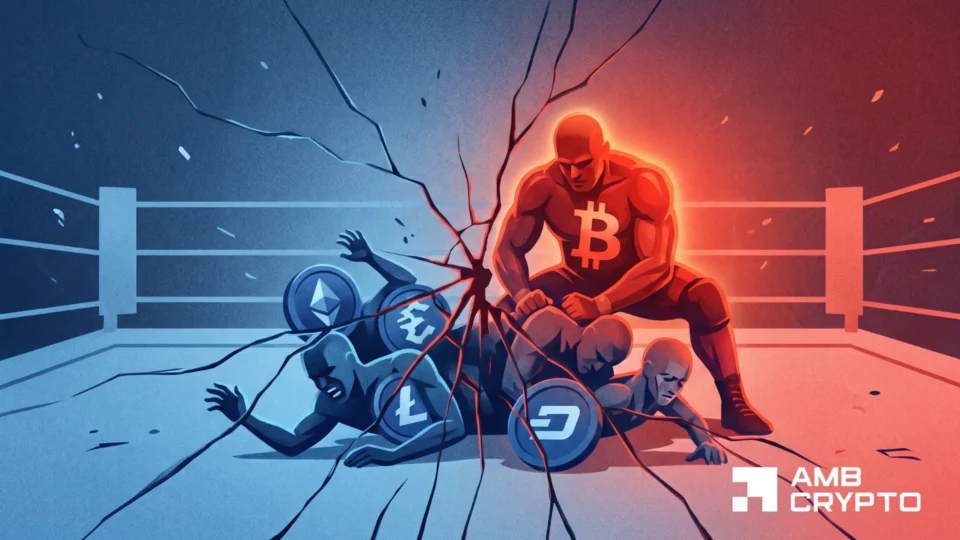
For years, investors in the crypto market have followed a familiar pattern. The moment they see that Bitcoin’s price gains are eventually slowing down, they begin moving capital into Ethereum and other altcoins in search of higher returns.
This rotation has historically fueled what the market calls an “altcoin season.”
However, 2026 is beginning to challenge that expectation. Though the market has seen brief periods of outperformance, these have failed to develop into a sustained rally across the wider altcoin ecosystem.
What makes this particularly concerning is that the year is now approaching its end without a convincing sign of the long-awaited rotation.
Bitcoin outpaces altcoins
To understand the case better first, let’s focus on the total altcoin market capitalization, which fell from approximately $1.85 trillion to $1.06 trillion in just a month, erasing almost around $800 billion in value.
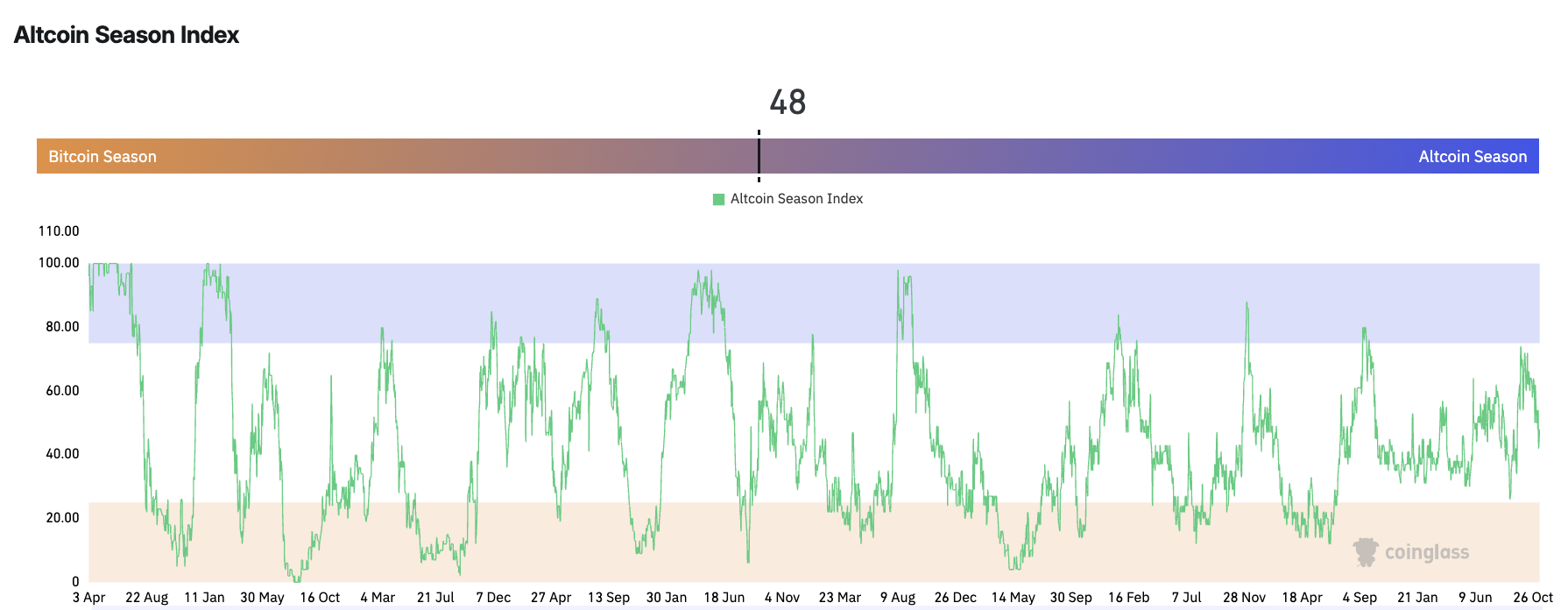
At the same time, the Altcoin Season Index has struggled to maintain readings above the 75 threshold, which traditionally signals an altcoin season.
At press time, too, the index was sitting at 48, which means that the Bitcoin [BTC] season continues to be in full swing at the moment despite BTC trading at $73,836.99 at press time.
This came after a recent report by AMBCrypto, which indicated that the median altcoin’s returns by November had dropped slightly below Bitcoin and that both Bitcoin’s 60-day returns and the altcoin’s returns had returned to zero.
What are the historical patterns pointing at?
Going back in time, the years 2021 and 2023 delivered substantial rallies during different parts of the year. However, the year 2022 remained dominated by bearish sentiment. Moving forward, the end of 2024 is what provides an important point of comparison.
Following Bitcoin’s move above $100,000 in December, market attention expanded towards Ethereum [ETH], XRP, Solana, and other large-cap altcoins. And the broader market entered 2025 with considerable optimism around a potential continuation of that rotation.
However, the experience of 2025 also demonstrated that such rallies are not necessarily sustained. Glassnode’s historical analysis highlighted that altcoin trading volume had previously surged to nearly four times Bitcoin’s volume around September 2025, before cooling as Bitcoin approached its October market top.
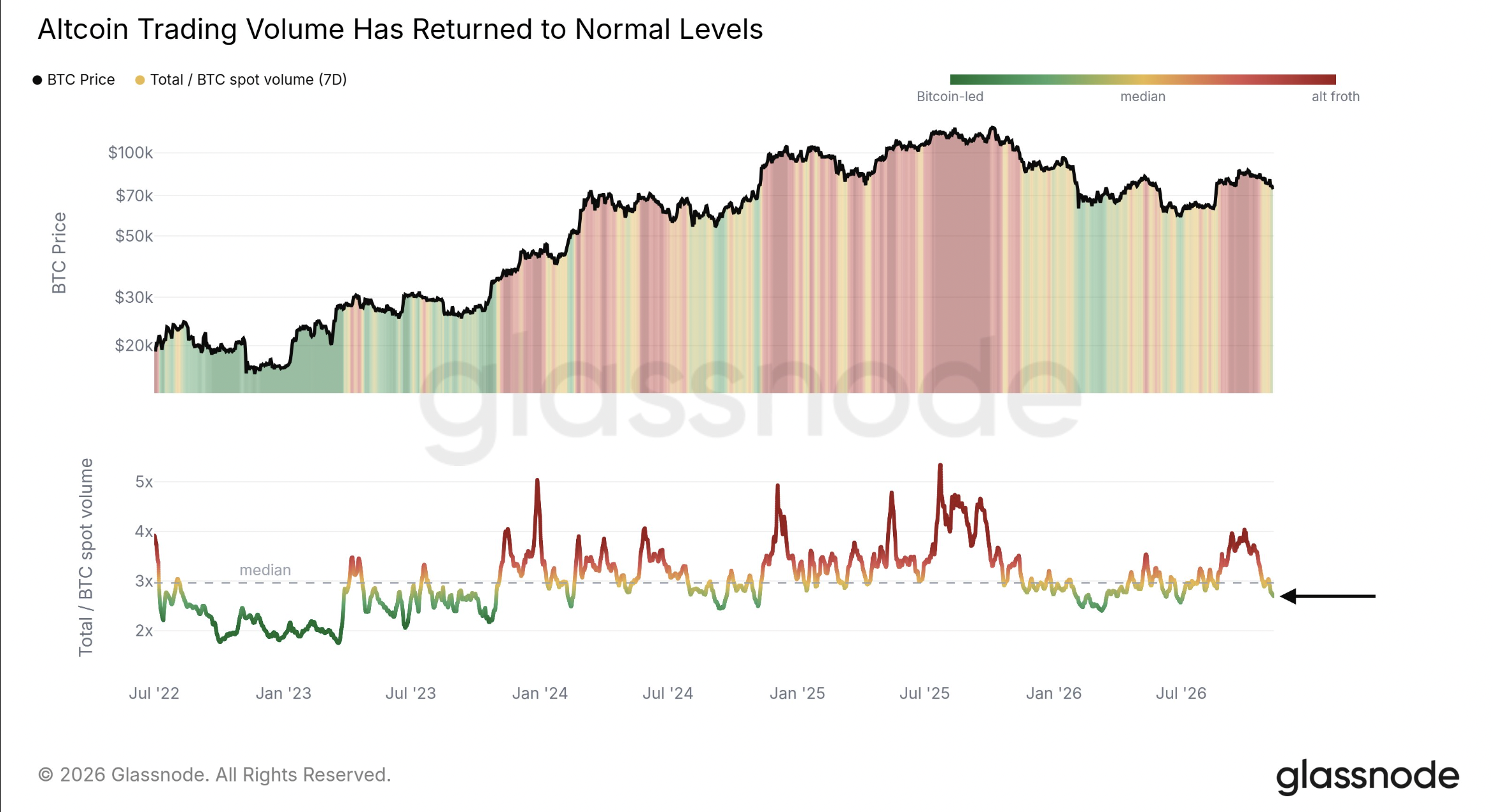
The same pattern appeared in September 2026. Altcoin spot volume again climbed to almost four times Bitcoin’s volume, suggesting a period of heightened speculation. By late October, however, the ratio had declined to approximately three times Bitcoin’s volume.
The crypto community says ‘altcoins are in trenches’
ALTCOIN SEASON IS OVER!
He warned that major altcoins are approaching critical support levels. For instance, Hyperliquid [HYPE] could fall to $64 or $53 if it breaks below $75, while Ondo [ONDO] risks dropping to $0.26 or $0.19 below $0.35. Quant [QNT] could also decline towards $160 if it breaks below $190.
These setups suggest that selling pressure is spreading beyond smaller tokens, making a broad-based altcoin recovery increasingly unlikely in 2026.
Altcoins under pressure
Echoing a similar sentiment, another crypto educator on X added,
Altcoins are officially in the trenches.
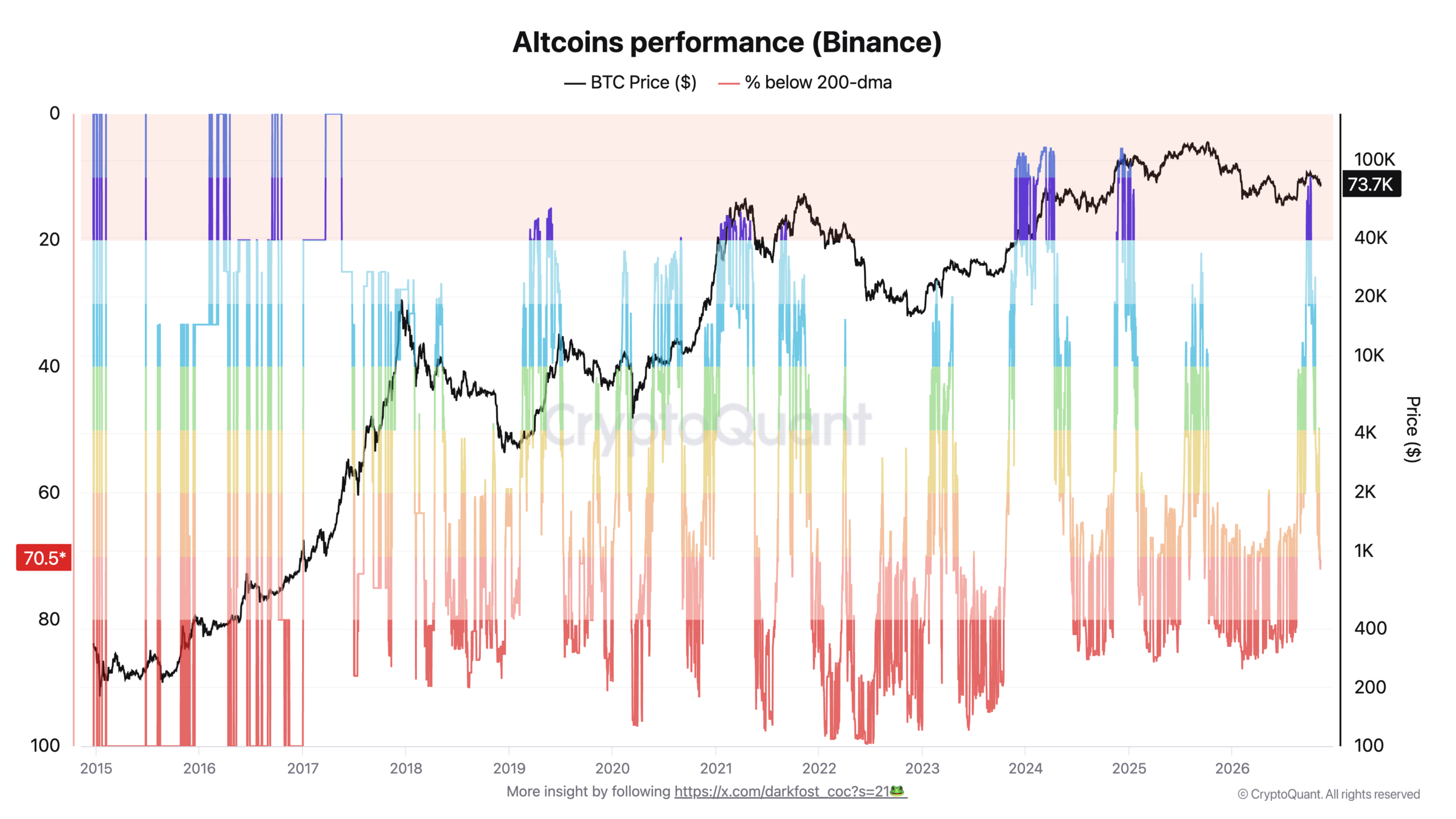
Using CryptoQuant analysis, he suggested that altcoins have lost approximately $200 billion in market capitalization. Around 70% of Binance-listed altcoins are trading below their 200-day moving averages, while only 13.2% of the top 250 crypto assets recorded positive returns in October.
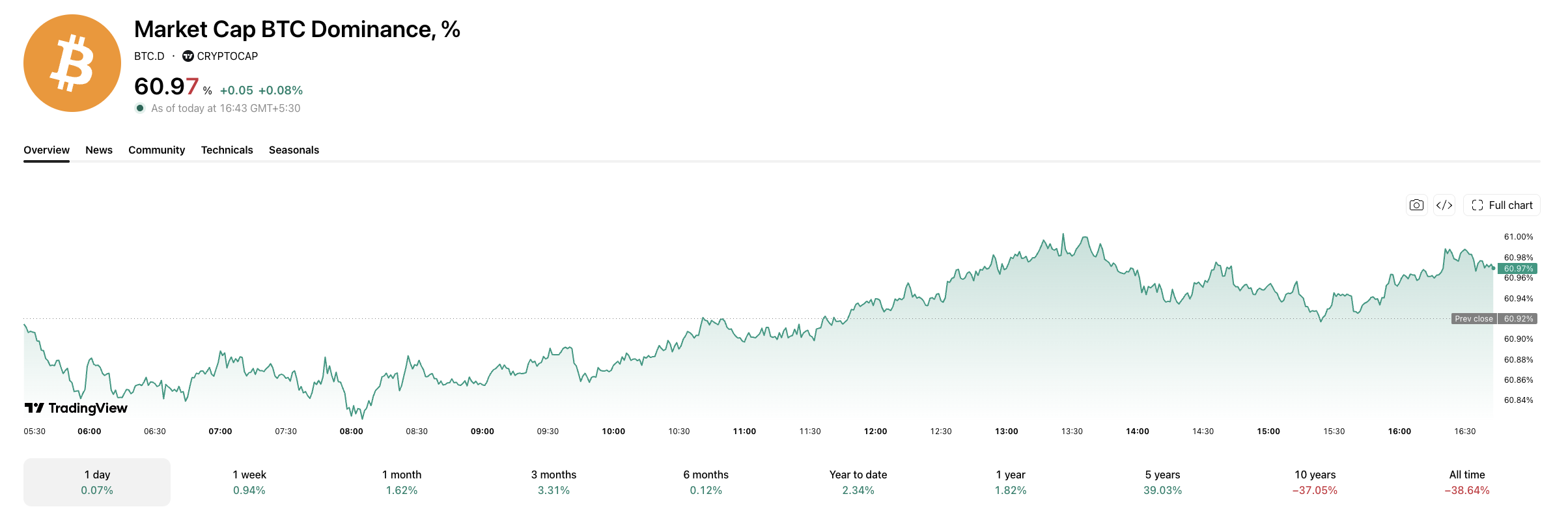
Then, one of the strongest arguments against an imminent altcoin season is Bitcoin’s continued dominance. At press time too, Bitcoin dominance was around 60.98%.
Additional concerns in the market
That said, execs in the crypto communities are also increasingly questioning whether the traditional altcoin cycle is still relevant.
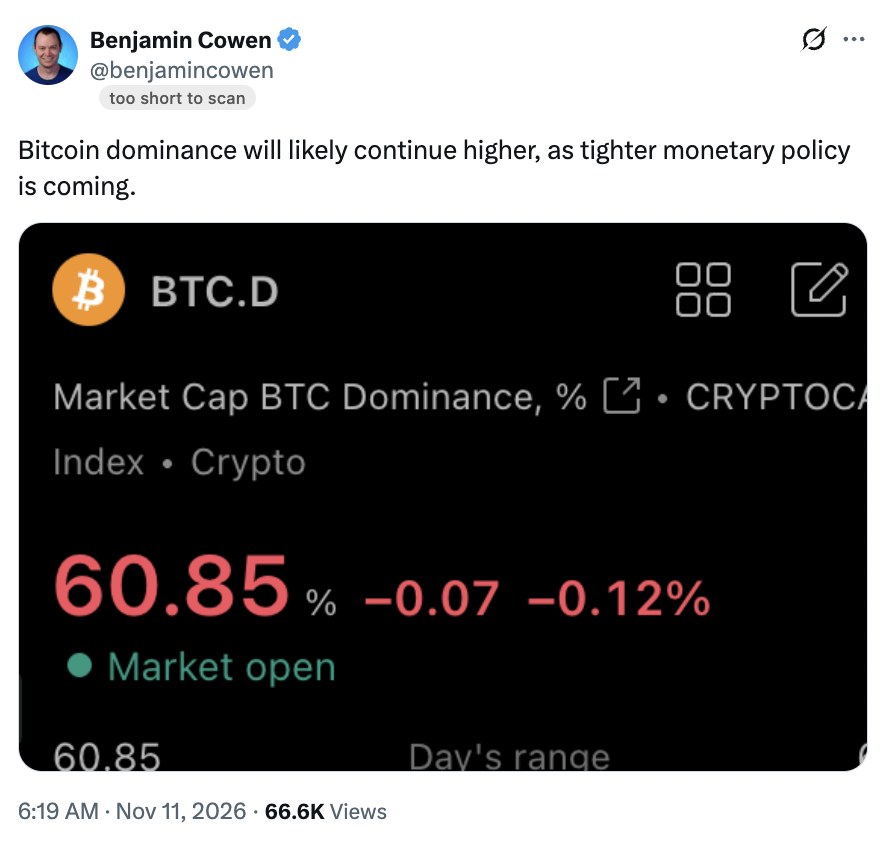
For instance, Benjamin Cowen, founder & CEO of ITC, in his recent commentary, added to this concern, where he argued that the arrival of Q4 highlighted the weakness across the market, with altcoins facing greater pressure.
Recently too he quoted,
Unfortunately, with the cryptocurrency market witnessing approximately $738.92 million in liquidations over the past 24 hours, affecting 120,474 traders according to CoinGlass data, concerns are valid.
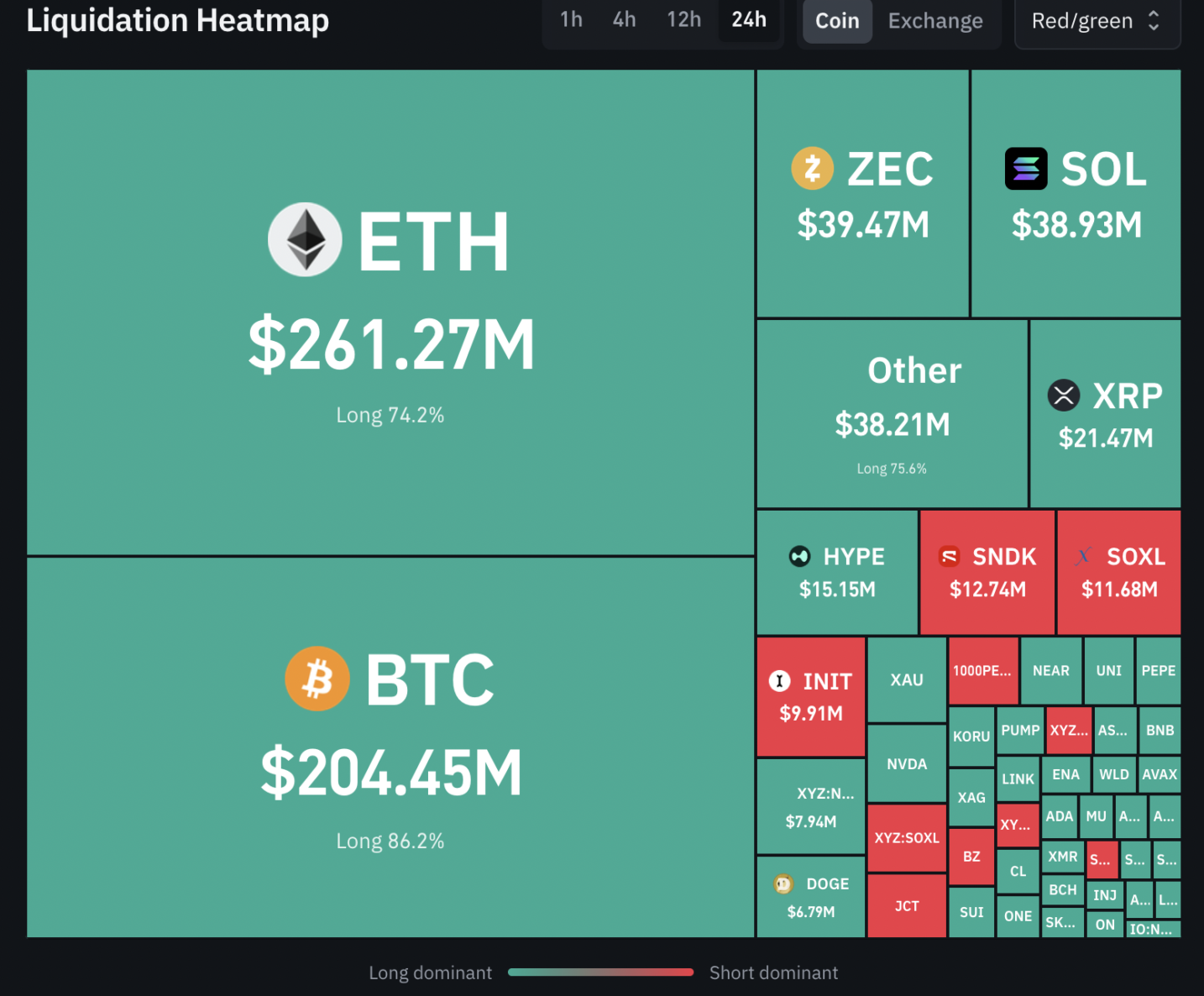
This is also because the largest altcoin, Ethereum, recorded the highest liquidations at $261.27 million, followed by Bitcoin at $204.45 million. Additionally, Solana [SOL] and Zcash also saw significant liquidations of $38.93 million and $39.47 million, respectively.
Then there is another caveat to figure out, and that is where investors are directing their money.
Where is the money actually rotating?
Well, in the month of November so far, BTC ETFs recorded the largest outflow worth approximately $1.58 billion, followed by ETH ETFs at $551.10 million. Among altcoins, HYPE ETFs saw $18.25 million in outflows, XRP ETFs recorded $18.57 million, while Hedera [HBAR] ETFs registered $2.83 million.
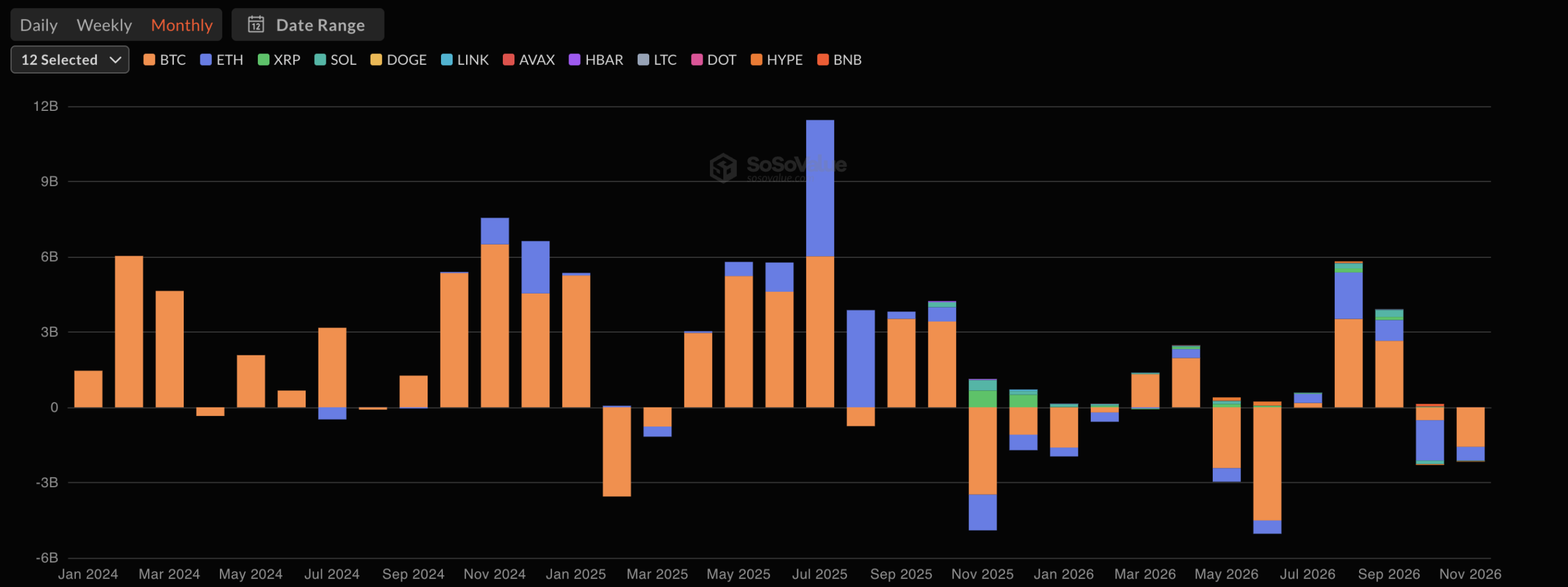
Chainlink [LINK], Avalanche [AVAX], Litecoin [LTC], and Binance [BNB] also recorded smaller outflows. This suggests that investors were withdrawing capital across both Bitcoin and altcoins rather than rotating into smaller cryptocurrencies.
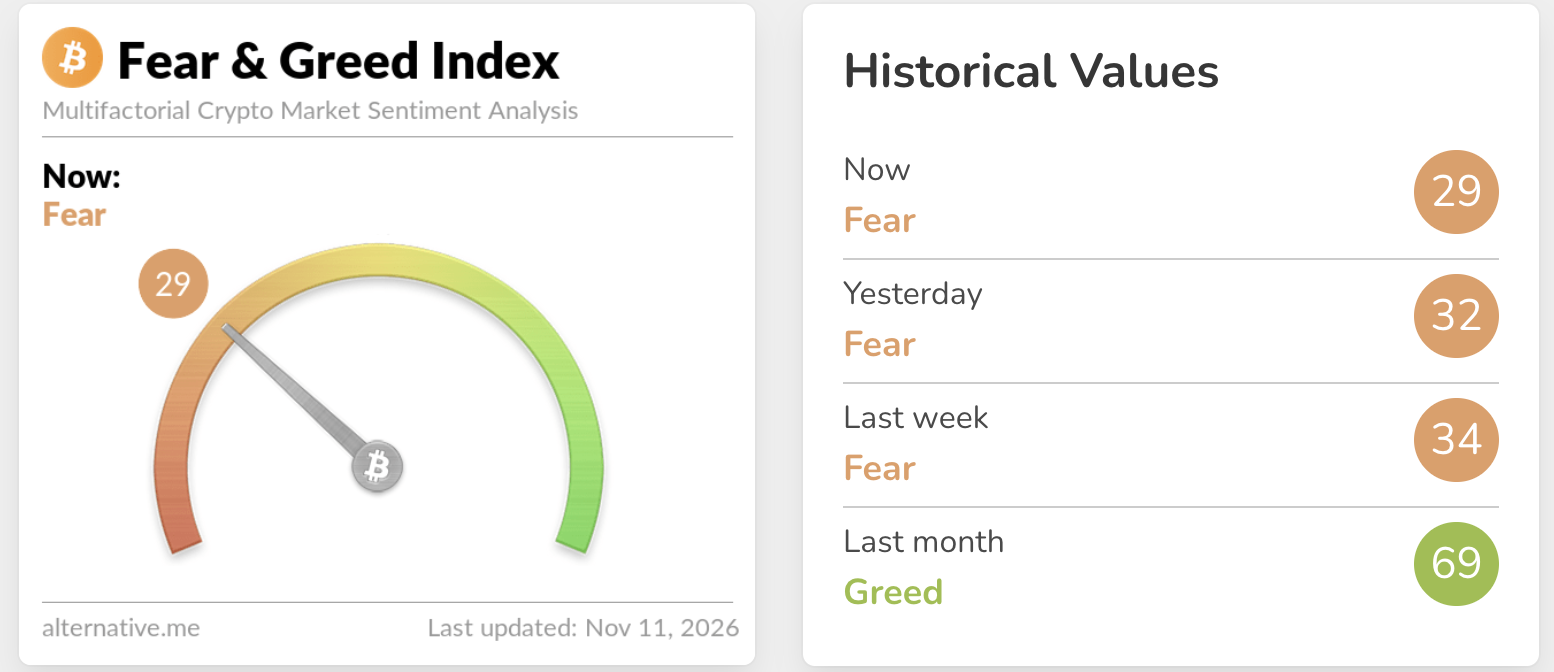
At the same time, the Crypto Fear and Greed Index was standing at ‘Fear’ at 29 at press time. These indicators reinforce one another and suggest that the traditional altcoin season is losing its momentum.
Final Summary
- Altcoin spot volume climbed to almost 4x Bitcoin’s volume, but by late October, the ratio had declined to approximately 3x Bitcoin’s volume.
- With Bitcoin dominance hovering around 60.98% and fear overtaking the market, the imminent altcoin season looks unpromising.