STX is the native token for Stacks. Stacks is a layer-2 network built to bring smart contracts and decentralized applications (dApps) on the Bitcoin [BTC] network. It uses the Proof of Transfer (PoX) mechanism.ย 

Muneeb Ali and Ryan Shea co-founded Stacks in 2013 under the name Blockstack. Currently, Muneeb serves as the companyโ€™s face and the CEO of Trust Machines, which was built alongside Stacks. However, Ryan Shea stepped away as Stacks CEO in November 2018, with his official departure occurring in 2025. The two co-founders helped the company get their first SEC-qualified token, STX, in July 2019. It officially started trading in October the same year.ย 

For its tokenomics, Stacks has a maximum supply of 1.81 billion STX, while the unlocked circulating supply is currently 1.59 billion STX. The initial supply at the genesis block was 1.32 billion STX tokens, with minting expected to end in 2050. Only 17.9% was sold to the public, while the rest was divided among the team. It follows a similar emission system to that of Bitcoin, with halving happening every four years.ย 

Notable early institutional backers of the Stacks project included Union Square Ventures (USV), HashKey Capital, and SNZ Holding. Others were Digital Currency Group (DCG), Drapper Associates, Blockchain Capital, Winklevoss Capital, and Havard Management Company. Moreover, CoinList helped with the initial coin offering (ICO), which raised $18 million.ย 

According to the network’s roadmap, the team has scheduled more developments for 2026. Worth noting though that most developments done before 2017 were not recorded, as the project was still under research. However, in 2019, the project received historic SEC approval for its token.

In 2021, Stacks 2.0 mainnet went live, allowing builders to develop smart contracts on Bitcoin using the Clarity programming language.ย 

In late 2024, Stacks deployed the Nakamoto Upgrade. This decoupled the blockchain from Bitcoin’s slow transactions, reducing the period from 10 minutes to 5 seconds while ensuring 100% Bitcoin finality. In early 2025, the network rolled out sBTC, a decentralized 1:1 Bitcoin-backed asset for easier BTC movement across different dApps. Late in 2025, Dual Stacking & USDCx were launched to enable holders to earn BTC-denominated rewards and to bring stablecoin liquidity to the network.ย 

Recently, the Stacks 3.3 Network Upgrade in February 2026 aimed to enhance chain-state growth and improve block production efficiency. Additionally, the SIP-039 Upgrade boosted DeFi capacity, scaling up bandwidth.ย 

Meanwhile, even with the development improvements targeting its DeFi ecosystem, it is still facing the impact of the whole ecosystem collapsing to lows not seen in two years. For instance – The Total Value Locked (TVL) of Stacks was down by around 60% from its all-time high of $410 million in June 2026.

Despite the hike in the number of exploits across the crypto market, Stacks has continued to have a strong security history. However, its bridges and dApps have seen major exploits in the last two years. For example – Zest Protocol, which was the first lending protocol, was hacked shortly after launching by manipulating the collateral list.

Similarly, ALEX Lab Bridge in May 2024 suffered a $4.30 million exploit from its cross-chain bridge to the BNB Chain. Attackers again exploited ALEX Lab in June 2025 for $8.30 million by taking advantage of a flaw in the self-listing verification logic, which included Stacks.ย 

VIEW MORE

Overview

Market Cap
$296.46M
-0.1%
Volume (24H)
$4.54M
Volume (7D)
$45.36M
-8.7%
Max Supply
Circulating Supply
1,851,168,223 STX
All-Time High
$3.86
-95.8%
All-Time Low
$0.045596
+252.0%
(above ATL)

Prediction Analysis

Current Price
$0.16
Sentiment
Bearish
50-Day SMA
$0.21
Price Prediction
$0.05
-71.90%
Fear & Greed Index
200-Day SMA
$0.25
Green Days
9 / last 30 (31.0%)
Volatility
3.39%
Moderate
14-Day RSI
20.67
Oversold

Profit Calculator

Select asset
%
%
Total Profit
$0
(0%)
Total Exit Amount
$0
Total Investment Fee
$0
Total Exit Fee
$0

Stacks Price Prediction

Current Price
$0.16
2031
$0.00
2036
$0.00
2041
$0.00
2046
$0.00

Results are based solely on your predicted price change. They are not indicators of future performance and do not take into account different performance scenarios, historical data, or the effect of fees or other charges.

VIEW MORE

Short-Term Stacks Price Targets

Date Prediction Change
Jul 02, 2026 $0.16 -2.20%
Jul 03, 2026 $0.15 -4.36%
Jul 04, 2026 $0.15 -6.46%
Jul 05, 2026 $0.15 -8.52%
Jul 06, 2026 $0.14 -10.54%
Jul 07, 2026 $0.14 -12.51%
Jul 08, 2026 $0.14 -14.44%

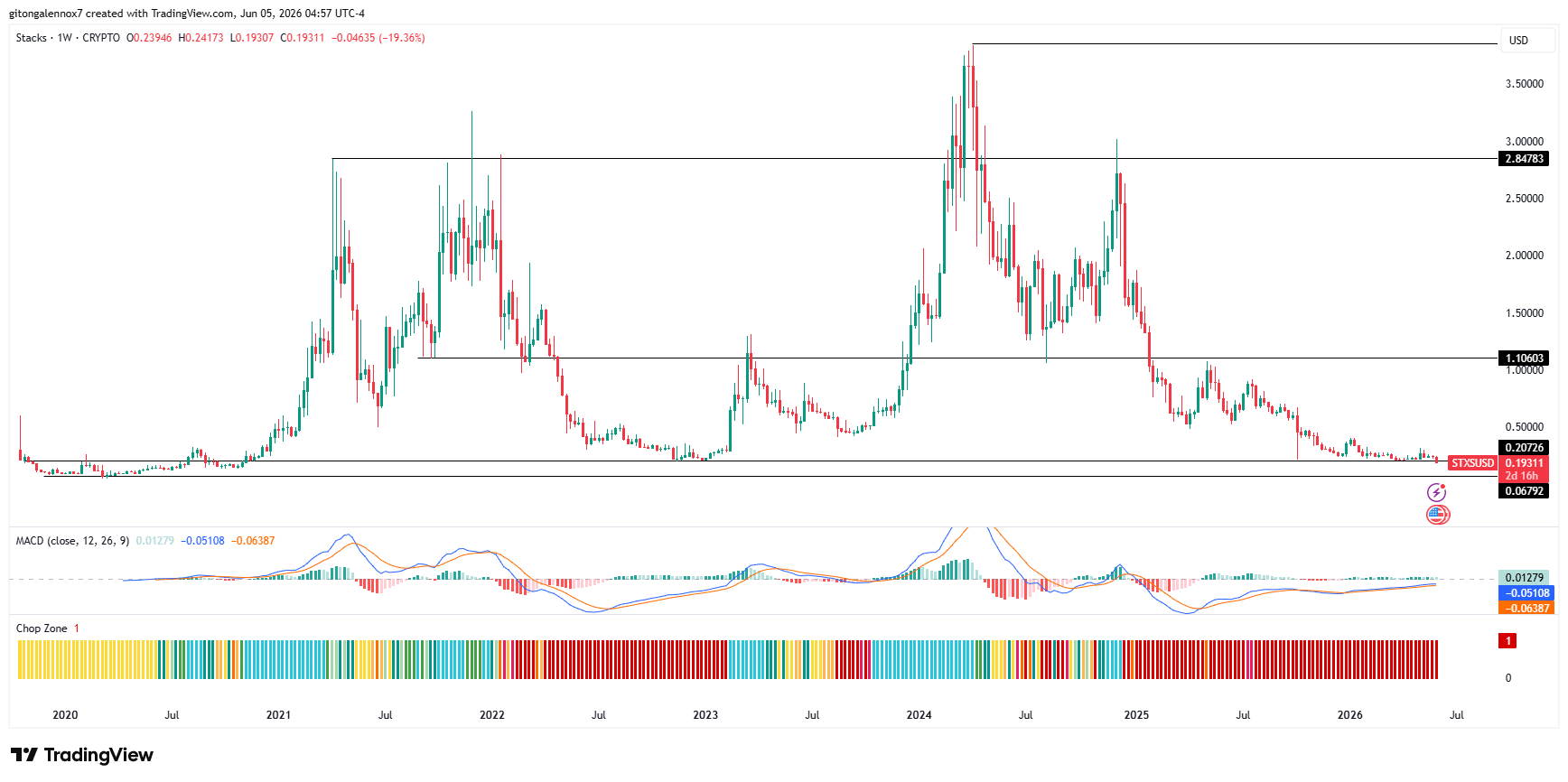
In June 2026, the altcoin's short-term price outlook indicated that Stacks may decline further as it was trading below the $0.20-level, with $0.06792 in sight. The level between $0.06 and $0.20 seemed to be coinciding with the post-launch consolidation too. However, a reclaim of the $0.20-level as support would put $1.10 as a target in the near term, though there may be minor resistances that need to be broken. These minor resistances would appear at the $0.40-$0.60 zone and the $0.80-level.

VIEW MORE

Monthly Stacks Price Prediction

Jun 30, 2026
$0.16
Jul 1, 2026
$0.16
Highest in Jul
$0.16
Lowest in Jul
$0.16
Overall Performance
Falling

Long-Term Stacks Price Prediction

Month Price AVG Price Max Price Change
Jul $0.11 $0.13 $0.13 -31.31%
Aug $0.07 $0.09 $0.09 -56.29%
Sep $0.05 $0.06 $0.06 -68.78%
Oct $0.03 $0.04 $0.04 -81.27%
Nov $0.02 $0.03 $0.03 -87.51%
Dec $0.02 $0.02 $0.02 -87.51%
The bigger targets on the buy-side sat above the $1-mark but seemed dependent on short-term traders pushing Stacks above the aforementioned levels. While the long-term outlook was bullish for Stacks and the broader crypto market, bears could still be a hurdle against such a move. After reclaiming $1 as support, STX bulls would target $2, which was the midpoint of the entire move by the altcoin. Then, the next target will be the $2.85 resistance, which rejected an appreciation in three instances. The Q1 rally of 2024, however, breached it. In an extremely bullish case, STX's price could reclaim its peak value at $3.85 or break higher.
VIEW MORE

Historical Price Performance

Year Highest Price Lowest Price
2026 (to date) $0 $0
2025 $2 $0
2024 $4 $1
2023 $2 $0
2022 $2 $0
2021 $3 $0
2020 $0 $0
2019 $0 $0

Historical price performance of STX has been heavily correlated with Bitcoin, as it is a Layer 2 blockchain built for BTC smart contracts and dApps. Upgrades like the Nakamoto and launch of sBTC drove prices up in the short term, but they did not maintain the altcoin's rally. On the other hand, Bitcoin price crashes like the one that saw BTC fall to $60K in a few days led to STX breaking below $0.20. Extreme fear levels and exchange bankruptcies like the one for FTX and broader market crashes have also sparked massive declines in STX's price in the past.

VIEW MORE

Technical Analysis

Stacks has been trading between the price range of $0.04 and $3.85 since its inception in October 2019. The price action of STX saw two major rallies – One from $0.20 to $2.85 and another from $0.20 to $3.85.ย 

Since mid-2024, STX’s price has been on a consistent downtrend. However, since last December, the price action has been tightly consolidating, indicating low volatility in the short term. This consolidation has been occurring between $0.20 and $0.31 amid a broader weak crypto market.ย 

At the time of writing in June 2026, the MACD was green and flashed a bullish crossover, supporting this accumulation. Additionally, the Chop Zone indicator has been red since 2025. On the price charts, STX seemed to be breaking below the $0.20-support level.

Source: STX/USDT, TradingView

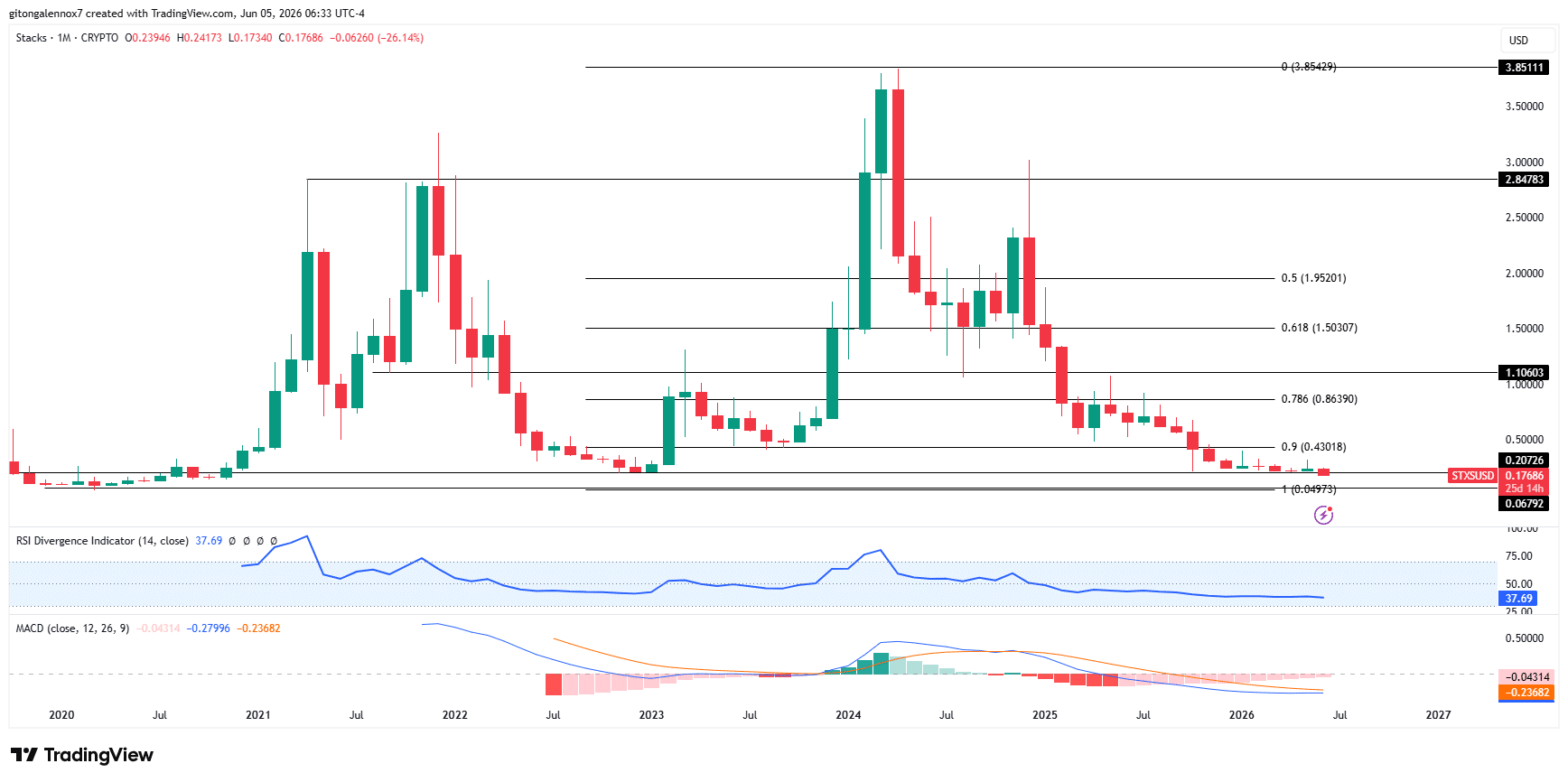
When the long-term perspective was looked at, the same accumulation pattern seemed to be emerging. In June 2026, the altcoin appeared to be trading in the discount zone since dropping below the 50% Fibonacci Retracement level at $1.95. The RSI Divergence was approaching the oversold level as it traded around 3 too.ย 

The MACD was bearish, but the momentum of sellers seemed to be diminishing too, with bars becoming increasingly smaller. Moreover, the MACD and Signal lines were nearing a crossover – Hinting at a contrast between long-term and short-term outlooks.

Source: STX/USDT, TradingView

STX’s price is still more than 95% below its all-time high (ATH). It may crash lower too. This leaves Stacks in a bearish market structure over the short-term and long-term. However, the projection over the long term can turn bullish too.

Guides

How to Read Stacks Charts and Predict Price Movements?

Most traders use candlestick charts, as they provide more information than a simple line chart. Traders can view candlesticks that represent the price action of Stacks with different granularity โ€“ for example, you could choose a 5-minute candlestick chart for extremely short-term price action or choose a weekly candlestick chart to identify long-term trends. 1-hour, 4-hour, and 1-day candlestick charts are among the most popular.

Letโ€™s use a 1-hour candlestick chart as an example of how this type of price chart gives us information about opening and closing prices. The chart is divided into โ€œcandlesโ€ that give us information about Stacksโ€™s price action in 1-hour chunks. Each candlestick will display the assetโ€™s opening price, closing price, as well as the highest and lowest prices reached within that period.

Stacks Price Prediction Indicators

Moving averages are among the most popular Stacks price prediction tools. As the name suggests, a moving average provides the average closing price over a selected time frame, which is divided into a number of periods of the same length. For example, a 12-day simple moving average is calculated by summing the closing prices over the last 12 days and dividing the result by 12.

In addition to the simple moving average (SMA), traders also use another type of moving average called the exponential moving average (EMA). The EMA gives more weight to recent prices, and therefore reacts more quickly to changes in market conditions.

What Affects the Price of Stacks?

Just like with any other asset, the price action of Stacks is driven by supply and demand. These dynamics can be influenced by fundamental events such as block reward halvings, hard forks, or new protocol updates. Regulations, adoption by companies and governments, cryptocurrency exchange hacks, and other real-world events can also affect market sentiment.

Technical indicators such as moving averages, RSI, and trading volume are also used by traders to anticipate price movements and identify potential trend reversals.

FAQs on Stacks Price Predictions

As of today, Stacks (STX) is trading at $0.160145. The current market sentiment is Bearish, with RSI at 20.67 (Oversold) and volatility classified as Moderate.
Based on our technical analysis and projected annual growth rate, Stacks could reach $0.045001 by 2027. This estimate assumes continued market momentum and adoption trends.
According to our technical analysis indicators, the Stacks price prediction is forecasted to reach $0.000281 within the next five years (by 2031). Over the last 30 days, Stacks recorded green days 31% of the time.
Based on multiple technical indicators, the current outlook for Stacks in 2026 is Bearish. RSI currently sits at 20.67, which indicates Oversold momentum. However, investors should evaluate both technical signals and fundamental developments before making any investment decisions.
Long-term forecasts indicate that Stacks may continue to grow over the next decade if adoption, technology development, and global crypto demand continue to expand.
While Stacks's future value depends on various factors, technical indicators suggest it could experience both bullish and bearish cycles over time. Long-term investors typically monitor RSI levels, moving averages, and broader market sentiment when evaluating STX's future trajectory.
Disclaimer

AMBCrypto's content is meant to be informational in nature and should not be interpreted as investment advice. Trading, buying or selling cryptocurrencies should be considered a high-risk investment and every reader is advised to do their own research before making any decisions.