Tezos is a blockchain network that facilitates decentralized finance (DeFi), applications, and NFT projects. Tezos employs a proof-of-stake consensus allowing stakeholders to vote on upgrades and other major decisions.
Arthur Breitman founded Tezos. He had previously worked as an engineer at Google and as a quantitative analyst at Morgan Stanley. In 2014, Breitman published a white paper under a pseudonym that outlined the concept behind Tezos.
Breitman and the Switzerland-based Tezos Foundation organized an initial coin offering (ICO) in 2017. The 2017 ICO turned out to be a major success, raising $230 million – The largest sum ever raised at the time.
However, after the ICO, the project faced many challenges, leading to a legal lawsuit. The Tezos Foundation, the Breitmans, and DynamicLedger Solutions settled the lawsuit brought by ICO participants for $25 million.
In light of these problems, the Tezos community created its own foundation, the T2 Foundation – A newly formed foundation aimed at launching the network anyway if the Tezos Foundation failed to do so.
In the end, John Gavers resigned as President, resolving leadership problems. After resolving the governance problems, Tezos launched its beta net, the first step before mainnet, in July 2018. In September, the Mainnet was launched, allowing users to engage in network governance.
After the launch, the Tezos landscape finally began to take shape and blockchain infrastructure development continued. In fact, the blockchain has undergone a series of upgrades to keep up with competition in the space.
Firstly, in 2019, the Arthens upgrade introduced improvements to gas costs and smart contract functionality. The upgrade market is the first instance of a blockchain autonomously modifying its own core software via on-chain stakeholders.
In 2021, the protocol underwent a Granada upgrade, which improved block times, making it faster while reducing gas consumption.
In 2023, the chain underwent back-to-back updates, with the Mumbai upgrade going live in March and the Nairobi upgrade in June. The two upgrades revolutionized Tezos’ scalability, cutting block times in half and laying the groundwork for layer-2 scaling. These two upgrades ushered Tezos into an era of high-speed, rollup-centric infrastructure.
In February 2024, Tezos conducted its 15th upgrade as Oxford 2 went live. The upgrade focused on layer-2 scalability, refined proof-of-stake (PoS) economics, and smart-contract security features.
In 2025, Tezos activated the Quebec upgrade, which effectively reduced the layer 1 block time to 8 seconds.
These developments have affected the trajectory of Tezos’s native token – XTZ. Tezos’s native token XTZ operates under unique tokenomics.
Here, it’s worth noting that XTZ supply remains uncapped. The token’s supply is infinite, but the circulating supply is 1.08 billion, and the issuance is responsive to staking participation.
The initial token distribution saw 79.5% of the supply allocated to ICO participants, 10% to the Tezos Foundation, 10% to DLS, and 0.41% to early backers.
In 2024, Tezos introduced adaptive issuance and staking as a major proof-of-stake overhaul. Adaptive issuance ties the regular issuance budget to the global staked ratio, nudging staking participation towards 50%. The blockchain’s tokenomics have left XTZ highly inflationary as supply is not declining and could increase further.
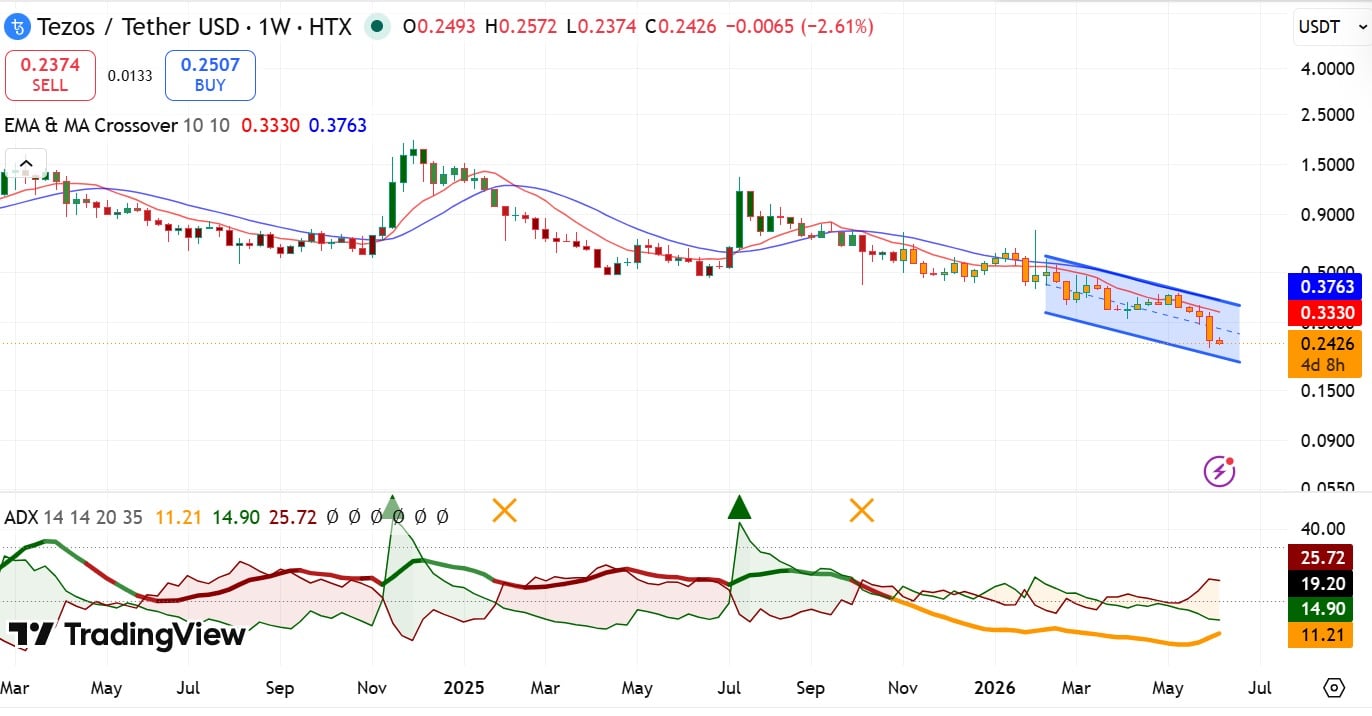
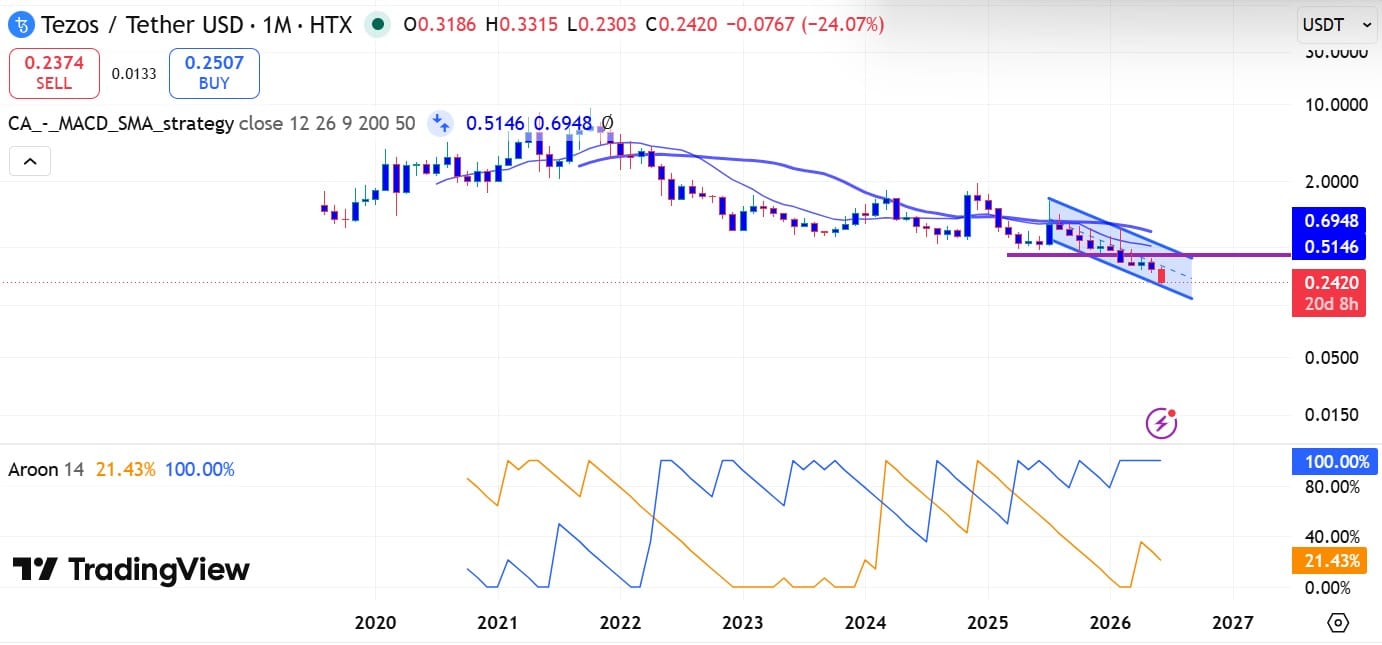
Besides its tokenomics, Tezos’s market value has continued to decline too. For instance – Tezos’s Total Value Locked dropped from $199 million 2021 to $25 million – A five-year low.