IOTA is a layer-1 distributed ledger network built for enterprise solutions, real-world asset (RWA) tokenization, and global trade infrastructure.

IOTA was founded in 2015 by Sergey Ivancheglo, Serguei Popov, David Sonstebo, and Dominik Schiner. The project was officially announced during the 2015 Bitcoin talk forum. In the same year, IOTA began developing the Tangle architecture. 

In 2017, a more formalized description was published after Popov released a white paper titled the “Tangle.” It uses a Directed Acyclic Graph, or DAG, which enables scalable, low-fee, and parallel transaction processing. 

In practice, Tangle uses a DAG in which two previous transactions must directly approve each new transaction. This structure allows the network to expand as more activity occurs on the ledger. 

Initially, the project was called the Jinn Project—aimed at developing low-cost, energy-efficient hardware for the IoT ecosystem. 

At first, IOTA was designed and advertised as an ecosystem for the Internet of Things (IoT). However, the network has evolved into a project with multiple goals, particularly in Real-World Asset (RWA) tokenization. 

In September 2014, Jinn held its first crowd sale for the tokens. In 2015, Jinn was rebranded as IOTA, and another token sale followed, raising $590k in total. The network finally went live in 2016 after a successful initial coin offering. 

After the rebranding, Jinn token holders could convert their tokens to IOTA. In 2017, IOTA joined the Trusted IoT Alliance, a group of organizations and businesses dedicated to developing open standards for IoT technology.

The same year, the network saw massive growth in popularity and adoption, with the market cap exceeding $15 billion. 

In equal measure, the project faced heavy criticism and scrutiny due to security vulnerabilities and issues with the network’s consensus mechanism. Despite these concerns, IOTA continued to develop and innovate, thus effectively addressing these problems. 

In fact, to make the network fully decentralized, IOTA introduced the Coordicide project in 2019. This initiative aimed at removing the centralized coordinator node from the IOTA network. 

In 2021, the IOTA team conducted another funding round, raising $100 million, which cleared the path for network growth. 

To successfully achieve the set goals while effectively competing with other chains, IOTA has undergone a total structural reengineering. 

In doing so, the network moved away from the earlier experimental architecture to a modern decentralized layer 1 chain. In the process, the network has undergone a series of upgrades. 

Firstly, in October 2020, IOTA launched the Chrysis phase 1, and phase 2 (minnet migration) was completed in 2021. Through the upgrade, the network shifted from a ternary logic structure to a standard binary system. 

The upgrade dramatically stabilized transaction speed and reduced confirmation times to under 20 seconds. 

In 2023, IOTA underwent the Stardust upgrade, which transformed the layer 1 into a multi-layer ledger. The upgrade allowed users to mint and transfer native tokens and NFTs directly on the Tangle without fees. 

In 2024, IOTA launched an Ethereum Virtual Machine (EVM)-compatible layer-2 chain anchored directly to the Stardust L1.

In 2025, the team abandoned previous theoretical upgrade paths and rebased the network using an advanced object-based move VM directly on layer 1. The recent upgrade transformed IOTA into a competitive, hyper-scalable layer 1 network processing over 50,000 transactions per second. 

The rebased mainnet upgrade of 2025 had a significant impact on IOTA’s tokenomics. The network transitioned from a fixed supply to a dynamic burn-and-mint tokenomics model. To enforce long-term supply discipline and maintain equilibrium, the network balances rewards and deflation. 

Inasmuch, while participants are rewarded, token burns also remain central, with 100% of all base fees and storage gas fees permanently burned.

VIEW MORE

Overview

Market Cap
$174.17M
-0.5%
Volume (24H)
$9.58M
Volume (7D)
$50.85M
-16.1%
Max Supply
Circulating Supply
4,511,534,931 IOTA
All-Time High
$5.25
-99.3%
All-Time Low
$0.036385
+6.0%
(above ATL)

Prediction Analysis

Current Price
$0.04
Sentiment
Bearish
50-Day SMA
$0.05
Price Prediction
$0.01
-70.30%
Fear & Greed Index
200-Day SMA
$0.07
Green Days
10 / last 30 (34.5%)
Volatility
3.80%
Moderate
14-Day RSI
25.52
Oversold

Profit Calculator

Select asset
%
%
Total Profit
$0
(0%)
Total Exit Amount
$0
Total Investment Fee
$0
Total Exit Fee
$0

IOTA Price Prediction

Current Price
$0.04
2031
$0.00
2036
$0.00
2041
$0.00
2046
$0.00

Results are based solely on your predicted price change. They are not indicators of future performance and do not take into account different performance scenarios, historical data, or the effect of fees or other charges.

VIEW MORE

Short-Term IOTA Price Targets

Date Prediction Change
Jun 27, 2026 $0.04 -1.27%
Jun 28, 2026 $0.04 -2.53%
Jun 29, 2026 $0.04 -3.77%
Jun 30, 2026 $0.04 -5.00%
Jul 01, 2026 $0.04 -6.21%
Jul 02, 2026 $0.04 -7.40%
Jul 03, 2026 $0.04 -8.58%

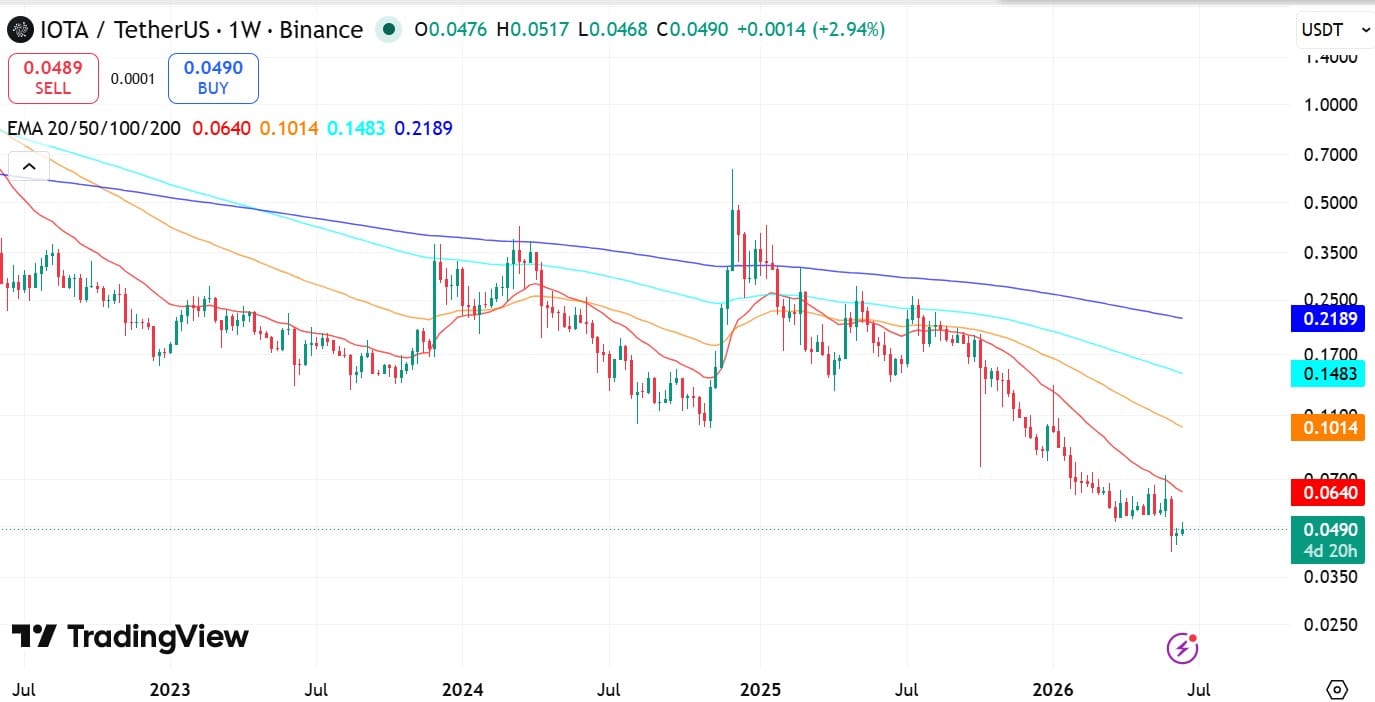
IOTA has presently lost the $0.05 support and has established $0.04 as a new support level. The altcoin has traded within a descending channel throughout 2026 and mostly held below 50,100 and the 200-day EMA. The 20-day EMA has closed above it occasionally, exhibiting dominant bearish pressure. In the short term, the altcoin still holds below all moving averages. The positioning points towards extended weakness. Under these circumstances, IOTA is likely to trade between $0.04 and $0.05 if bulls hold $0.04. If the support is lost, there could be a drop to $0.03. A trend reversal could mean a close above $0.06 and a flip of $0.07 resistance.

VIEW MORE

Monthly IOTA Price Prediction

May 31, 2026
$0.06
Jun 26, 2026
$0.04
Highest in Jun
$0.06
Lowest in Jun
$0.04
Overall Performance
Falling

Long-Term IOTA Price Prediction

Month Price AVG Price Max Price Change
Jun $0.03 $0.04 $0.04 -22.29%
Jul $0.03 $0.03 $0.03 -22.29%
Aug $0.03 $0.03 $0.03 -22.29%
Sep $0.02 $0.03 $0.03 -48.19%
Oct $0.02 $0.02 $0.02 -48.19%
Nov $0.02 $0.02 $0.02 -48.19%
Dec $0.02 $0.02 $0.02 -48.19%
In 2026, IOTA (IOTA) is anticipated to trade between $0 and $0 , leading to an average annualized price of $0 . This could result in a potential return on investment of -29.69% compared to the current price.
VIEW MORE

Historical Price Performance

Year Highest Price Lowest Price
2026 (to date) $0 $0
2025 $0 $0
2024 $0 $0
2023 $0 $0
2022 $1 $0
2021 $3 $0
2020 $0 $0
2019 $1 $0
2018 $4 $0
2017 $5 $0

IOTA has traded within a well-established downtrend. Lower highs and lower lows characterize the altcoin market structure. After launching on Binance in 2018, the altcoin jumped to $2.1 and then retraced. The altcoin closed 2018 on a strongly bearish note, dropping to a low of $0.20. Early 2019 showed some strength, rising to $0.59 in May before crashing and hitting a yearly low of $0.18. 2020 also started strongly, rallying to $0.37 in February before crashing to $0.18 after the COVID-19 lockdown. Shortly after the market recovered, rallying to $0.44 in August, it dropped again. 2021 started on a high note, rallying to a high of $2.6 and clearing losses incurred since 2018, with the altcoin closing 2021 above $1. However, 2022 was extremely bearish, with the weakness exacerbated by the FTX collapse, and the price hit a yearly low of $0.15. 2023 was also bearish but ended the year strongly at $0.37. 2024 started strongly, rallying to $0.42 in March before crashing to $0.1 in October. Trump's reelection boosted the market, rallying to $0.48. 2025 was extremely bearish, dropping to a low of $0.07 in October. This trend continued in 2026, with the altcoin dropping to 2020 lows of $0.04 in June.

VIEW MORE

Technical Analysis

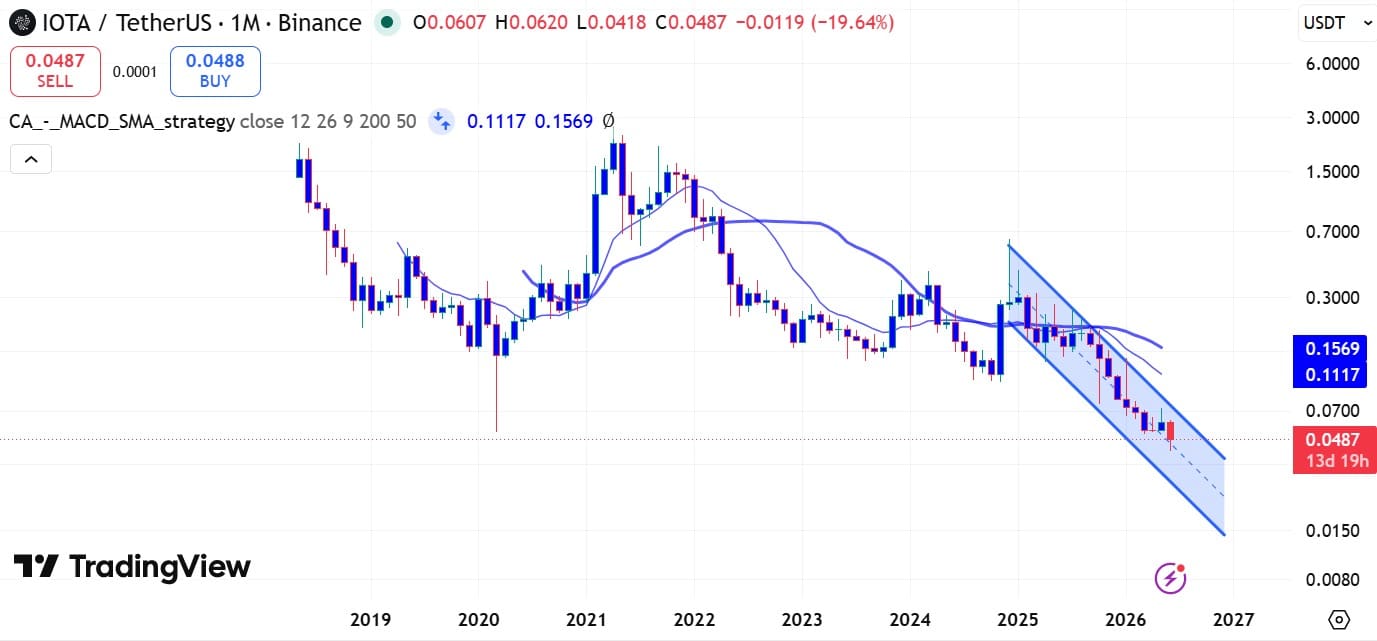
Over longer timeframes, IOTA has traded within a descending channel, closing at lower lows since December 2024. The 2024 bullish run, inspired by crypto-friendly policies, turned short-lived, and IOTA crashed shortly after. 

Source: TradingView

Even more, the altcoin has traded below the SMA since September 2025, further confirming the strength of the downtrend. The extension of these market conditions could see IOTA drop further, lose $0.04 support, and fall towards $0.03.

A long-term price trend reversal will mean a move above $0.07 and an eye on the MACD-SMA crossover. This is probable if the broader market turns bullish, pushing the altcoin above $0.11, with the 2027 most bullish case of $0.15. 

Source: TradingView

On shorter timeframes, the altcoin is likely to hold in the $0.04-$0.05 range as an accumulation zone. Holding this zone in June will help IOTA target $0.06 and $0.07 in July. In doing so, it will be strong enough to target $0.1. If broader market sentiment changes, a sudden pump could push the price towards $0.14. 

 However, if this zone fails to hold, IOTA will drop, breaching $0.40 and making a new ATL around $0.03. 

Guides

How to Read IOTA Charts and Predict Price Movements?

Most traders use candlestick charts, as they provide more information than a simple line chart. Traders can view candlesticks that represent the price action of IOTA with different granularity – for example, you could choose a 5-minute candlestick chart for extremely short-term price action or choose a weekly candlestick chart to identify long-term trends. 1-hour, 4-hour, and 1-day candlestick charts are among the most popular.

Let’s use a 1-hour candlestick chart as an example of how this type of price chart gives us information about opening and closing prices. The chart is divided into “candles” that give us information about IOTA’s price action in 1-hour chunks. Each candlestick will display the asset’s opening price, closing price, as well as the highest and lowest prices reached within that period.

IOTA Price Prediction Indicators

Moving averages are among the most popular IOTA price prediction tools. As the name suggests, a moving average provides the average closing price over a selected time frame, which is divided into a number of periods of the same length. For example, a 12-day simple moving average is calculated by summing the closing prices over the last 12 days and dividing the result by 12.

In addition to the simple moving average (SMA), traders also use another type of moving average called the exponential moving average (EMA). The EMA gives more weight to recent prices, and therefore reacts more quickly to changes in market conditions.

What Affects the Price of IOTA?

Just like with any other asset, the price action of IOTA is driven by supply and demand. These dynamics can be influenced by fundamental events such as block reward halvings, hard forks, or new protocol updates. Regulations, adoption by companies and governments, cryptocurrency exchange hacks, and other real-world events can also affect market sentiment.

Technical indicators such as moving averages, RSI, and trading volume are also used by traders to anticipate price movements and identify potential trend reversals.

FAQs on IOTA Price Predictions

As of today, IOTA (IOTA) is trading at $0.038604. The current market sentiment is Bearish, with RSI at 25.52 (Oversold) and volatility classified as Moderate.
Based on our technical analysis and projected annual growth rate, IOTA could reach $0.011465 by 2027. This estimate assumes continued market momentum and adoption trends.
According to our technical analysis indicators, the IOTA price prediction is forecasted to reach $0.000089 within the next five years (by 2031). Over the last 30 days, IOTA recorded green days 35% of the time.
Based on multiple technical indicators, the current outlook for IOTA in 2026 is Bearish. RSI currently sits at 25.52, which indicates Oversold momentum. However, investors should evaluate both technical signals and fundamental developments before making any investment decisions.
Long-term forecasts indicate that IOTA may continue to grow over the next decade if adoption, technology development, and global crypto demand continue to expand.
While IOTA's future value depends on various factors, technical indicators suggest it could experience both bullish and bearish cycles over time. Long-term investors typically monitor RSI levels, moving averages, and broader market sentiment when evaluating IOTA's future trajectory.
Disclaimer

AMBCrypto's content is meant to be informational in nature and should not be interpreted as investment advice. Trading, buying or selling cryptocurrencies should be considered a high-risk investment and every reader is advised to do their own research before making any decisions.