Tether overtakes Ethereum: Is crypto entering a ‘stablecoin season’?
The first USDT-ETH market cap flip in eight years highlights a growing shift from risk-taking to capital preservation.



One of the clearest signals of a bearish market phase comes from a key correlation.
From a technical perspective, the simultaneous decline in stablecoin market cap and risk-asset valuations suggests that investors are not simply rotating into defensive positions. Instead, they are exiting the ecosystem altogether.
In other words, rather than seeking refuge in stablecoins, capital appears to be flowing out of the market, reflecting a clear reduction in risk exposure.
To put this into perspective, the stablecoin market has contracted by more than $7 billion in less than 21 days, while investors have pulled $400 billion from the crypto market. Of course, that easily highlights this liquidity exodus in real time.
What makes this cycle particularly notable, however, is the strength of this relationship.
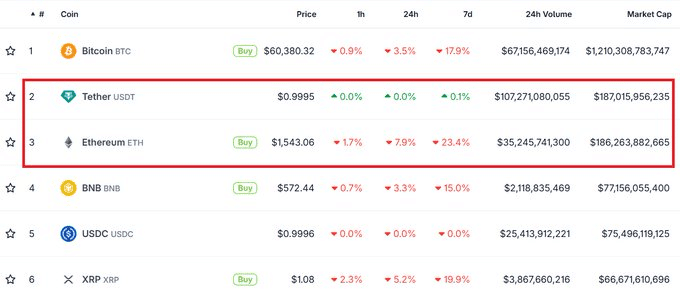
As the chart above shows, Tether’s (USDT) market cap recently surpassed Ethereum’s [ETH] after ETH’s market cap fell to around $185 billion while USDT remained relatively stable at approximately $187 billion. Notably, this was the first time in nearly eight years that USDT overtook Ethereum in market value.
Unsurprisingly, the move quickly became a major talking point across the market.
As noted earlier, this divergence reinforces the broader risk-off trend, with investors selling Ethereum while moving toward stablecoins. As a DeFi player, the impact is also visible in ETH’s TVL, which has fallen to just $36 billion.
In essence, the decline in both Ethereum’s market cap and TVL suggests that capital is not only leaving risk assets but also becoming less active on-chain, reflecting weaker investor conviction.
As a result, this trend has become increasingly visible throughout the current cycle, with some investors already referring to 2026 as a “stablecoin season.” And looking at the recent capital flows, that idea may not be as far-fetched as it sounds.
From altcoin season to stablecoin season
Is the market becoming too utility-driven?
Usually, capital rotates into altcoins when Bitcoin [BTC] hits resistance, as investors look for higher risk-reward opportunities across the market. This time, however, the rotation appears absent. Despite Bitcoin dominance (BTC.D) stalling around the 60% level, ETH/BTC has remained in a steady downtrend for nearly eight weeks, showing little sign of risk capital flowing into altcoins.
Meanwhile, the stablecoin market cap has continued to trend higher, extending its recent upside. This suggests that investors are choosing liquidity and utility over speculation.
Unlike most crypto assets, stablecoins offer an immediate use case as a store of value, trading pair, and settlement asset, making them attractive during periods of uncertainty.
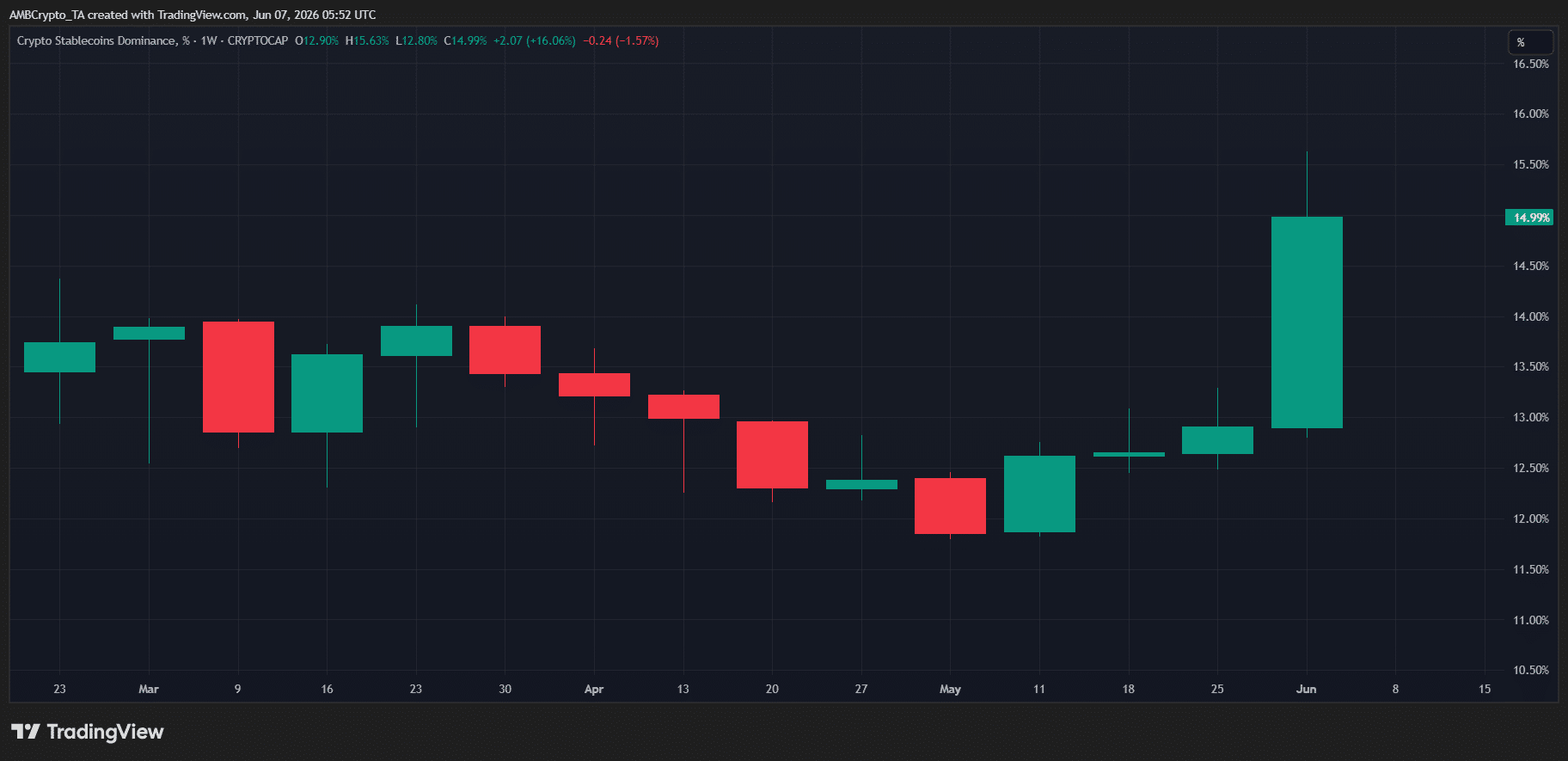
In other words, capital is flowing toward assets that serve a clear functional purpose.
As a result, investors appear more focused on preserving capital than chasing the next altcoin rally, helping fuel the narrative that 2026 may be shaping up as a “stablecoin season.”
Tether’s recent flip above Ethereum offers a clear example.
For the first time in nearly eight years, USDT overtook ETH in market cap, highlighting the market’s growing preference for liquidity over risk. While Ethereum continues to function as the backbone of DeFi, current capital flows suggest that investors are placing a higher premium on stability and utility than on speculative upside.
Final Summary
- Investors are reducing risk exposure, pulling capital from both crypto assets and on-chain ecosystems.
- Stablecoins are attracting more demand than altcoins, signaling a growing preference for liquidity, utility, and capital preservation.