Tether: Why USDT’s Kenya deal could expand crypto across Africa
The Nairobi Securities Exchange is testing how blockchain can improve market access, settlement, and investor participation.


Regulated exchanges in Africa are moving beyond blockchain research, beginning to test its potential to modernize financial markets.
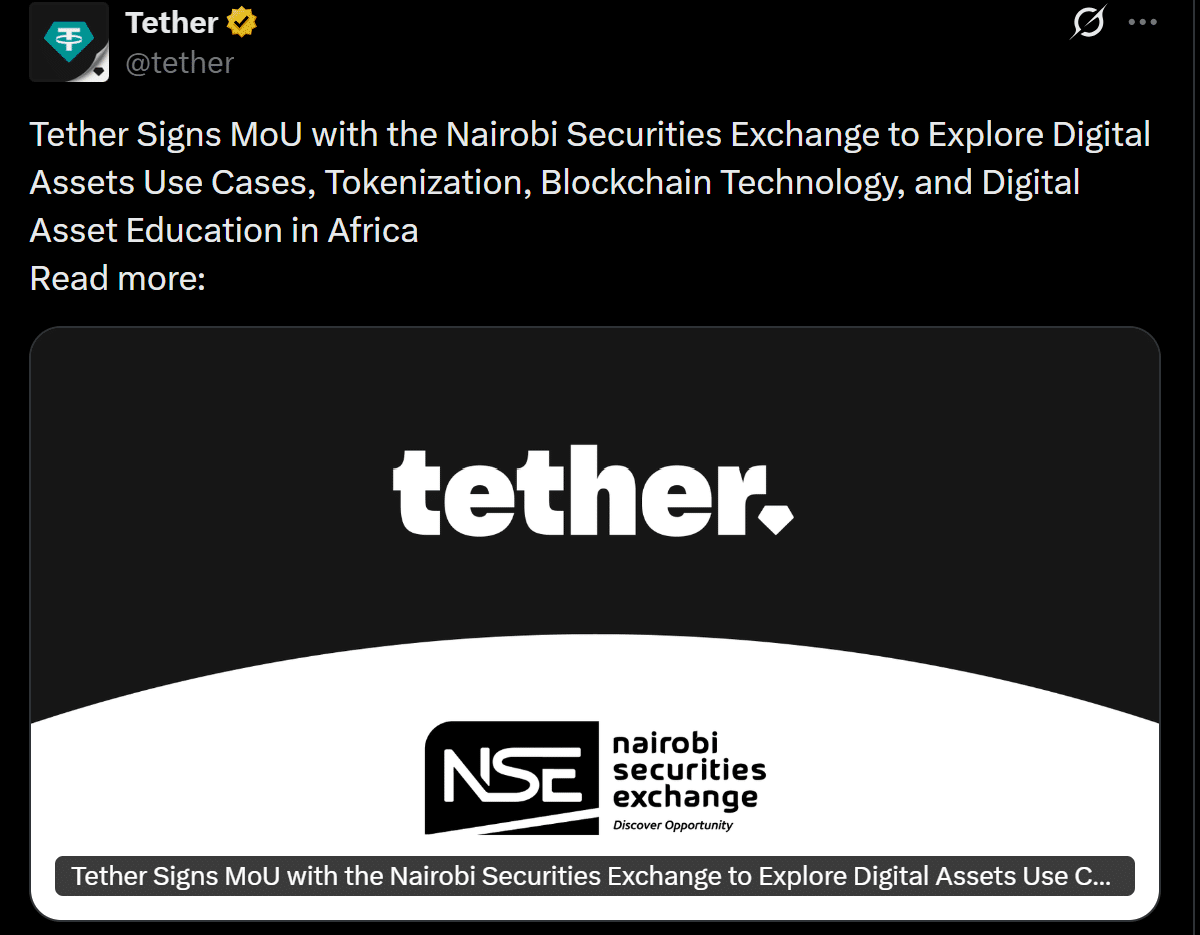
Against that backdrop, Tether [USDT] has partnered with the Nairobi Securities Exchange (NSE) by signing a memorandum of understanding (MOU), representing a significant institutional milestone.
The agreement focuses on three priorities, namely, digital asset education, securities tokenization through Tether’s Hadron platform, and a Kenya-specific anti-money laundering (AML)/KYC framework.
Consequently, this initiative will support the NSE’s stated goal as part of its 2025-2029 strategic plan to evolve the market infrastructure and expand investor accessibility.
More importantly, the collaboration positions Tether deeper within regulated capital markets, extending its role beyond stablecoin payments into institutional infrastructure. If these pilot programs demonstrate faster settlement, transparent ownership, and lower transaction costs, they could encourage similar initiatives across Africa.
This would result in strengthening Tether’s presence in emerging markets while accelerating blockchain adoption within regulated financial systems.
Tokenized securities take shape
The partnership now moves from institutional commitment toward practical market infrastructure. Rather than limiting blockchain to payments, the NSE will test tokenized securities and fractional ownership within a regulated exchange.
This model intends to lower investment thresholds, allowing more retail and diaspora investors to access assets previously reserved for larger participants. Meanwhile, blockchain settlement could shorten today’s multi-stage settlement process into near-instant transfers, freeing capital and improving market liquidity.
Supporting that direction, Paolo Ardoino, Tether CEO, noted,
Digital assets are evolving from crypto into real-life applications and ultimately cross-border institutional finance.
His comments reinforce Tether’s broader strategy of embedding blockchain technology into regulated financial systems. If these pilots succeed, the NSE could become one of Africa’s first exchanges to launch tokenized securities and stablecoin-assisted settlement under regulatory oversight.
Can blockchain move beyond pilots?
The partnership’s success now depends on execution rather than ambition. The Nairobi Securities Exchange must prove tokenized securities can operate within existing market rules while maintaining compliance.
Meanwhile, investor education and streamlined AML/KYC processes will determine whether participation expands beyond traditional markets.
Notably, that would shift blockchain from isolated pilots toward regulated market infrastructure. The move would then position the NSE as an early blueprint for tokenized capital markets across the continent.
Final Summary
- Tether [USDT] is advancing regulated tokenization beyond stablecoin payments through African capital markets.
- Tether and the NSE could establish a blueprint for regulated tokenized markets across Africa.