How to compare small Bitcoin amounts in BTC and Sats


A Bitcoin balance can be mathematically exact and still look difficult to use. One screen may show 0.0001 BTC, another may show 10,000 sats, and a third may add a local-currency estimate. The first two figures represent the same quantity. What changes is the unit and, with it, the amount of mental work required to compare the balance with a payment or selectable stake. The clearest format is therefore the one that keeps the figures in the same denomination for the decision being made.
A PLOS One study helps explain why decimal length can mislead. The researchers found that participants were less efficient when the smaller decimal contained more digits, such as 1.45 compared with 1.5. They linked the difficulty partly to suppressing a whole-number shortcut: the assumption that more digits mean a larger value. The study did not examine cryptocurrency users, but it identifies a numerical conflict that also appears when a Bitcoin amount contains several leading zeros.
Match the units before comparing
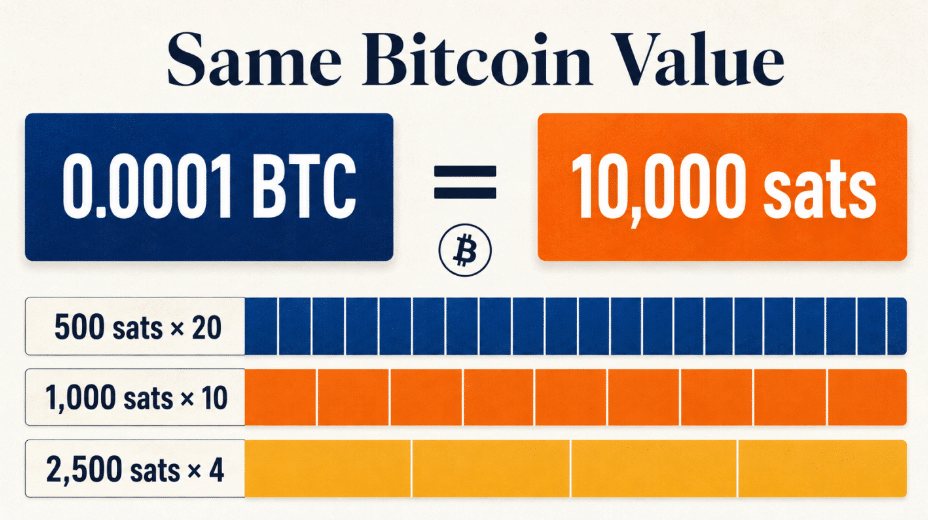
The comparison becomes easier once two separate questions are answered: which unit is being used and how much Bitcoin that figure represents. BTC and sats can describe the same underlying quantity, but switching between them can make equal values look unrelated. Before deciding whether a balance covers a payment or selectable stake, every amount should be placed on the same scale. That turns a visual reading problem into straightforward arithmetic and gives the comparison a consistent starting point.
Bitcoin is divisible into 100 million satoshis, so 1 satoshi equals 0.00000001 BTC and 0.0001 BTC equals exactly 10,000 sats. A useful comparison starts by converting every relevant figure into one of those units. Suppose a hypothetical activity allows you to make payments in increments of 500, 1000, and 2500 sats. A 10,000-sat balance supports 20, 10, or 4 equal selections, respectively, before considering anything outside the example.
Let’s now put this into a practical setting and say that someone is trying to figure out their wallet balance at a casino. They want to know how much they have available to play crypto slots. Their account balance shows 0.00001 BTC, which is 1,000 sats. The casino wallet will probably show one unit or the other (not both) to minimize confusion, but if a player is not used to the one being displayed, they will need to mentally convert the amount before they get started on a crypto session. They might find it easier to think in sats because it removes the string of 0s, or they might prefer to stick with a fraction of a BTC because it’s more familiar. Being clear about the unit in use is key to ensuring the session remains enjoyable and easy to understand.
Many people find sats easier to understand because this unit makes the division visible without repeatedly counting decimal places, but that does not make sats inherently superior. A reader comparing a wallet holding with one whole bitcoin may find BTC more intuitive. The important step is consistency: choose one unit for the immediate comparison, convert accurately, and avoid switching formats halfway through the arithmetic, particularly if you are in the middle of playing a game and therefore more likely to lose track of an external number. Taking this approach also makes an error easier to spot because every figure can be checked against the same scale.
Where fiat estimates fit
A local-currency estimate serves another purpose. It can give a familiar sense of scale, but its relationship with Bitcoin is not fixed. The BTC-to-satoshi conversion is permanent by definition, while a dollar, pound, or euro estimate depends on the exchange rate and the moment at which it is calculated. Two screens can therefore show the same Bitcoin amount and different fiat estimates without disagreeing about the underlying number of sats.
For accurate Bitcoin arithmetic, the fiat figure should remain a reference, rather than the conversion base. First, compare the balance and the payment or stake in BTC or sats. Then use the local-currency amount only if it helps interpret scale. This order prevents a changing market price from being confused with the fixed relationship between Bitcoin’s own units. Many game platforms will offer a local-currency conversion for user convenience, but it needs to be kept mentally separate regardless.
Choose the format for the task
The Bitcoin Design guide to units and symbols describes Bitcoin value presentation as a persistent interface challenge. It notes that small quantities with many leading zeros can be hard to parse, while using BTC and sats together can create a separate learning hurdle for new users. The guide also discusses an integer-only proposal that would display base units without relying on decimal BTC notation or the word “sats,” showing that the design debate extends beyond choosing between two familiar labels.
For readers, the practical method remains simpler than the interface debate. Identify the unit attached to each figure, convert the amounts being compared into one denomination, and keep the denomination separate from the permitted increment.
BTC may provide useful context when dealing with large values, while sats are often the better choice if you are making multiple small transactions. A fiat estimate can help keep the amounts being discussed more familiar to most users, but it’s important to keep in mind that it will change any time the exchange rate shifts. Once each display is assigned its proper job, 0.0001 BTC and 10,000 sats stop looking like competing values and become two labels for the same amount, with no change to the value being compared.
Disclaimer: This is a paid post and should not be treated as news/advice.