Can perpetuals be futures without expiry? Hyperliquid wants regulators to decide
But why does HPC believe regulators could provide clarity with the existing laws?



In a recent request, the Hyperliquid Policy Council (HPC) has urged the SEC and CFTC to create one clear, consistent U.S. regulatory framework for perpetual contracts, especially equity perpetuals.
The HPC was not questioning whether perpetual contracts should exist.
Instead, it wanted U.S. law to clarify how these products should be classified and regulated.
For context, a perpetual contract is a derivative that gives traders asset exposure without ownership. Unlike traditional futures contracts, perpetual contracts have no fixed expiration date.
The central U.S. regulatory question was whether a perpetual contract legally qualified as a future or a swap.
Why is HPC pressing on the distinction?
That distinction is extremely important because futures and swaps are regulated differently. Futures generally fall under the Commodity Futures Trading Commission (CFTC), while swaps can fall under the Securities and Exchange Commission (SEC).
Adding more information on the matter, the HPC noted,
Products straddling the CFTC and the SEC’s jurisdictional boundary have raised classification questions for decades, including novel options, index participations, Dow Jones index futures, and volatility index futures.
The ultimate motive
For HPC, the main issue is that traditional futures expire, while perpetuals do not. However, HPC argues this alone should not prevent perpetuals from being classified as futures. This is because their funding mechanism helps keep prices aligned with the underlying asset, similar to how expiration promotes convergence in traditional futures.
At the same time, HPC argues the SEC and CFTC can provide clarity through interpretive guidance, policy statements, and staff actions under existing law, rather than waiting for Congress. They believe that the framework could later be refined through formal rulemaking.
However, one federal judge had already described this exercise as deciding “whether tetrahedrons belong in square or round holes.”
Hence, HPC put it best when they noted,
A harmonized taxonomy will let exchanges instead compete on execution quality and liquidity.
Market dynamics surrounding Hyperliquid
This request comes as there has been increased demand of $480 billion in HIP-3 perpetual volume over ten months, covering commodities, currencies, indexes, and stocks.
Meanwhile, HyperEVM has reached a new all-time high in weekly revenue, exceeding $1 million. This shows that activity and economic demand on HyperEVM—the Ethereum-compatible smart-contract environment within the Hyperliquid ecosystem—are continuing to grow.
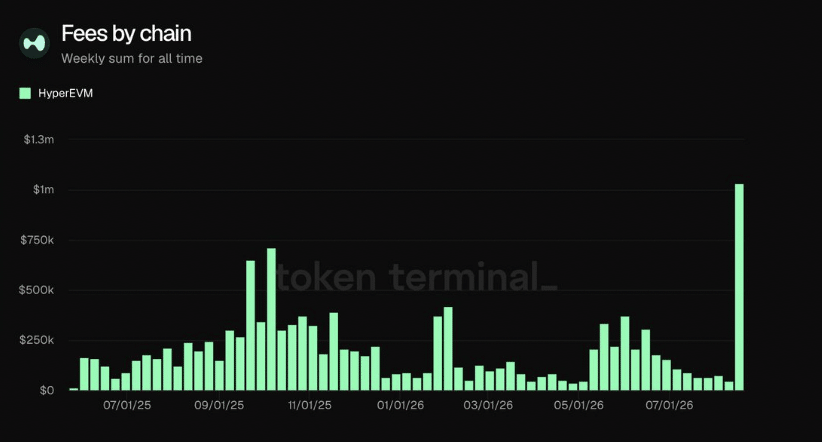
In other words, HyperEVM is generating more revenue from activity on its network than ever before. Hence, now with Hyperliquid entering a key test after HYPE hit a new ATH, it remains to be seen what comes next for HYPE.
Final Summary
- HPC argues that the main issue is that traditional futures expire, while perpetuals do not.
- For now, the HPC wants the SEC and CFTC to provide clarity under existing law instead of waiting for Congress.