Bitcoin – Why BTC must break THIS liquidation wall to target $86K
Bitcoin’s recovery gained support from ETF inflows and wallet accumulation, although Binance trading remains heavily leveraged.



Bitcoin [BTC] climbed 26% from its mid-August low after falling prices left traders heavily positioned for further downside. When the price reversed on the 19th of August, those investors were forced to close their short positions, accelerating the rise.
In fact, these short trades accounted for roughly $1.4 billion of the total liquidated positions.
Furthermore, the inflow into Bitcoin ETFs for approximately $2.23 billion was indicative of how spot demand helped reinforce the price action driven by the derivatives markets.
-

Source: Glassnode
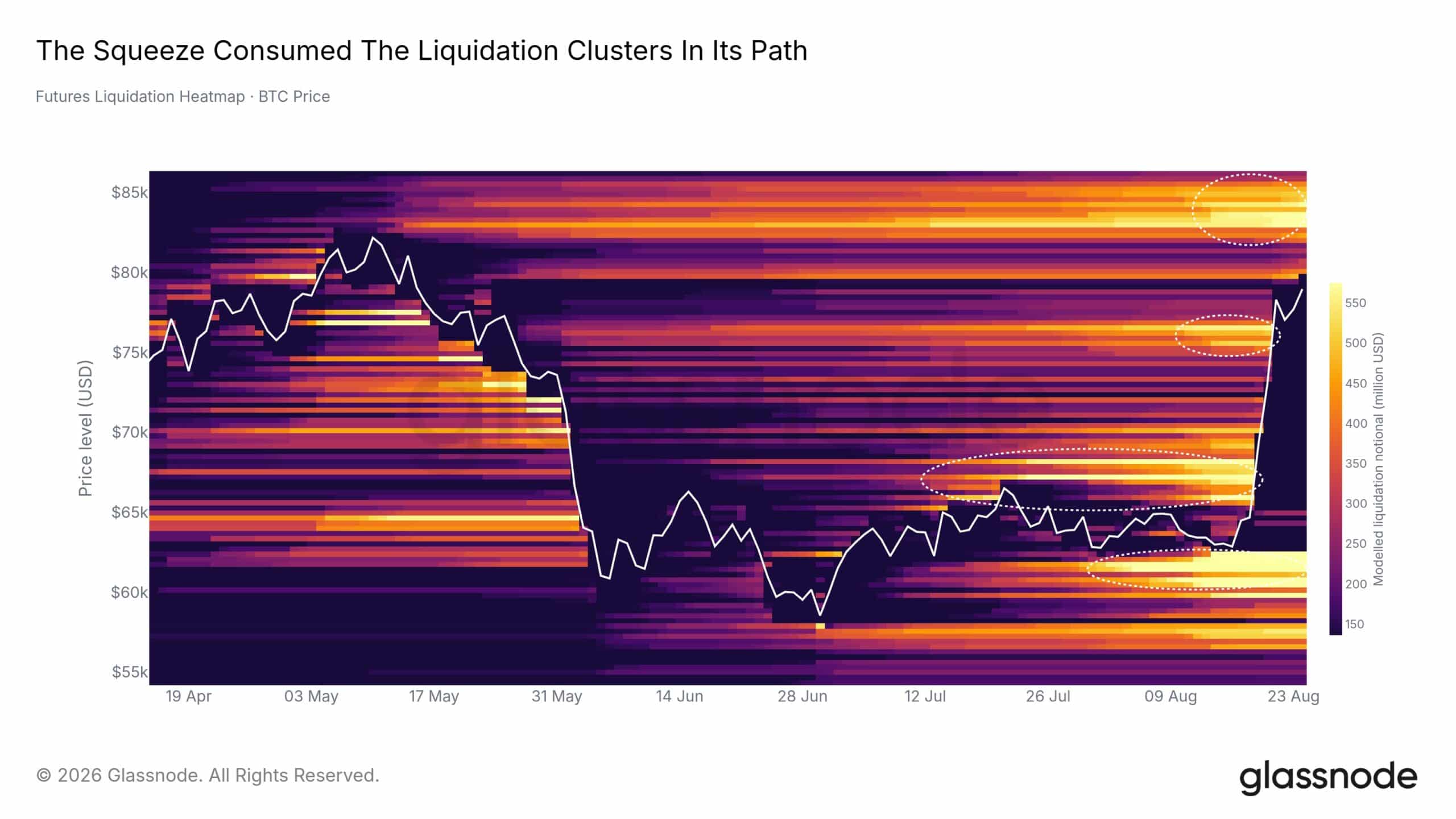
That support matters because Bitcoin now faces its remaining short cluster between $82,000 and $86,000 (bright yellow zones). Clearing this band would remove the final liquidity barrier below January’s high.
If that occurs, it would mark an important step toward clearing the price of Bitcoin at or above its January high. Until then, however, it represents the biggest test for the price’s recovery.
Broad accumulation strengthened Bitcoin’s recovery
While forced liquidations drove Bitcoin’s initial breakout, the rally found support as real capital followed. Spot ETFs recorded seven consecutive inflow days, drawing $2.23 billion in 2026’s strongest week.
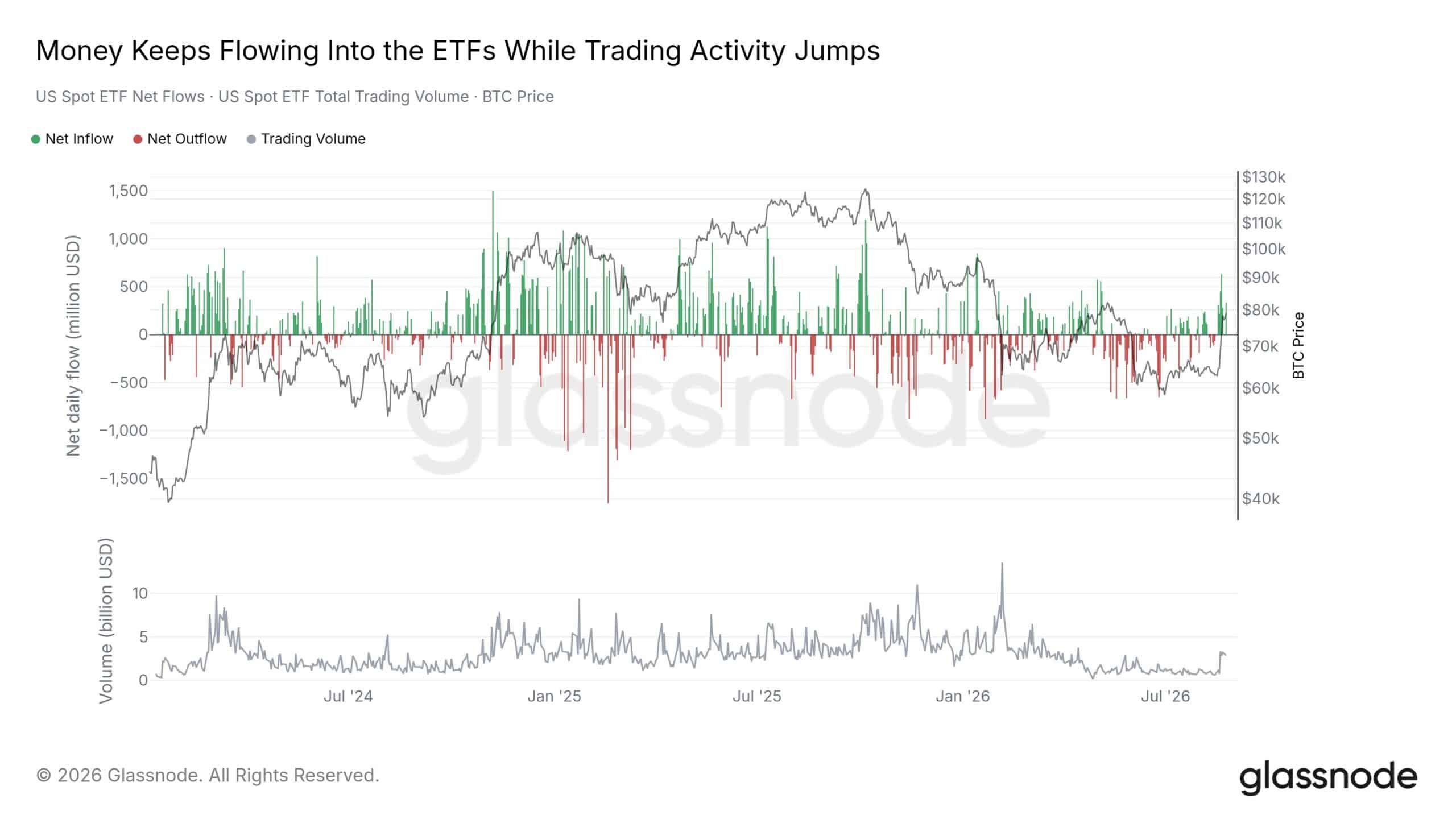
Even so, turnover averaged $2.4 billion, well below early-year levels, suggesting demand expanded without excessive trading.
That demand also reshaped ownership. Since the 30th of June, wallets holding 1,000–10,000 BTC released 50,500 coins, while custody-linked entities absorbed 59,100 BTC.
In simple words, this implies that Bitcoin demand was strong. However, the buying was concentrated in longer-term institutional channels rather than high trading activity.
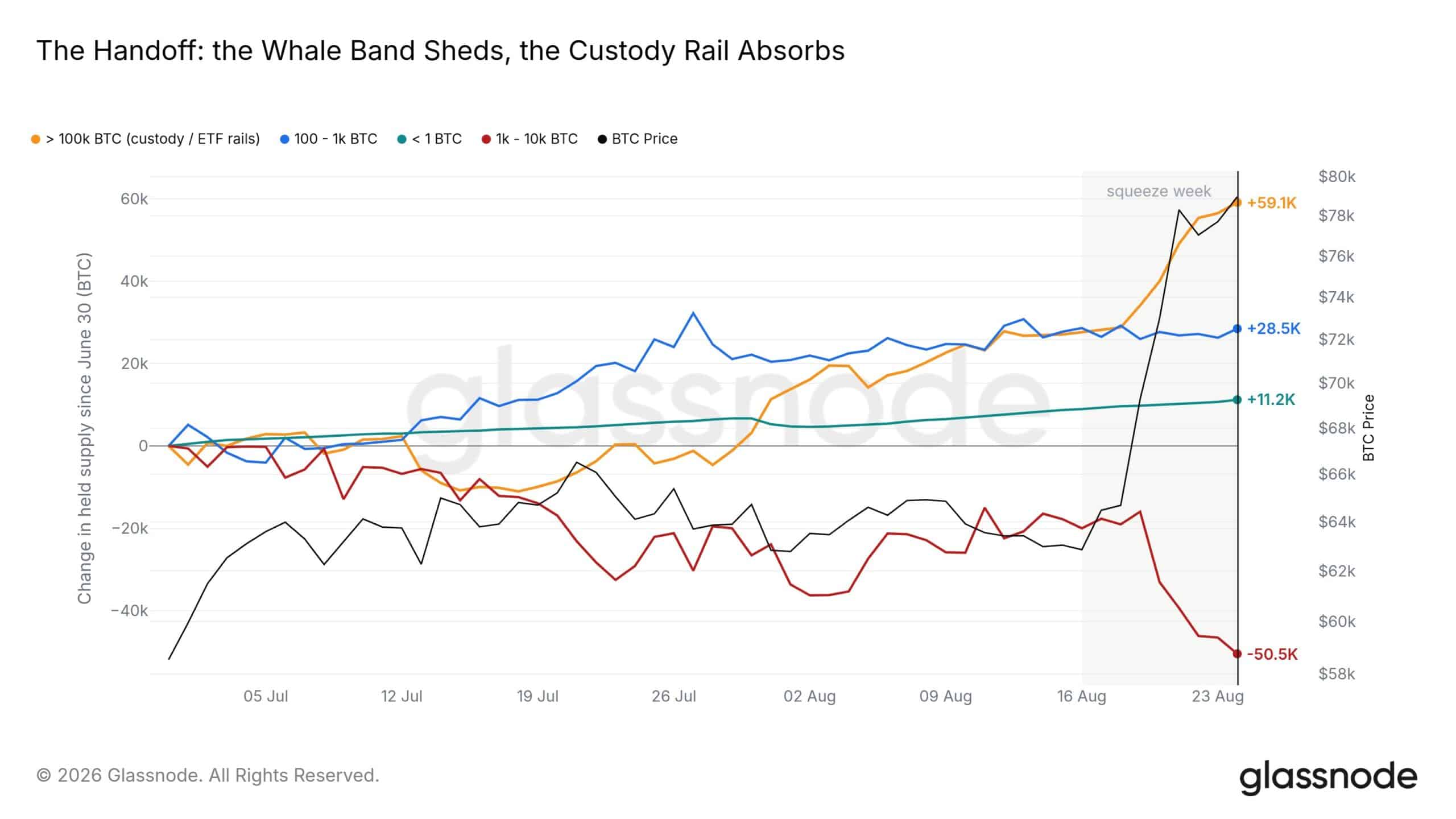
Of that increase, 31,500 BTC arrived during the squeeze week, broadly matching ETF creations. All six wallet cohorts were above the 0.5 accumulation threshold for 20 days.
Therefore, for the recovery to continue, there needs to be widespread accumulation. Otherwise, if one of these cohorts falls below 0.5, then it will indicate that participation by investors is weakening.
Binance traders remain firmly leveraged
The accumulation story changes once Bitcoin trading reaches Binance. Although BTC climbed toward $78,500, spot turnover remained only 10% of perpetual volume.
As such, this means Binance traders largely expressed the rally through leverage rather than direct BTC purchases, leaving the price more exposed to shifts in derivatives positioning.
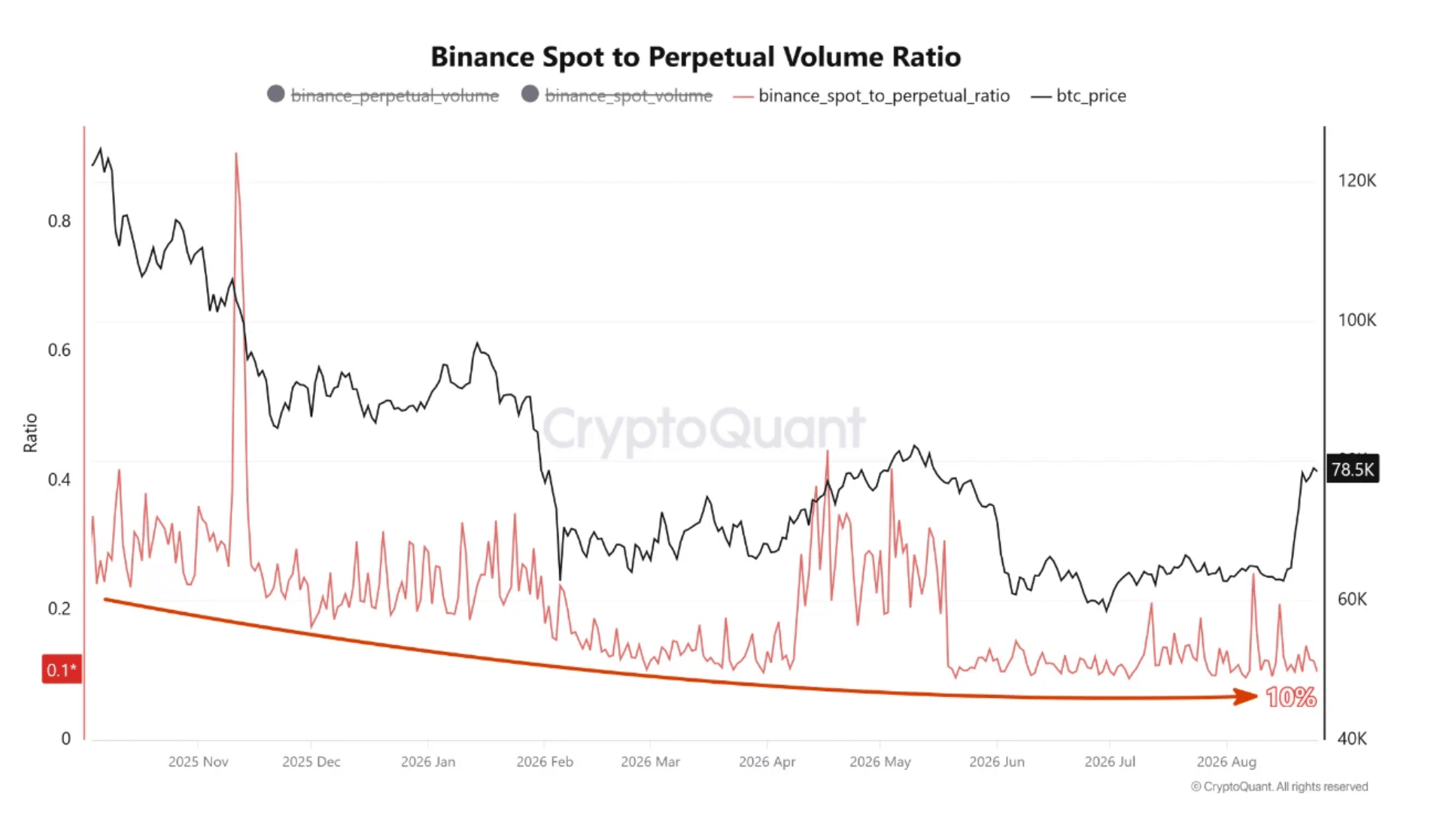
The rally, therefore, brought higher prices without shifting Binance activity toward direct ownership. Instead, perpetuals continued carrying most hedging, leverage, and short-term positioning.
This contrasts with the $2.23 billion entering ETFs and the accumulation recorded across custody-linked entities. Yet that underlying demand has not shifted Binance away from leverage, leaving the exchange heavily derivatives-driven.
That divergence now matters at $80k. At press time, Bitcoin had slipped to 79.7k, giving back the psychological level despite broader accumulation.
The recovery, therefore, has stronger ownership underneath it, but holding $80,000 will show whether that demand can outweigh Binance’s leverage-heavy positioning.
Final Summary
- Bitcoin gained 26%, with $82K–$86K now separating the recovery from January’s high.
- BTC ETFs and wallet demand supported the rally, although Binance activity remained heavily leveraged.