CFTC Chairman claims ‘we will go to war with the statute we’ve got’ as CLARITY Act fails
The CLARITY Act may be facing delays, but the CFTC has a different plot twist to offer.


The CLARITY Act’s failure to pass the Senate has disappointed the crypto market a lot and killed the hopes of many looking forward to the bill’s passage.
In this list of disappointed groups and individuals, the U.S Commodity Futures Trading Commission (CFTC) has disclosed that they do not want to wait any longer for Congress to pass comprehensive crypto legislation before establishing rules for the cryptocurrency market.
According to CFTC Chairman Mike Selig,
We would have preferred to have a federal regulatory framework codified into statute, but we go to war with the statute we’ve got and we’ve got clear authority and we’re going to use it.
What’s the CFTC’s game plan?
The CFTC intends to use its existing powers to establish basic rules and provide greater clarity for crypto businesses and market participants.
At the same time, Selig also expressed hope that Congress will revisit the CLARITY Act in the future, potentially refining its provisions to address remaining regulatory gaps.
Faryar Shirzad, Chief Policy Officer at Coinbase, argued that the proposed CLARITY Act would have helped the CFTC strengthen its ability to regulate crypto markets by providing additional funding mechanisms and faster hiring authority.
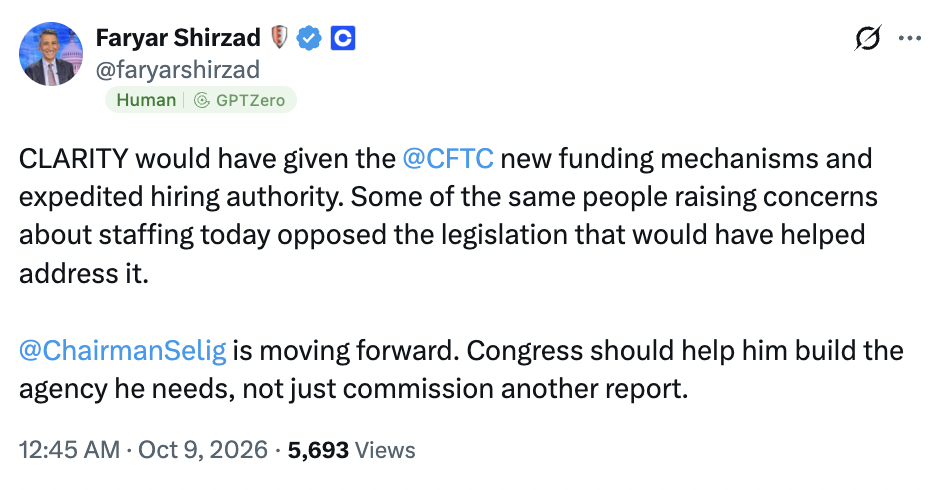
However, he believes that Congress should provide practical support, including the resources and staff needed to enforce rules effectively. This, rather than simply requesting another report on the agency’s challenges.
Tension remains but…
Needless to say, despite multiple temporary fixes, the frustration is still felt among many Republicans.
This was particularly underscored by Senator Cynthia Lummis, who claimed that Democrats opposed the CLARITY Act despite its desire for a new rule. For those unaware, the Democrats have demanded that digital commodity exchanges should provide customers with clear disclosures about consumer protections.
Lummis noted,
We added it to the Clarity Act, and Senate Democrats voted no.
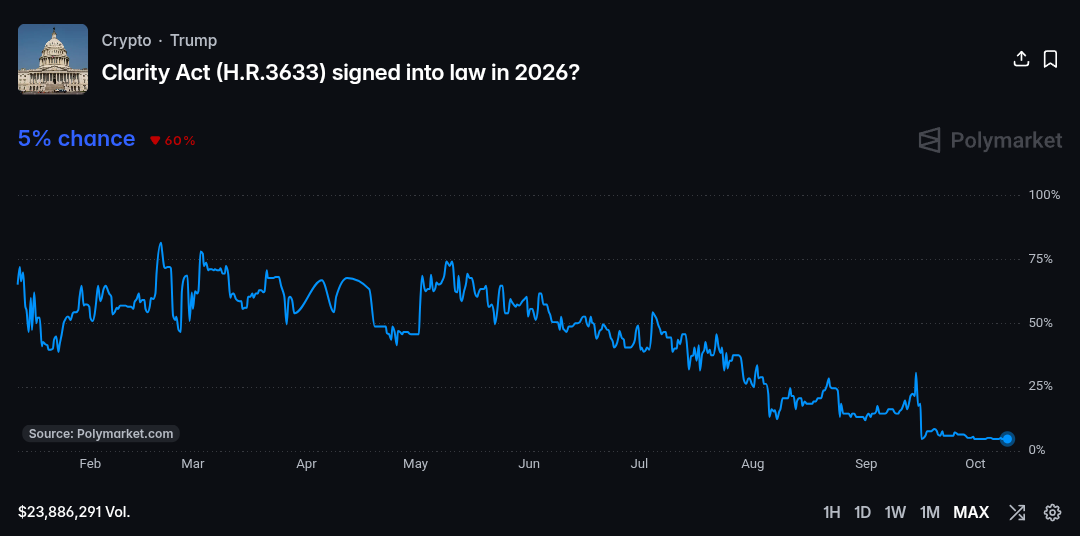
In fact, the delay was also felt in Polymarket’s odds, with the same down to 5% at press time. No matter the uncertainty, however, the CFTC is not stopping.
Just recently, the CFTC updated its FAQs to clarify how tokenization and blockchain technology can operate within existing regulations. The agency also allowed regulated firms to use blockchain for record keeping, provided records remain authentic, accessible, and reliable.
Final Summary
- Mike Selig is hopeful that Congress will revisit the CLARITY Act in the future.
- Senator Lummis claimed that Democrats opposed the CLARITY Act despite its desire for a new rule.