From Alpenglow to Quantumglow – Inside Solana’s post-quantum plan
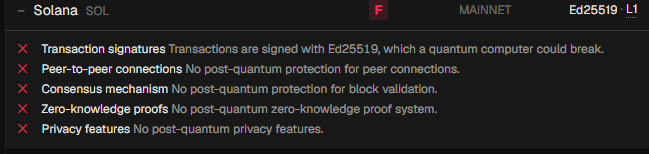
Solana currently has an 'F' rating for post-quantum readiness due to its classical signatures across wallets and validator votes.



After achieving a massive 85x faster transaction finality via the Alpenglow upgrade, Solana [SOL] is now pitching its quantum upgrade plan.
On the 22nd of October, Solana and Anza, the software company building some of its core infrastructure, proposed an adaptation of Alpenglow to secure the chain against quantum computer threats. But no dedicated timeline or deadline has been issued yet.
Post-Alpenglow: Solana quantum plan
The proposal seeks to upgrade Alpenglow signatures, which are currently quantum-vulnerable. At the consensus layer, Solana validators use the heavy and slow BLS (Boneh-Lynn-Shacham) signatures.
For token swaps and transfers between wallets and apps such as Phantom, the faster ED25519 signatures are used. Both signature schemes rely on elliptic curve cryptography, which quantum computers can break.
Quantumglow seeks to replace BLS with hash-based signatures for validators and ED25519 with Falcon signing. Dilithium and Falcon are among the most widely used quantum-proof signatures.
For Solana, Quantumglow would still allow the chain to get its post-quantum security while retaining its 0.15-second transaction finality. However, Anza and Solana have not committed to any timeline or deadline for the upgrade.
Still, this is an incredible update that Alpenglow can be adapted to accommodate post-quantum signatures without losing speed. Amid advanced AI models and quantum breakthroughs, blockchains now face double security threats.
Google has set an internal post-quantum deadline of 2029. Some blockchains like Tron and Starknet are at advanced stages to meet the deadline. Others, such as Quantus, Tezos, and Algorand, are quantum-ready, but Bitcoin and Ethereum are yet to agree on the PQ signatures to use.
For his part, Vibhu Norby, Solana Chief Product Officer, said,
Solana is ready for quantum & whatever comes next with AI. Anza’s cryptography team is world class
Similarly, Jacob Creech also hailed the Quantumglow plan, adding that it’s “simple and has no loss in speed.”
Solana quantum push: What’s at risk?
As mentioned earlier, signatures or approvals at the validator/consensus level and app or wallet transfers are secured by classical cryptography. Similarly, the risks extend to crypto custody and bridge systems.
This makes the entire blockchain tech stack that relies on classical signatures at risk from advanced AI models or quantum computers. Currently, $2.7 trillion, or 99.7% of the crypto market, is still vulnerable.
In fact, even Solana is still vulnerable and has an ‘F’ rating because it currently does not use post-quantum signatures across its entire stack, including transactions, P2P transfers, and the consensus layer.
Final Summary
- Solana announced Quantumglow to make the chain quantum-proof, but no timeline was shared.
- The L1 currently has an ‘F’ rating in quantum readiness but still leads Ethereum in planned migration.