SUI adds Cetus AI tools and Samsung access – Why is capital leaving?
Gasless transfers remove a barrier for users while weakening the assumption that adoption requires buying SUI.


With AI buzz spreading across global markets, blockchain projects are racing to give autonomous agents more tools. Sui [SUI] and Cetus Protocol are the latest to expand those capabilities.
However, the network’s growing reach has yet to translate into stronger token demand, with capital continuing to leave.
What can Cetus AI tools actually do?
Cetus Protocol, a leading decentralized exchange (DEX) on Sui, unveiled its Cetus Skills infrastructure.
These Claude Code skills let AI agents interact with Cetus programmatically to execute swaps and manage liquidity.
Practically, the tools create a path for agents to handle on-chain decentralized finance (DeFi) tasks. Instead of stopping at market analysis, agents can interact with the trading and liquidity tools themselves. GitHub
That could make automated DeFi workflows easier to build. Whether those capabilities attract sustained activity and capital remains the next test.
Will Samsung access increase SUI demand?
Beyond AI tools, Sui is extending its reach to mobile users.
As Altcoin Buzz reported, Samsung Wallet was set to add gasless USDC support on Sui.
The rollout was scheduled for the last week of October, covering up to 82 million eligible U.S. Galaxy devices. That offers Sui a much larger potential audience, although eligible devices do not equal active users.
There is also a catch for the token-demand argument. Users can send supported USDC transfers without holding SUI, and Samsung Wallet will initially support USDC rather than the native token.
So, wider distribution could increase network usage without requiring every new user to buy SUI.
Why is SUI still struggling?
Despite the expansion, capital flows remained weak. Sui recorded negative Network Netflows from the 10th of October, with particularly large outflows on the 25th and 26th.
On the 26th of October, Netflows fell to approximately negative $20 million, the weakest reading in 11 months.
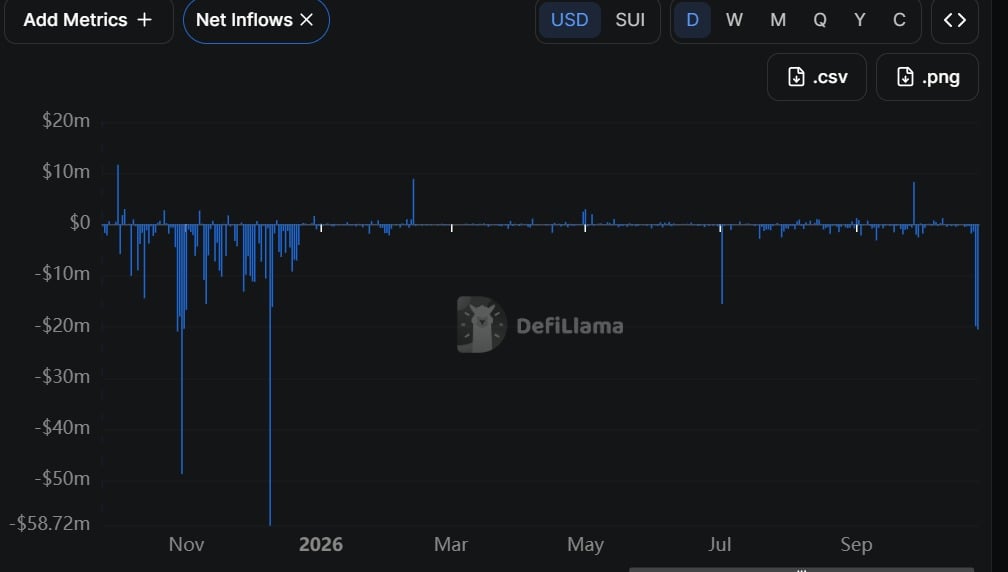
In other words, more capital was leaving the network than entering it. The same selling pressure appeared in SUI’s Spot Buy/Sell Volume. Its Delta stayed negative for three consecutive days, indicating that tracked sell-side activity exceeded buying.
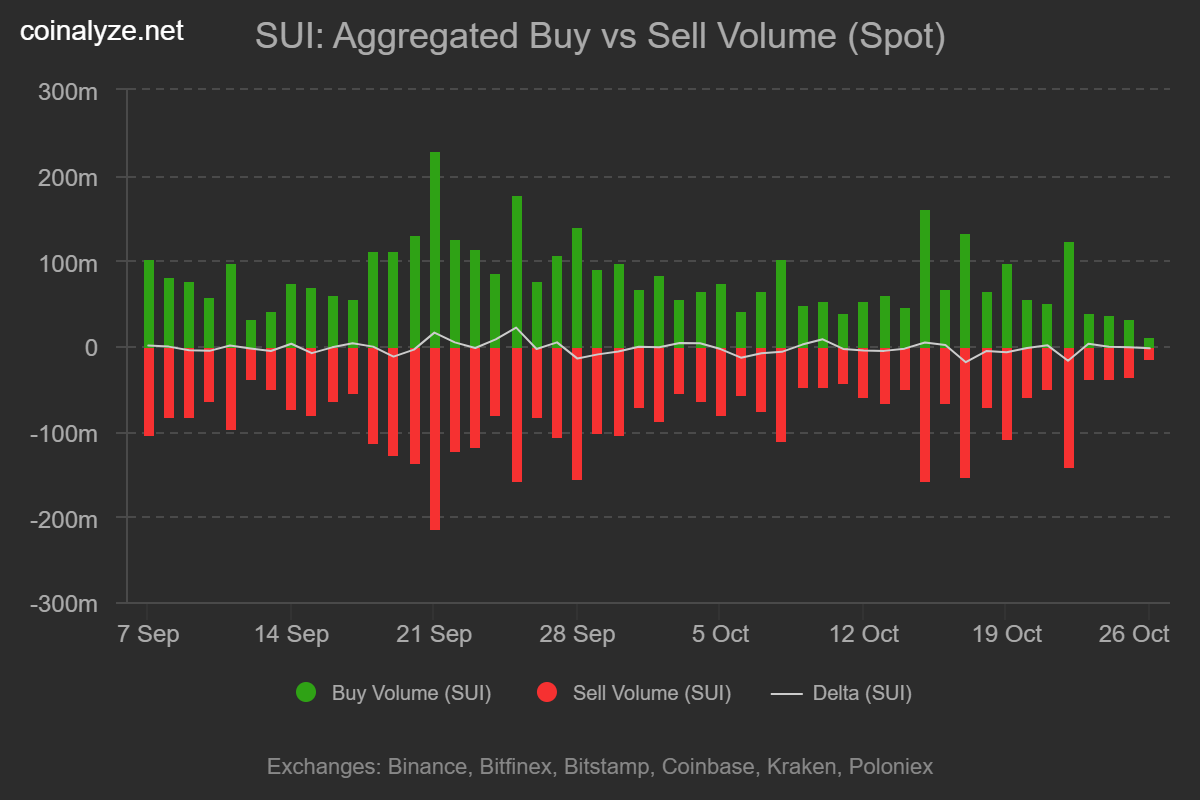
Together, network outflows and negative Spot Delta pointed to weak near-term demand despite the adoption announcements.
If that pressure continues, SUI could lose $0.90 support and retreat toward $0.88. For now, new access points have expanded what users can do on Sui; capital flows have yet to follow.
Final Summary
- Cetus introduced AI tools for swaps and liquidity management, while Samsung Wallet prepared gasless USDC access.
- Sui’s negative Netflows and Spot Delta suggested selling pressure persisted, leaving $0.90 support exposed.