‘Our collateral resides off-exchange’ – Ethena downplays $8.8M Binance exposure
Ethena dimissed the ongoing FUD over contagion risks due to Binance hack.



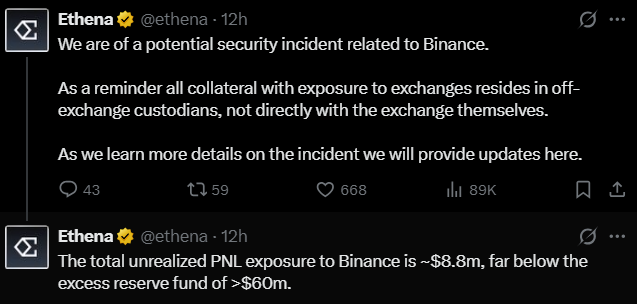
Ethena, the protocol behind the synthetic, yield-generating stablecoin USDe, has downplayed exposure to the Binance hack. The team clarified that all their USDe backing resides offchain with its custodians, not on centralized exchanges.
In fact, for the Binance scenario, the team claimed only $8.8 million in unrealized PnL (profit and loss) exposure to the platform.
The total unrealized PNL exposure to Binance is ~$8.8M, far below the excess reserve fund of >$60m.
In a separate update following the FUD tied to the Binance exploit, Ethena added that independent attestors, Chainlink and Llama Risk, have verified its overcollateralized backing for USDe.
Each of these independent 3rd parties mentioned above have confirmed USDe remains overcollateralised by more than $60m at >101.0%.
But before evaluating the claims, AMBCrypto explored why the community seemed worried about Ethena’s outsized exposure to the exploit.
Ethena’s massive partnership with Binance
Ethena and Binance recently signed a partnership agreement for RWA (real-world assets) basis trade. This involves Binance’s bStocks, which promised an 11% yield and a great expansion into a $150T opportunity in the equity sector for USDe backing.
The deal was signed last month, but the exposure seems relatively small.
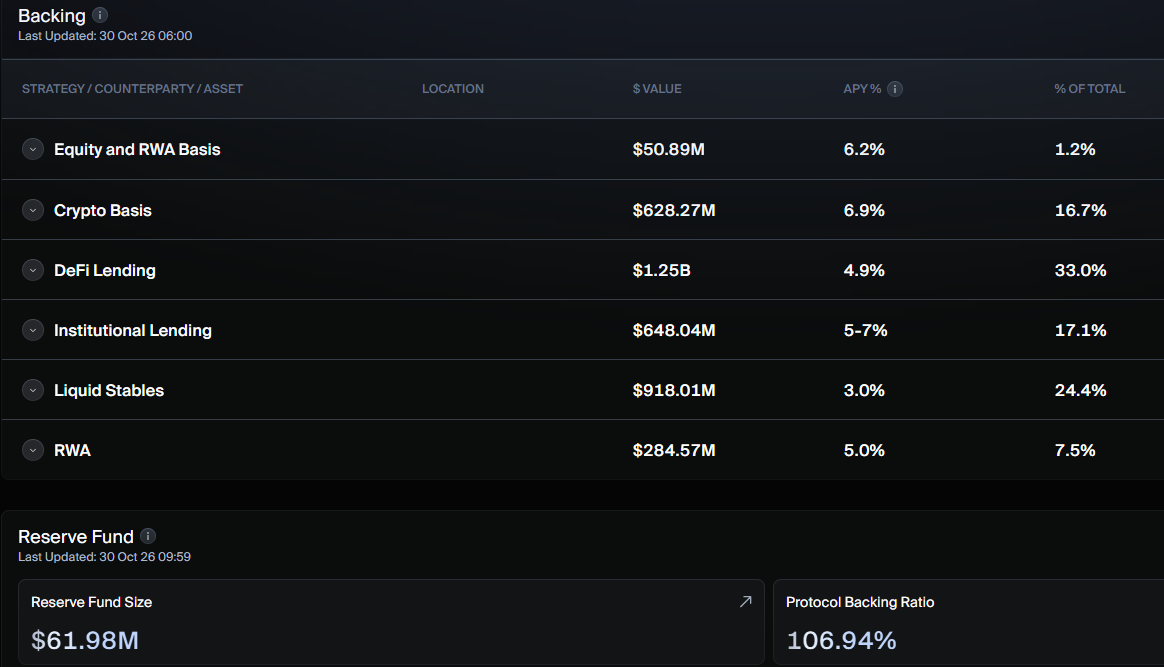
According to Ethena, RWA basis accounts for $51 million, or 1.2% of its $4.54 billion collateral for USDe. Beyond the RWA basis, Ethena also uses the crypto basis across Bitcoin [BTC] and Ethereum [ETH] to hunt for yield. The crypto basis segment accounts for about 17% of the USDe backing ($628 million) and is spread across Binance, Deribit, Coinbase, Huobi, Bybit, OKX, and Hyperliquid.
Collectively, this is about 18% USDe collateral exposure to crypto platforms for RWA and crypto basis. In fact, the largest share of the collateral is DeFi lending ($1.3 billion) across Aave and Morpho. But Aave was also affected and paused operations after the Binance hack. So, the contagion risk fears over Ethena’s exposure to the exploit were warranted.
However, as the project mentioned, it has off-exchange settlements (OES) or custody arrangements with Coinbase, Copper, and Ceffu. So, the risk may be limited, as the project said.
In fact, Mikhail Kedzel, Founder of Yumi Finance, confirmed that Binance offers such off-chain arrangements to top institutional players.
For everyone asking why: it’s because Ethena doesn’t keep funds in Binance’s hot wallet. They keep it with their custodian, and Binance just ‘recognizes’ it as funds stored at the CEX. Stuff only really available to the big guys.
It’s like the ‘custodied collateral lending’ design being explored by Aave.
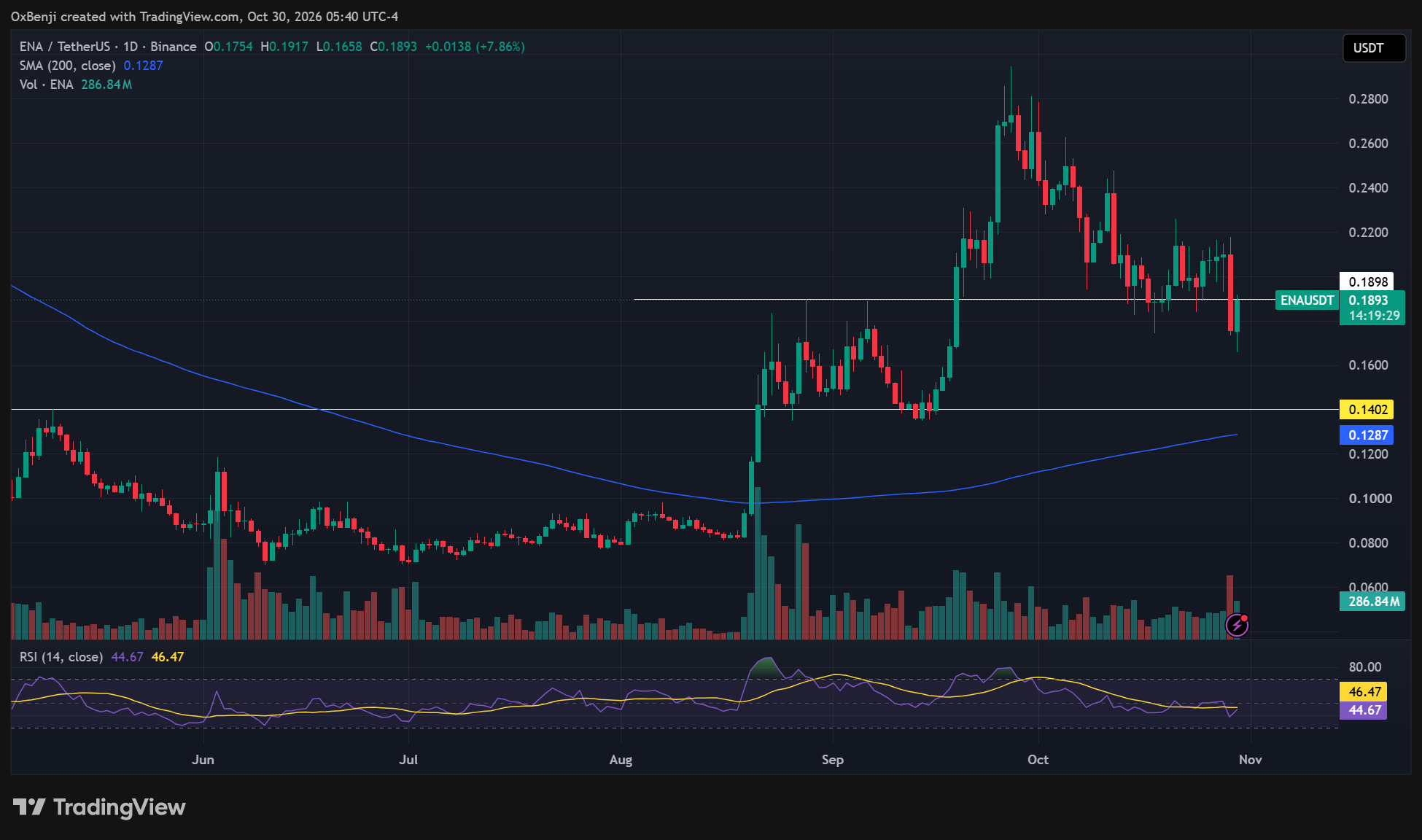
That said, the Binance attacker stole and dumped 217 million ENA ($34 million) for ETH. This dragged ENA below $0.19 after a 16% drop. Whether Ethena’s clarification on the Binance hack is enough to stop the pullback remains unclear.
Final Summary
- Ethena clarified that it can cover the $8.8 million Binance exposure.
- Binance attacker sold $33 million in ENA for ETH to avoid seizure and freezing.