Binance net outflows cross $3.64B after withdrawals restart – Can user confidence return?
Binance’s reopening has exposed the scale of user withdrawals, while asset recovery remains central to restoring confidence.



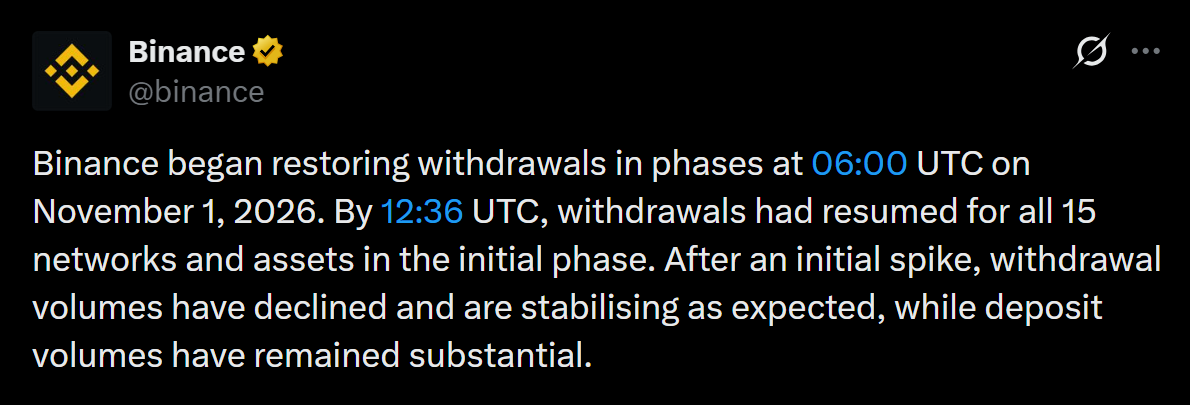
On Sunday, the 1st of November, at 06:00 UTC, Binance resumed withdrawals, allowing users to withdraw their assets. Immediately upon opening for withdrawals again, there was an increase in the volume of withdrawal transactions.
Within the first two hours of withdrawals reopening, $733 million was withdrawn before gradually declining as the initial rush eased. However, a high volume of withdrawals continued to be initiated throughout the day.
This indicated users were continuing to withdraw their assets from the exchange even though they can do so.
As of 15:30 UTC, withdrawals totaled $4.649 billion, and deposits totaled $1.01 billion, thus resulting in a net withdrawal amount of $3.638 billion. This represents 2.1% of Binance’s stated $171 billion in assets.
Although the net outflow indicates a large number of post-resumption withdrawals were made from the exchange, it may not indicate a loss of confidence. The fact that deposits continue to occur, along with decreasing withdrawal rates, suggests that trading activity appears to be normalizing.
However, if a large volume of additional withdrawals are made, it will decrease the exchange’s reserve levels and liquidity.
USDT leads the post-hack withdrawals
Soon after the withdrawals began, some assets experienced outflows in larger volumes. Notably, Tether [USDT] led with the most outflows, with 1.96 billion tokens leaving the exchange.
USD Coin [USDC] trailed closely by 557.65 million tokens. Still, during this time, Binance saw 19,569 Bitcoins [BTC] worth approximately $1.53 billion leave the exchange. Meanwhile, while Ethereum [ETH] outflows totalled 154,147 ETH, valued near $360 million.
This distribution shows that users moved both stablecoins and major cryptocurrencies rather than concentrating on one asset.
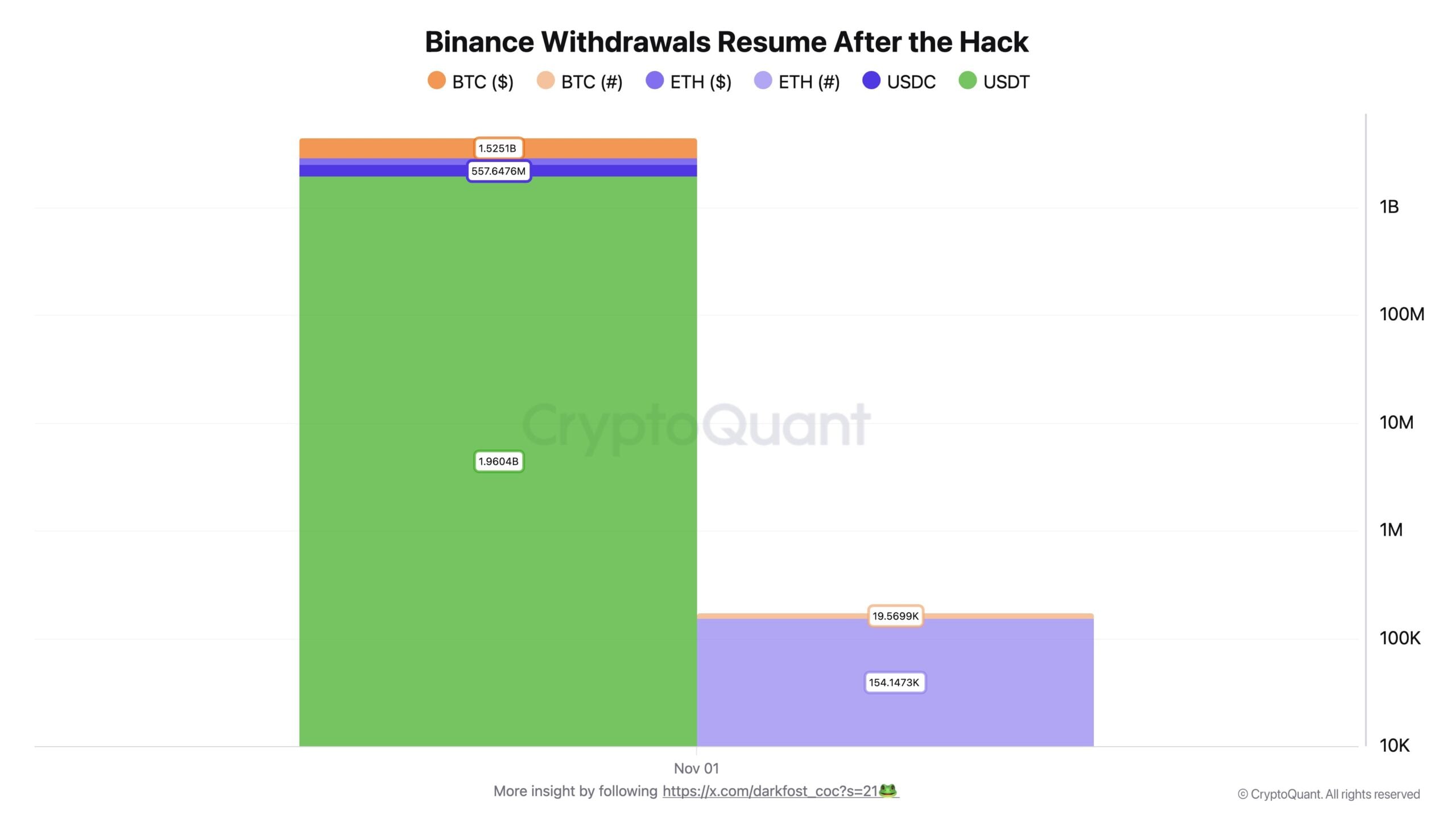
Given that many users withdrew both types of assets, many seem to want to maximize their liquidity and ease transferability. Simultaneously, Bitcoin and ETH outflows further reduced assets held on Binance
Continued removals could negatively affect exchanges‘ reserves and delay the end of the examination into the security measures taken by Binance.
Can Binance recover the remaining funds?
Now, instead of focusing solely on the breach itself, Binance is facing pressure to determine what portion of the stolen funds cannot be recovered. Both Tether and Circle have issued freezes on approximately $2.7-$3 billion in stablecoins.
This severely limits attackers’ ability to withdraw any part of the funds. Binance claims that through company funds and SAFU reserve accounts, they have been able to recover over 90% of the impacted assets.
Nonetheless, most of the remaining exposure is comprised of Bitcoin and ETH. These assets are far more difficult to freeze since they are currently controlled by attackers.
Furthermore, independent verification of the amounts reported by Binance regarding recovery is extremely important. Until transaction records clarify the outstanding balance, confidence will depend on evidence rather than reported progress.
Final Summary
-
Binance recorded $3.64 billion in net outflows after reopening withdrawals following the hack.
-
Binance recovered over 90% of stolen assets, but the remaining losses threaten user confidence.