Michael Saylor prioritizes STRC buybacks as Strategy’s Bitcoin buying slows 90% – Why?
Can Strategy's growing focus on STRC buybacks come at the expense of MSTR shareholders?


Nothing highlights the impact of ongoing market volatility better than Strategy.
In a recent interview, Michael Saylor outlined a potential shift in Strategy’s approach. He explained why the company could sell MSTR shares even below its net Bitcoin value to buy back STRC. The key takeaway? The market is calling this arguably the most revealing part of the 19th of November’s investor Q&A.
Fundamentally, this seems logical. As outlined below, MSTR has performed extremely poorly as Bitcoin has fallen, losing over 40% of value within Q4. If MSTR loses another 25% of value, it will have lost more this quarter than last year’s Q4 crash, potentially making it the worst quarter MSTR has had since the bear market back in 2022.
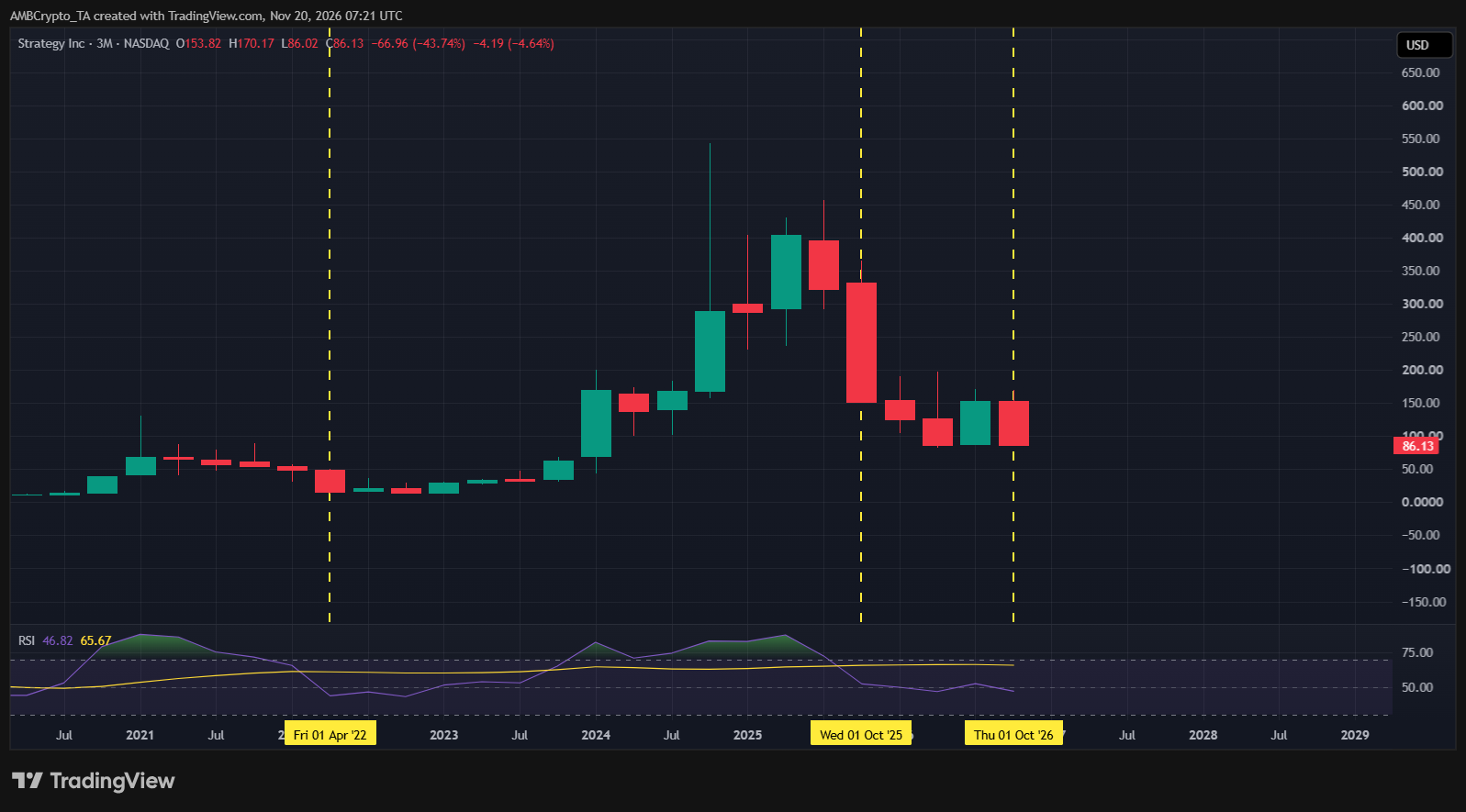
The result? Strategy’s Bitcoin [BTC] accumulation has slowed sharply in Q4 2026.
In Q4 2025, Strategy bought 32,470 BTC. In comparison, it has only bought 3,183 BTC so far in Q4 2026. This represents a drop of 90%. To date, Strategy also used $206.3 million proceeds from selling MSTR shares to buy STRC shares. However, only $33.4 million has been used to buy Bitcoin.
In short, broader market weakness is putting Strategy under pressure. Against this backdrop, Michael Saylor’s latest STRC strategy doesn’t look like a random move. Strategy seems to be shifting more capital toward supporting its preferred stock while navigating a difficult market. But with FUD around the company continuing to build, the bigger question is whether STRC can still attract enough investor demand to support Strategy’s Bitcoin accumulation plans.
STRC buybacks could change Strategy’s Bitcoin playbook
One thing is clear: Strategy’s main priority is to keep STRC stable.
As one analyst pointed out, this could mean the company would continue selling MSTR shares to fund STRC buybacks. If that isn’t enough, Strategy could also sell Bitcoin whenever STRC trades below its $100 par value. Saylor believes STRC’s 12% dividend is already attractive enough, making it a key income-generating product for institutional investors.
But what does this mean for Strategy shareholders? As the chart below shows, major institutional investors increased their MSTR holdings in Q3 2026. The top 15 now own around 33% of all outstanding shares. This shows that big investors are still interested in MSTR despite market weakness.
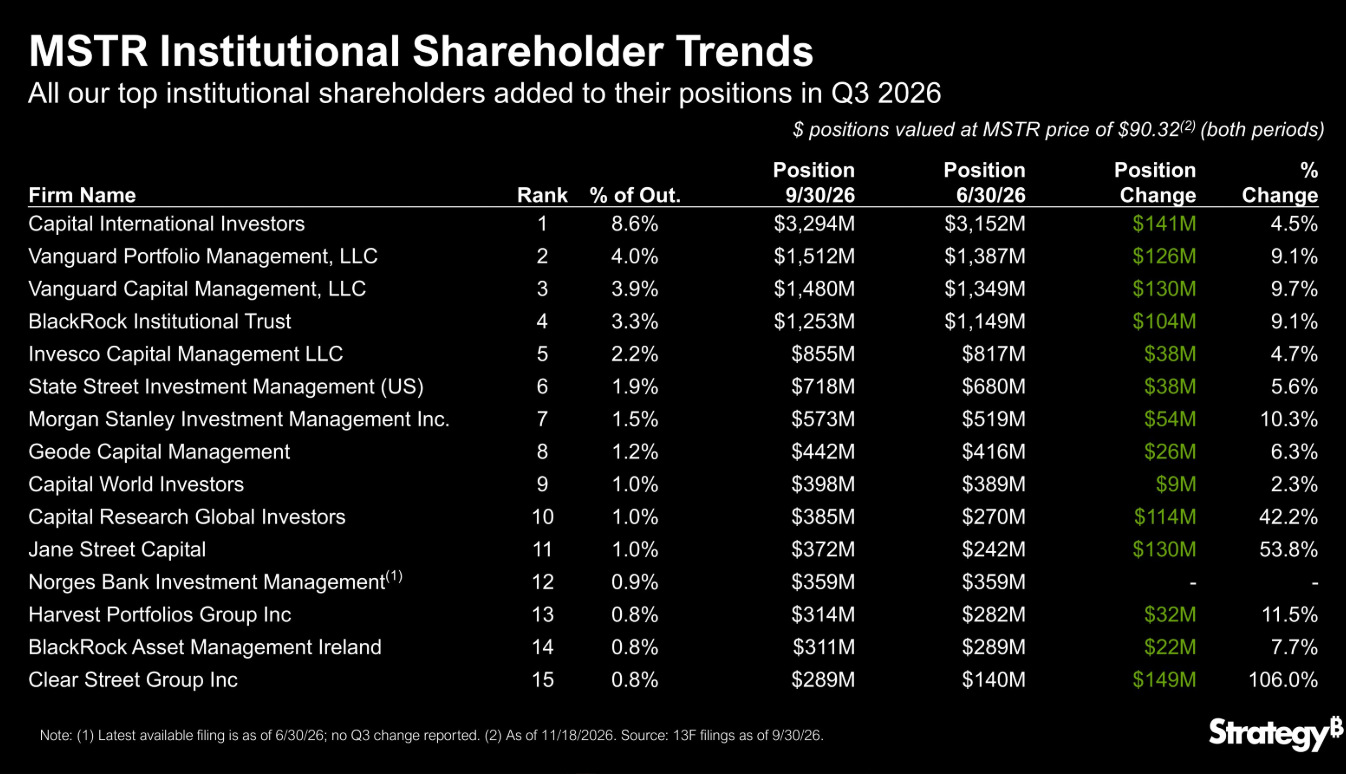
However, with Strategy focusing more on STRC, will MSTR shareholders still benefit from its BTC strategy?
Notably, this is where a potential feedback loop comes in. Continued weakness in MSTR could push Strategy to rely more on STRC buybacks to support its capital structure. However, this could also put institutional demand for MSTR at risk. If investor confidence weakens, raising fresh capital for future STRC buybacks could become more difficult.
So, for now, Saylor’s shift towards STRC signals a “risky” change in how Strategy plans to fund future BTC purchases.
Final Summary
-
Strategy is focusing more on STRC buybacks as MSTR struggles, potentially slowing Bitcoin purchases.
-
STRC’s 12% dividend may attract investors, but can it maintain demand without hurting MSTR?