Bank of Korea governor backs CBDCs, deposit tokens as the ‘future of money’
Will Won-based stablecoins survive the Bank of Korea's chief plans to accelerate CBDC and commercial banks-issued deposit tokens?


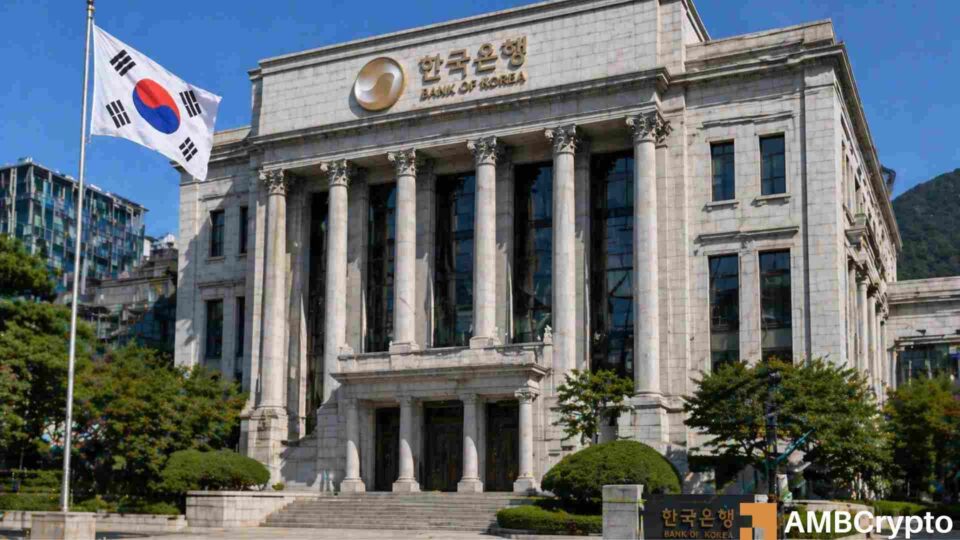
The Bank of Korea’s new chief, Shin Hyun-song, has pledged to double down on central bank digital currency (CBDC) and commercial bank-issued tokens.
During his inaugural speech as the newly appointed governor of the Bank of Korea, Hyun-Song hailed these two products as the ‘future of money,’ adding that,
We must proactively prepare for the design of the future monetary system. Through the second phase of Project Hangang, we will enhance the utilization of CBDCs and deposit tokens.
For the unfamiliar, CBDC is a digital version of the local currency issued by the central bank. Supporters of such projects highlight the ability to control the money supply and overall monetary sovereignty.
However, critics view it as an anti-freedom tool that can allow the government to freeze one’s funds at will.
For deposit tokens, these are similar to stablecoins. The only difference is that they are issued by regulated commercial banks, primarily for institutional transfers.
And Project Hangang is the framework for testing the usage of CDBCs and deposit tokens, launched in early 2026.
According to the new South Korea’s central bank chief, leveraging CBDC and deposit tokens would ‘elevate the status of the Korean Won’ in digital payments.
Will South Korea shun Won stablecoins?
Surprisingly, the traditional stablecoins, mostly issued by fintechs, were missing from the speech.
One would expect that the recent push for Won-based stablecoins to counter USDT and USDC dominance would earn them a feature in Hyun-Song’s speech.
Well, Hyun-Song was a former head of monetary policy and advisor at the BIS (Bank for International Settlements), commonly called the bank for central banks.
His former employer has always doubted the use of stablecoins, stressing their risks to the stability of financial markets. Whether he will adopt BIS’s strong stance against stablecoins remains to be seen.
That said, interest in Won-stablecoin has surged with over trademarks. Supporters believe that the products could help solve the ‘Kimchi Premium,’ where crypto assets trade higher in South Korea than overseas.
Still, critics argue the products would eventually accelerate capital outflows that regulators are trying to curb.

Meanwhile, Won-based stablecoin market supply has hit $1.3 million, dominated by Frax Finance’s KWRQ. It’s worth noting that this is too small compared to the broader stablecoin market of over $320 billion.
However, South Korea is one of the corridors that dominates 60% of global stablecoin payments. Hence, it will be interesting to watch how the Bank of Korea’s regulation will shape this payment corridor.
Final Summary
- Bank of Korea’s new chief said he will accelerate the development of CBDC and deposit tokens.
- Won-based stablecoin supply was only $1.3 million, a small drop compared to the broader market size of $321 billion.