Bitcoin’s retail demand remains flat – Here’s how it can affect BTC’s bull run!
Bitcoin’s rally has been led by institutions. Without retail support though, its strength may not last.



- Exchange outflows climbed as reserves dropped
- Large transactions have been dominant, but retail volume and address activity appeared weak
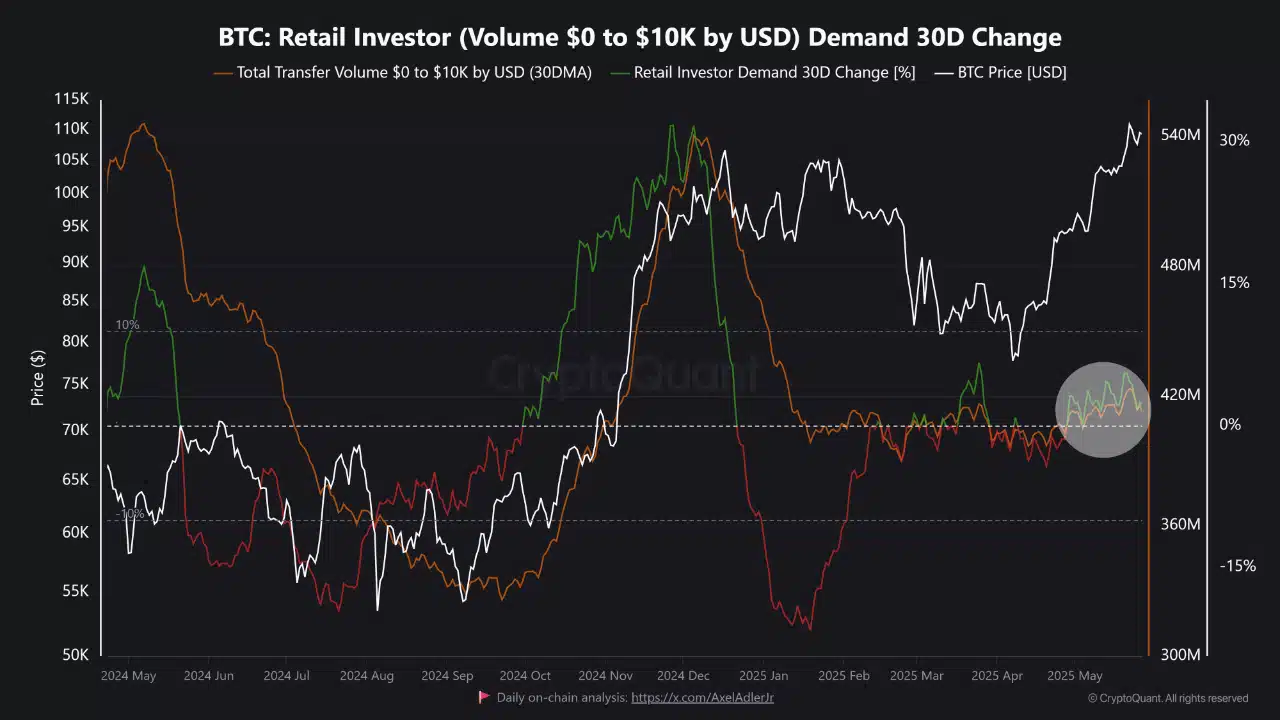
Bitcoin [BTC]’s 30-day percentage change in small investor activity has stayed flat, despite strong upward price momentum on the charts.
This divergence may be a sign that institutions or whales are leading the rally. Historically, sustained bull markets have relied on broader participation, with retail investors fueling mid-to-late cycle accelerations.
Without this layer of demand, the prevailing momentum may lack the depth required for long-term expansion. Despite the price remaining elevated above $100k.
Valuation metrics hint at overextension
Spot exchange flows on 28 May reflected strong outflows of $721.44 million against inflows of $616.51 million.
Additionally, exchange reserves dropped by 0.96%, with the same sitting at $266.49 billion at press time. This suggested that investors have been withdrawing BTC from exchanges, often a precursor to long-term holding or institutional custody.
Such a pattern has historically preceded strong price trends, as reduced liquid supply can tighten order books.

In fact, valuation indicators seemed to clearly show early signs of cooling, despite Bitcoin’s strong price trajectory. The NVT Golden Cross—used to assess price against on-chain transaction volume—dropped by 26.06% to 1.075.
Meanwhile, the Puell Multiple, which evaluates miner revenue against historical norms, fell by 11.22% to 1.297.
These findings implied that the price growth may be outpacing both network value and miner-based valuation anchors.
Retail presence fades as network activity drops, whales take control
Despite the hike in price, Bitcoin’s network growth has stalled somewhat. Over the past 7 days, new addresses declined by 5.93%, active addresses fell by 6.46%, and zero balance addresses dropped by 9.79%.
These metrics reflected falling onboarding and transactional activity. In a robust bull run, these numbers typically surge, indicating heightened demand and speculative interest.
Such a disconnect could be a sign that the ongoing rally has not been organically supported by a broader user base.

Bitcoin’s transaction profile revealed significant imbalances too. Transactions below $100 fell sharply, with the $0–$1 bracket down 66.38% and the $10–$100 bracket down 6.90%.
Conversely, transactions above $10 million soared by 59.26%, while those between $1 million and $10 million climbed by 13.26%.
This hinted at a rally led by high-net-worth investors or institutional participants – All while retail remained largely on the sidelines.
Although large players can move prices quickly, sustained rallies typically require volume and support across all transaction sizes.

Will BTC’s breakout be sustainable without retail participation?
Bitcoin’s recent price surge has been clearly driven by institutional flows and long-term holding sentiment, as evidenced by the shrinking exchange reserves and strong outflows.
However, cooling valuation indicators, declining address activity, and shrinking retail transaction volumes suggested the rally lacks a broad foundation. Without renewed retail interest, the momentum may weaken or become increasingly fragile.
For Bitcoin to break decisively into a sustainable bull cycle, retail participants must return with confidence, liquidity, and volume.