


Beyond AI and regulatory clarity, one key theme is taking center stage in 2026: Stronger tokenomics.
The logic is simple: While deflationary mechanisms can support price by creating scarcity-driven rallies, the bigger picture goes beyond short-term price action. Instead, they are increasingly becoming a key factor in improving long-term value capture for token holders.
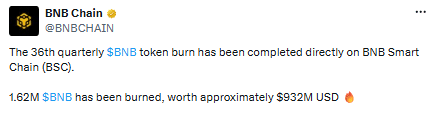
Notably, BNB’s latest burn cycle is a clear example of this shift. According to the official report, the BSC chain burned 1.62 million BNB tokens during its 36th quarterly burn, worth around $931 million at the time. This reduced BNB’s circulating supply to 133 million, putting it behind only Ethereum’s [ETH] 120 million and Bitcoin’s [BTC] 21 million among the top 10 crypto assets by supply.
More importantly, the market reaction after the burn showed growing investor interest in assets with in-built deflationary mechanics. The narrative quickly picked up momentum on social media, with many investors arguing that Binance Coin [BNB] is entering Q3 with a strong bullish setup.
However, the thesis may still seem a bit too early. From a technical standpoint, despite the burn and the surrounding hype, BNB is up only 1.5% this week, trailing Ethereum’s 6% rally. That said, compared to Solana’s [SOL] 0.5% gain, BNB is showing stronger relative momentum. With Solana’s liquid supply being over 5x larger than BNB’s, this divergence doesn’t look random.
Instead, it suggests investors are starting to favor assets with tighter supply dynamics. However, when it comes to long-term value capture, Solana is still in the race, driven by its growing RWA momentum. The bigger question now is whether Solana’s RWA growth can eventually outperform BNB’s stronger tokenomics, revealing which narrative has the stronger long-term edge.
BNB’s burn meets Solana’s RWA momentum
Both tokenomics and tokenization have emerged as major growth themes in the 2026 cycle.
While Solana still trails BNB when it comes to deflationary mechanics, its tokenization narrative is clearly gaining momentum. According to RWA.xyz, Solana is now the leading blockchain by RWA holders, with over 300k real-world asset holders, a new all-time high, and far ahead of BSC’s 118k holders. Notably, this surge has been fueled by tokenized equities, with Solana recording $3.47 billion in tokenized equities trading volume in June 2026, also marking a new all-time high.
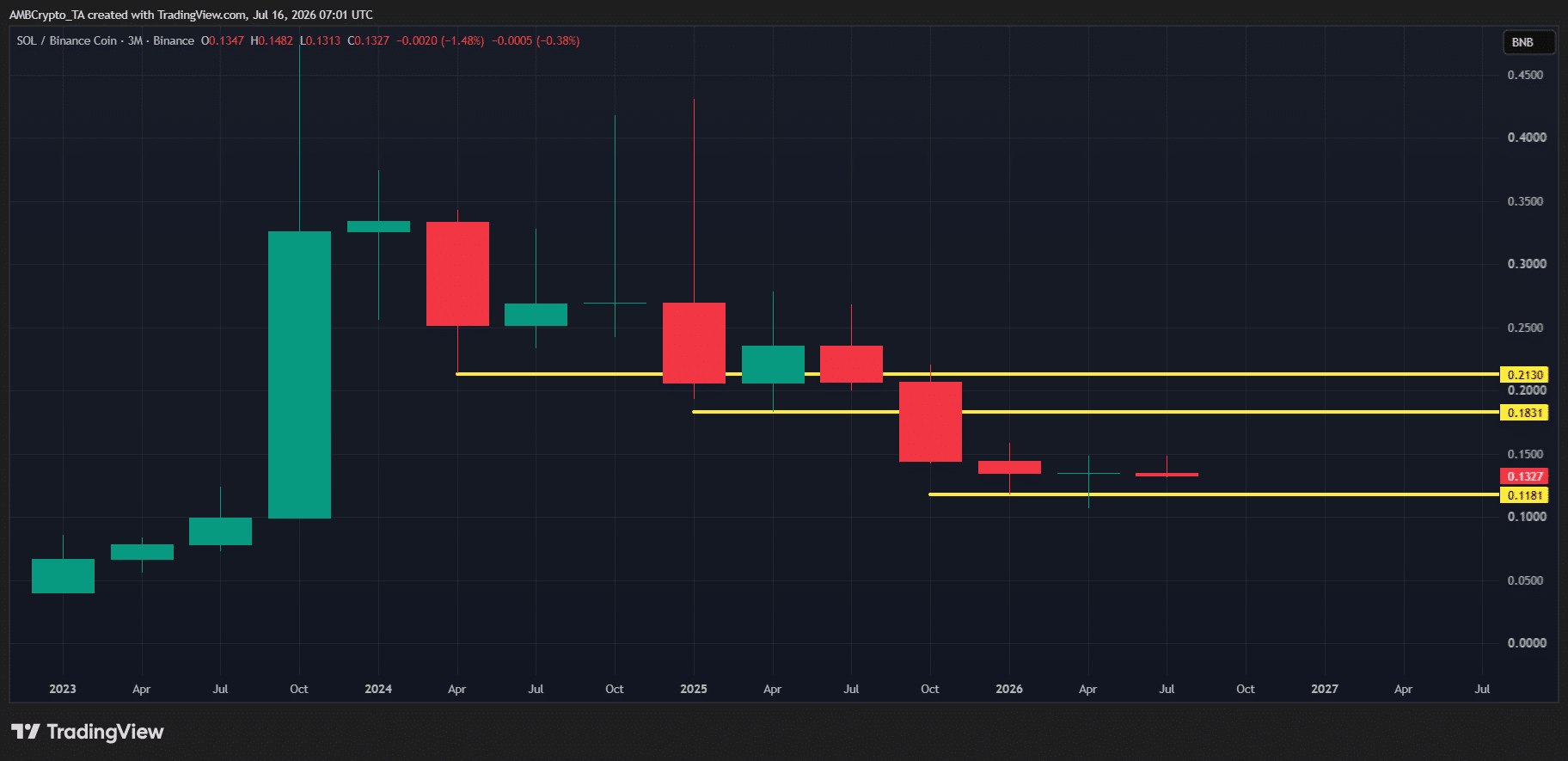
However, price action tells a different story. SOL/BNB remains in a steady downtrend, failing to reclaim key support levels since Q4 2023’s 227% rally. Since then, each cycle has followed a similar pattern. Around two quarters of consolidation before another breakdown, underscoring that Solana’s strong fundamentals have yet to fully translate into relative strength against BNB.
Naturally, this shifts the focus back to BNB’s recent 1.62 million token burn.
With supply tightening further and the gap widening against Solana’s 582 million liquid supply, Solana’s RWA momentum has yet to show up in the SOL/BNB ratio. Moreover, investors appear to be placing more weight on stronger tokenomics as a more reliable driver of long-term value capture.
In this context, a SOL/BNB breakout in Q3 still looks like a tough challenge.
Final Summary
- BNB’s 1.62 million token burn is boosting its deflationary narrative, as investors focus more on assets with stronger supply control.
- Solana’s RWA growth is strong. But BSC’s tighter supply keeps the SOL/BNB breakout uncertain.