CFTC sues New Mexico for violating its ‘federal jurisdiction’ – What’s going on?
The prediction markets legal war continues as states challenge CFTC's authority.



The U.S. Commodity Futures Trading Commission (CFTC) has sued New Mexico to block the state’s push to regulate Kalshi’s sports event contracts (prediction markets).
Last week, the state of New Mexico filed a lawsuit against prediction markets, arguing that it is an unlawful sports betting site that “evades state gaming laws.” The state now wants Kalshi to stop offering the markets.
In response, the CFTC moved to block New Mexico’s push to regulate prediction markets offered by CFTC-approved platforms like Kalshi. The regulator maintained that it has exclusive federal jurisdiction over event contracts and prediction markets under the Commodity Exchange Act.
Commenting on the update, CFTC chairman Michael Selig said,
New Mexico is the latest state seeking to nullify black letter law and decades of judicial precedent by imposing state gaming laws on federally regulated derivatives exchanges subject to the CFTC’s exclusive jurisdiction.
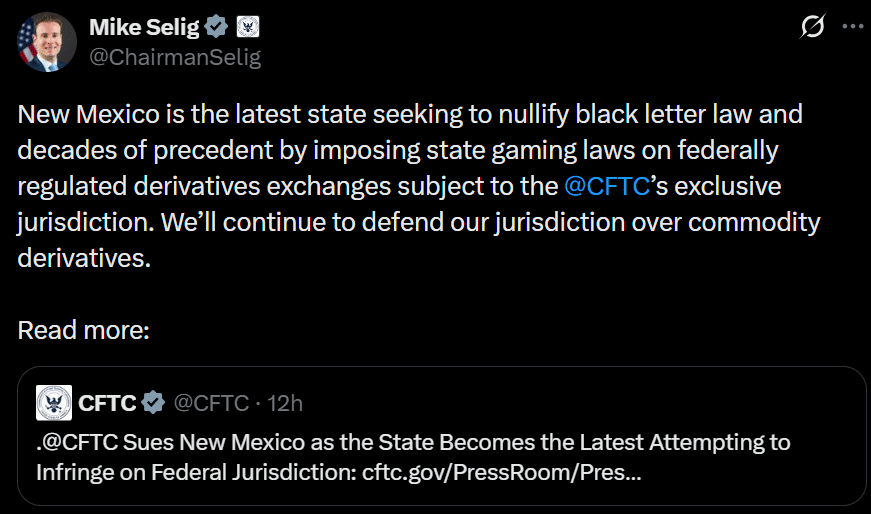
Other states like Arizona, Connecticut, Minnesota, Illinois, and Wisconsin have also begun regulatory enforcement or legislative bans against prediction markets.
But Selig vowed to defend the agency’s control over commodity derivatives.
Gary Gensler says CFTC should avoid sports betting
As the FIFA World Cup kicks off, sports betting across prediction markets continues to feature prominently in the ongoing CFTC vs. states legal fight.
Notably, the North American Derivatives Exchange (Nadex) filed a lawsuit against the state of New York to prevent it from taking enforcement action against its sports event contracts.
However, most sportsbooks argue that all prediction markets are ‘100% gambling platforms’ and should be regulated as such.
Surprisingly, even former SEC and CFTC chair Gary Gensler also reinforced a similar stance. He recently filed an amicus brief arguing that the CFTC was not granted authority in prediction markets on sports betting.
If Dodd-Frank had preempted the states on sports betting, it would have been one of the biggest stories about Dodd-Frank at the time. But nobody ever mentioned it.
Genler’s brief was filed as part of the Ohio state vs. Kalshi case involving prediction markets. However, Kalshi’s communications officer, Jacki McGavick, dismissed his argument as ‘wrong.’
This is the same person who insisted crypto was a security for years, and lost in court several times. It’s not surprising he’s wrong about what qualifies as a swap under the Commodity Exchange Act.
The intensifying legal fight comes at a time when the CFTC is actively pushing for clear rules for prediction markets.
Final Summary
- CFTC has moved to block New Mexico’s plan to regulate sports event contracts under the state’s gambling rules.
- Former SEC chair Gary Gensler said the CFTC has no authority on sports betting.