Why $25B in whale stablecoin inflows matters for crypto’s next move
FOMC could bring whales' capital back after billions in exits.



The crypto market has been gripped by fear since the 19th of May, when the Fear and Greed Index fell into the ‘Fear zone’ below 40. Since then, the market has faced a shrinking capital base and decreased investor willingness to fund it.
Several factors have played a role in the capital exits hitting the market. Oil-driven inflation concerns persist, while geopolitical conflict and tension continue to flare with no clear resolution in sight.
With limited capital in play, investors remain positioned around key events capable of dictating whether money flows into or out of the market.
Whale stablecoin inflows hit 2-year low
Among the groups leaving the market and exposing its structural weakness are the whales, the investors who hold significant sums of capital.
Tracking whale movements of stablecoins, specifically those shifting at least $1 million into Binance, the largest exchange by volume, reveals a massive decline.
Stablecoin inflows into exchanges typically occur when investors intend to purchase crypto from the market.
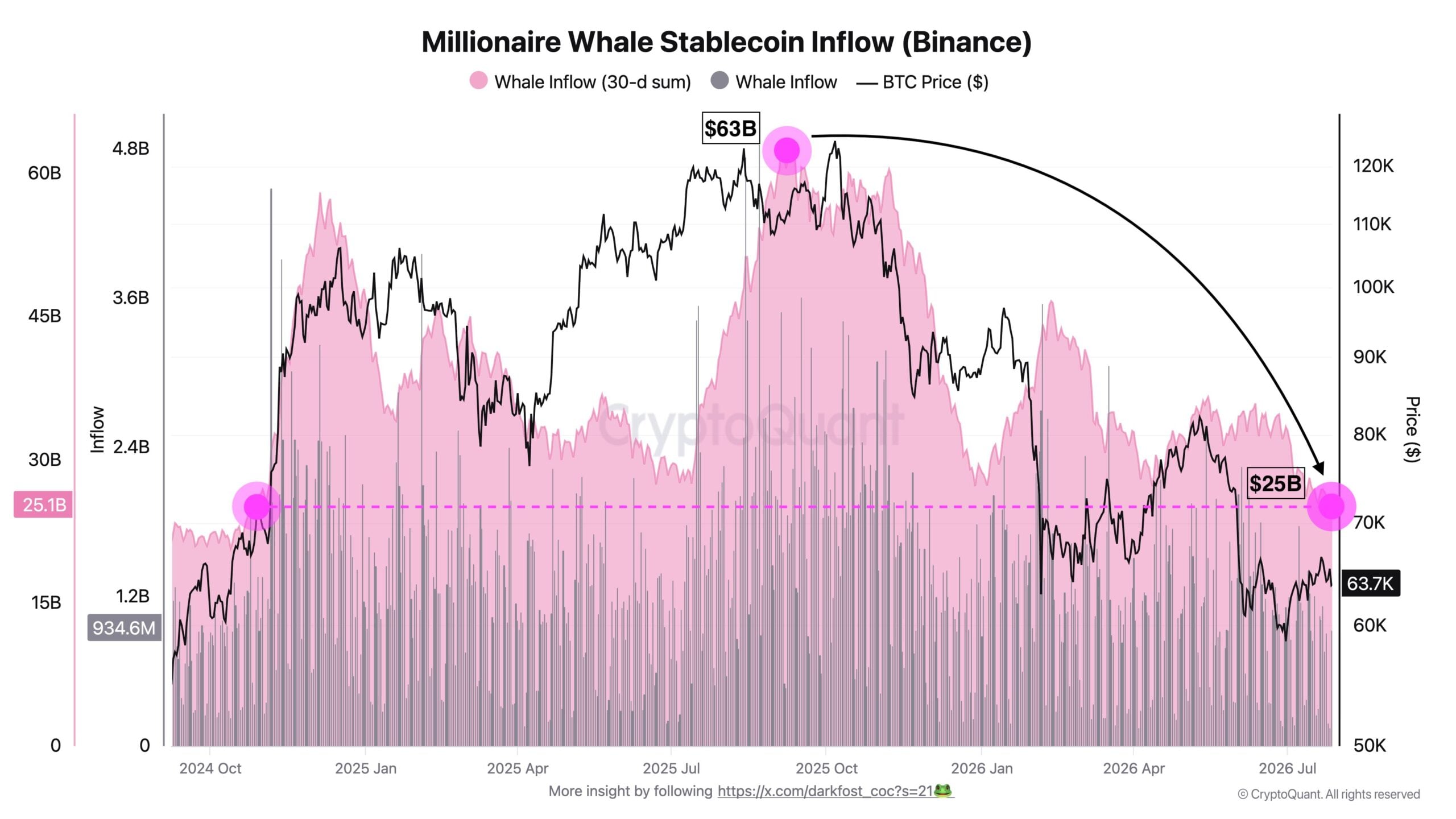
Since the market peaked in 2025, the figure has dropped from $63 billion to $25 billion, a level last seen in November 2024. Investors now prefer to hold stablecoins over risk assets as concerns over volatility remain high.
Whale inflows made their impact clear in February. Following a decline in Bitcoin, a resurgence of whale activity helped push the price into a rebound and built a key support wall at that level.
The Fed’s July decision holds the market’s next move
The Fed’s Federal Open Market Committee (FOMC) meeting remains the market’s key event and could determine whether demand returns through its decision on interest rates.
Interest rate cuts have often aligned with market easing, allowing U.S. investors to move out of stable assets like fiat or stablecoins and rotate back into risk assets. A rate hike typically signals potential economic stress and tightens capital in risk assets.
A steady rate, with no cut or hike, is more often interpreted as a neutral outlook. Before the Fed’s meeting on the 29th of July, Darkfost, a senior CryptoQuant analyst, says it could define market demand.
Another analyst, Benjamin Cowen, expects the Fed to keep rates steady this time, though he concedes it would force “(Bond) yields head higher,” a classic liquidity-tightening scenario affecting risk assets.
According to his analysis, he expects a 10–20% drop in the SPX (the S&P 500 index) extending between August and September, based on historical reference.
“This would also align with Bitcoin putting in a market cycle bottom later this year, just when it always does.”
Bitcoin whales accumulate despite the exodus
Bitcoin [BTC], the largest cryptocurrency by market capitalization, has seen major whale involvements over the past week as they accumulate.
According to AMBCrypto, whales holding between 10 and 10,000 Bitcoin have accumulated roughly 19,696 BTC from the market, helping sustain the price.
On a broader scale, whale involvement needs to deepen, with stablecoins flowing back into exchanges, if the wider market is to experience a more sustained rally. For context, stablecoin supply fell by $2.23 billion in July alone.
Final Summary
- Whale stablecoin inflows to exchanges have collapsed from $63 billion to $25 billion since the 2025 peak.
- The July 29 Fed meeting is the pivot; a shift in tone may decide whether demand returns to the market.