Ethereum dormant whale sells 10K ETH – Shorts lock $5.8 mln profit
Weighing bear Ethereum positioning amid weak technicals and whale distribution.



Any whale activity in a risk-off market tends to trigger a strong market reaction.
That impact becomes even more significant when a long-dormant wallet suddenly becomes active. Recently, a similar Ethereum move caught attention across the market.
According to Lookonchain, a wallet inactive for three years sold 10,000 ETH, receiving $17.72 million in USDC at an average price of $1,772.
Notably, this USDC flow is worth watching. According to DeFiLlama data, nearly $3.5 billion has flowed out of the stablecoin market this week alone, contributing to a decline of over 1.07%.
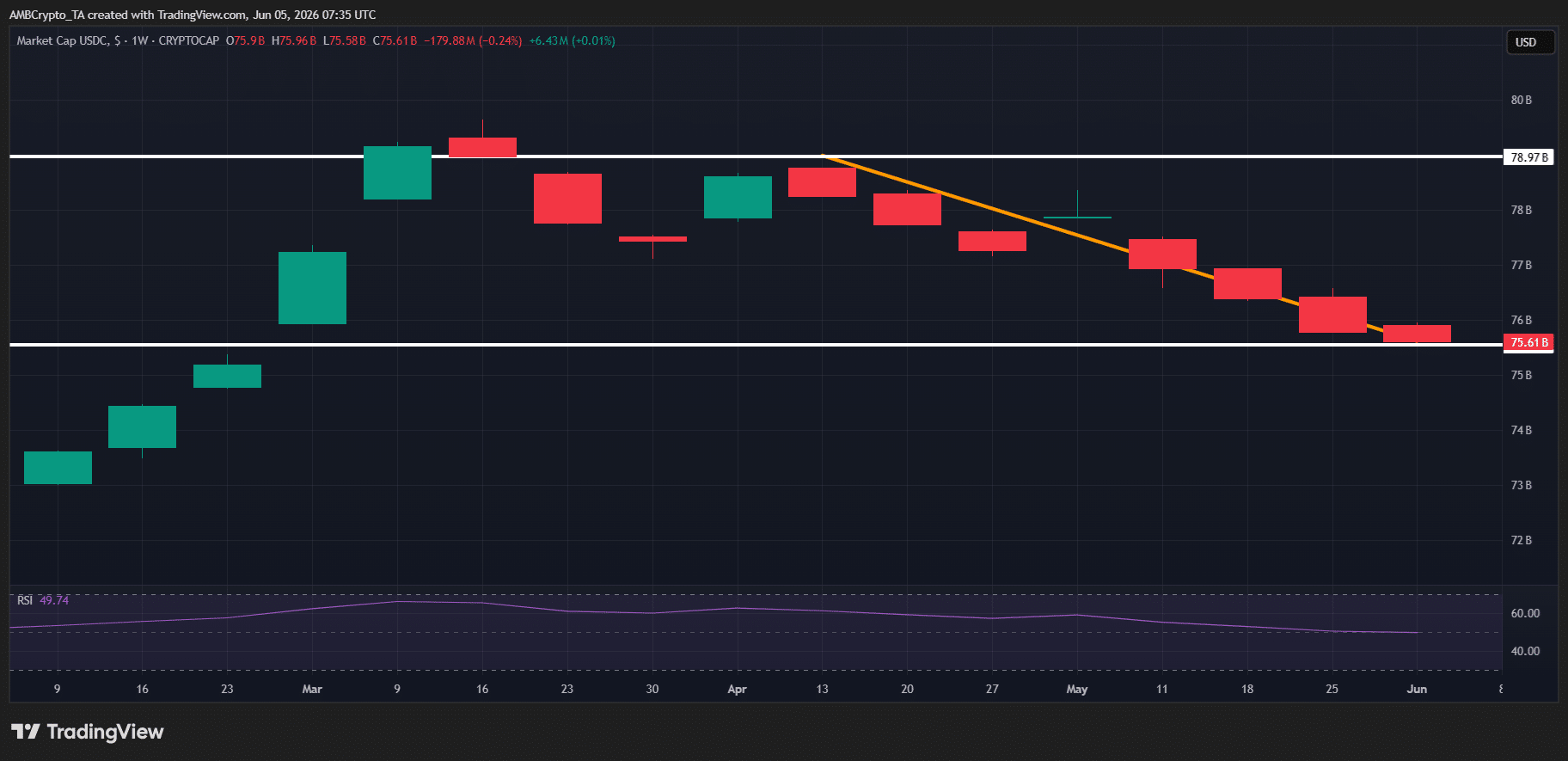
Meanwhile, USDC’s market cap has also softened, with eight consecutive weeks of outflows totaling more than $3 billion.
From a technical standpoint, this aligns with Ethereum’s [ETH] correction of over 33% from the local top at $2.4k, now testing the strength of the $1.5k support zone.
In this context, the USDC outflows suggest a broader risk-off positioning among whales, with the recent dormant whale sell-off potentially acting as a rotation into stable “dry powder” amid ETH weakness.
More importantly, this move lines up with a key technical signal. Ethereum’s daily RSI is now at its most oversold level in 7.5 years, even more extreme than prior stress events such as the COVID-19 crash, the FTX 2022 crash, and other major drawdowns.
And yet, the lack of strong buying momentum suggests that dip demand remains weak, with buyers not stepping in with conviction despite oversold conditions.
In this context, shorting ETH could be viewed as a relatively high-risk, high-reward setup, especially if spot demand fails to step in around key support levels.
Staking slowdown suggests fading Ethereum conviction
Normally, during risk-off conditions, strong long-term conviction is what tends to stand out.
The idea is simple: As the market flushes out weak hands, unwinds leveraged positions, and drives prices lower, conviction often fuels the next phase of accumulation.
This supports HODL sentiment as investors frame the drawdown as temporary while keeping long-term yield intact.
However, Ethereum’s staking flows aren’t fully reflecting that picture. Data shows demand for Ethereum staking remains elevated, with roughly 3,103,238 ETH still queued to enter the network.
That still far exceeds the 49,738 ETH waiting to exit, a gap of roughly 62x. However, that spread has started to compress, with staking entry requests trending lower since early May.
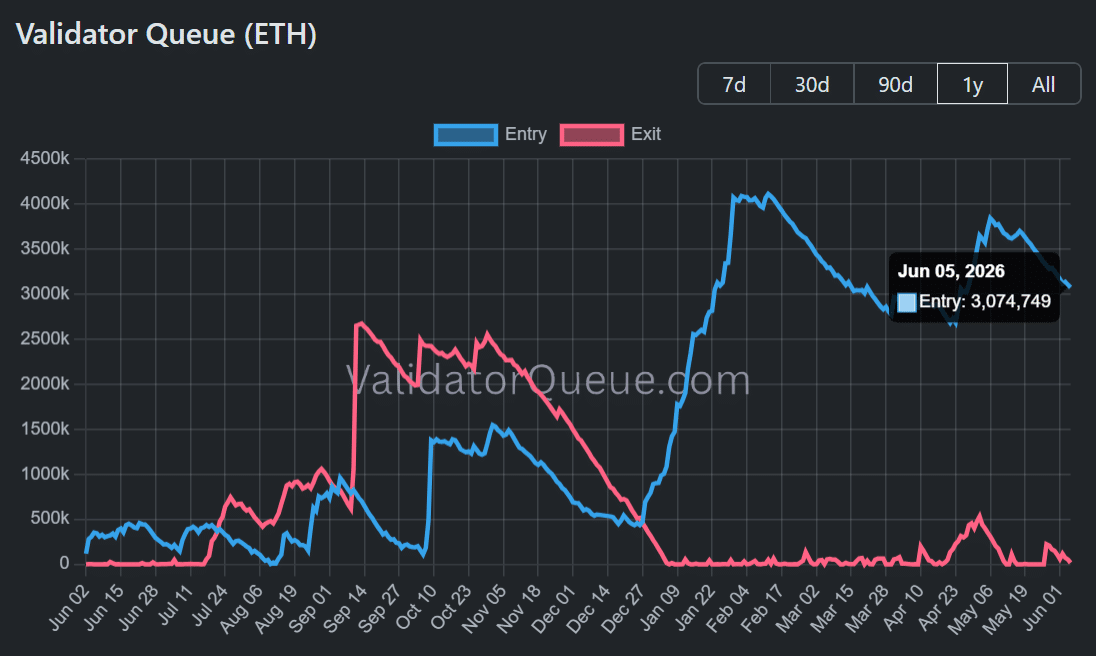
In fact, this month alone nearly 100k ETH has moved out of the staking queue.
Interestingly, this aligns with reports of over $5.8 million in profits from ETH short positions this week, highlighting where current high-reward setups are concentrated.
As a result, if leverage spikes and positioning becomes crowded, the risk of ETH breaking below the $1.5k level starts to look more plausible, with downside momentum potentially accelerating if key support fails.
Final Summary
- Dormant whale selling, weak staking inflows, and oversold RSI all point to a fragile ETH structure with weak dip demand.
- With liquidity softening and shorts performing well, ETH looks vulnerable if leverage builds and $1.5k support breaks.