
Site icon AMBCrypto

Ethereum pulls the plug on Holešky – Hoodi set to take over

Ethereum pulls the plug on Holešky - Hoodi set to take over

Ethereum pulls the plug on Holešky - Hoodi set to take over

Key Takeaways

Ethereum is phasing out its Holešky testnet as it transitions to a new, more reliable testing environment called Hoodi. The move comes ahead of major upgrades like Fusaka and Glamsterdam.


Ethereum [ETH] is preparing to say goodbye to Holešky, its biggest testnet, just two years after launch.

Developers confirmed that the network will be winding down in the coming weeks. Holešky has played a crucial role in stress-testing Ethereum’s upgrades before they hit mainnet.

But now, with its job done, Holešky is nearing retirement.

From Holešky to Hoodi

Holešky’s shutdown is part of a planned move by Ethereum developers, not a sudden decision.

The network will close about two weeks after the Fusaka upgrade is completed, in late September. Since Fusaka is set to go live on Ethereum’s mainnet in November, the testnet shutdown will happen well before then.

The foundation said,

“The network served its purpose, enabling thousands of validators to test protocol upgrades, including the Dencun network upgrade and most recently, Pectra…”

Source: blog.ethereum.org

After Holešky is retired, developers will switch to the new Hoodi testnet.
Hoodi steps in

Hoodi, launched in March, was created to avoid the technical issues Holešky faced earlier this year; like inactivity leaks that caused a big validator exit queue.

The Ethereum Foundation is now moving Holešky’s staking operators and infrastructure over to Hoodi, which already supports the Pectra upgrade and will handle future updates.

Source: blog.ethereum.org

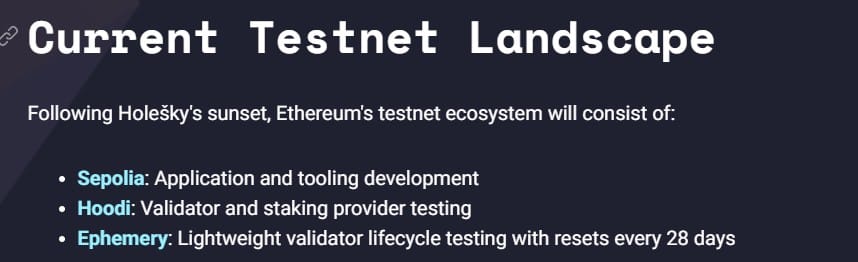
For developers building apps, Sepolia will remain the go-to testnet, while Ephemery offers short-term validator testing.

Fusaka and beyond

Ethereum’s roadmap isn’t slowing down, though!

The network’s next big milestone is the Fusaka hard fork, set for early November 2025. Short for Fulu-Osaka, Fusaka will make data access for rollups more efficient by spreading workloads across validators.

In practice, this could make nodes lighter to run, strengthen decentralization, and allow layer-2s to process transactions faster and cheaper.

Looking further out, the Glamsterdam upgrade is penciled in for 2026. Under EIP-7782, it could cut block times to six seconds and adjust validation to better support a zero-knowledge proof system.

Exit mobile version