Ethereum’s staking surge: Is Pectra attracting more than just retail investors?
The Pectra effect started long before the upgrade's May launch.



- ETH staking flipped from outflows to inflows right after Pectra’s February announcement — not at launch.
- Inflows hint at early institutional alignment with Ethereum’s yield-friendly, validator-focused future post-upgrade.
Ethereum [ETH] enthusiasts had been counting down to the Pectra upgrade, anticipating that its validator-friendly changes would reshape staking dynamics.
But the shift began earlier than expected — not at launch, but from the moment Pectra’s roadmap was announced in mid-February.
A recent report revealed that ETH staking flipped from months of outflows to net inflows almost immediately after the upgrade was announced.
Now that Pectra is officially live, the rebound raises a bigger question: is this just a short-term reaction, or the first signal of growing institutional confidence in Ethereum’s yield and infrastructure story?
Staking timeline

From the 16th of November to the 15th of February, staking participation declined notably — from approximately 34.88 million ETH to 33.86 million ETH.
That 1.02 million ETH outflow reflected market jitters, likely stemming from regulatory pressures and the broader risk-off sentiment that dominated Q1.
But the announcement of Pectra around mid-February altered that trend. From the 16th of February to the 16th of May, ETH staking rebounded with a net inflow of 627,000 ETH.
You can’t ignore the timing — Ethereum’s validator-centric upgrades, including EIP-7002’s flexible withdrawal credentials, landed well with the ecosystem and may have reassured more sophisticated stakeholders.
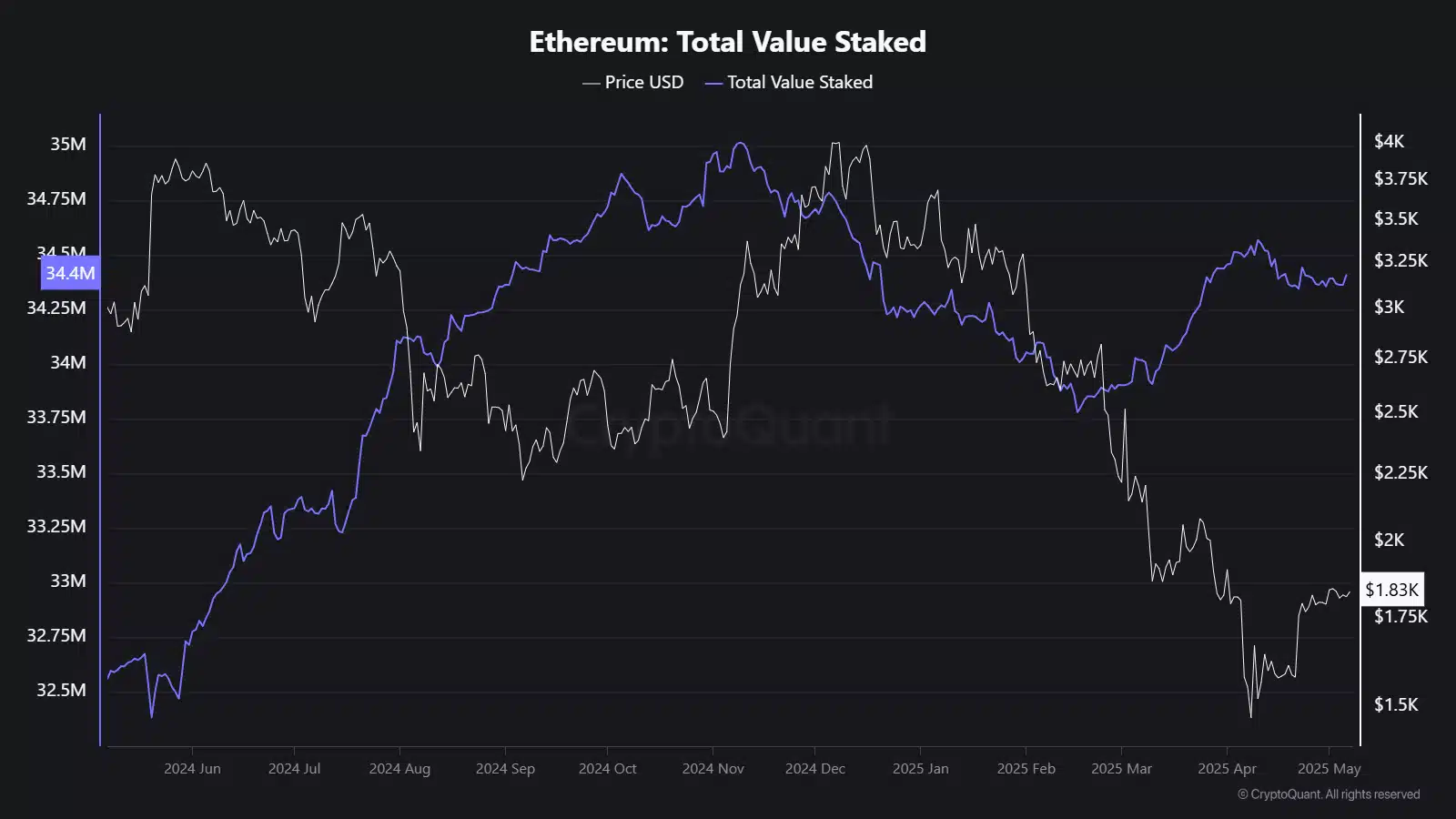
Staking inflows could signal growing institutional trust
Staking inflows often mirror behavioral shifts. And Ethereum’s recent trends suggest more than just a retail return.
The restoration of confidence in the staking system points toward a shift, possibly from institutions exploring or preparing for Ethereum’s post-upgrade profile.
Key staking milestones — like the Shanghai and Pectra upgrades — have historically driven ETH flows.
Around each, we’ve seen positioning shift weeks before the technical rollout, showing the market’s forward-looking approach.
With ETFs now in play and staking mechanics becoming more flexible, Ethereum’s design is increasingly friendly to large capital allocators.
The yield narrative
Ethereum’s native yield — through staking — has always been a central narrative. Now, with Pectra in place, that narrative gains credibility and structure.
The reduced operational friction, paired with protocol-level improvements, may attract further inflows.
While current inflow volumes aren’t explosive, they’re directionally important.
A slow but steady climb in staked ETH hints at a maturing market reassessing Ethereum’s yield potential — not just as a retail yield farm, but as a strategic, regulated, and ETF-compatible yield product.