



Fold, a Bitcoin treasury firm, sold roughly $45 million worth of Bitcoin [BTC] at an average price of about $71,000 per BTC as part of a strategic balance-sheet restructuring move.
Instead of just keeping its Bitcoin treasury, the business decided to turn some of its cryptocurrency holdings into cash.
It used $20 million of the proceeds to pay off its secured debt backed by Bitcoin in full. The remaining $25 million was kept in cash with no restrictions.
Has Fold offloaded all its Bitcoin stash?
Additionally, Fold stressed that it still has a sizeable Bitcoin treasury, which means it can profit from future long-term BTC growth and can sell off additional holdings if favorable investment opportunities present themselves.
However, if compared to big Bitcoin DATs, Fold just holds 192 BTC worth $12.1 million, according to BitcoinTreasuries.NET.
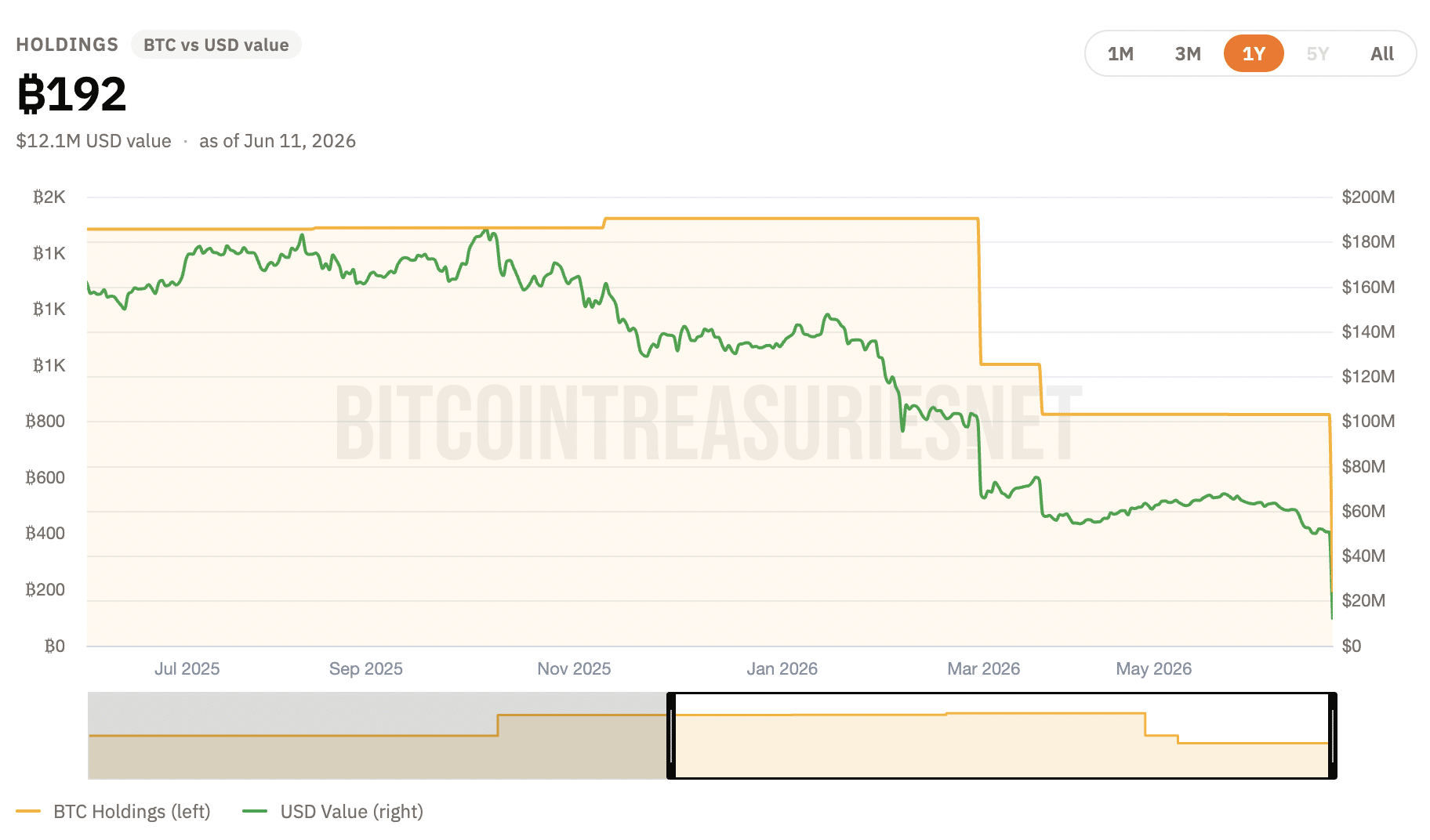
Remarking on the same, Will Reeves, Chairman and CEO of Fold, said,
We have reduced financing risk, strengthened our balance sheet, and ensured that short-term market volatility cannot stand in the way of executing our roadmap.
What’s behind this sudden sell-off?
For its part, Fold’s $20 million debt was a calculated financing choice rather than the direct result of financial difficulties.
As a financial services firm that specializes in Bitcoin, Fold had amassed a sizeable Bitcoin treasury and, like many other companies in the cryptocurrency space, decided to borrow against those holdings rather than liquidate them.
This kept the business exposed to Bitcoin’s possible growth while enabling it to obtain funding for operations, product development, and expansion plans.
Bitcoin-backed loans do, however, have interest fees and can become riskier when the market is volatile.
Now that it has sold some of its Bitcoin holdings and paid off the debt, Fold is free of those responsibilities, interest payments, and financing risks associated with fluctuations in the price of Bitcoin.
It also has more flexibility to invest in growing products like its Bitcoin Credit Card and business services.
Good timing or a miscalculated step?
This occurred as Bitcoin was trading at $62,742.09, up 1.92% over the previous day but down more than 22% over the previous month.
Given the timing, it appears that Fold’s choice was influenced less by the current price of Bitcoin and more by risk management and growth planning.
The monetization probably took place before Bitcoin’s drop toward the $61,000 range, as the company revealed that it sold its Bitcoin at an average price of about $71,000 per BTC.
Fold was able to raise more money for expansion and pay back its $20 million Bitcoin-backed debt by locking in gains at higher levels.
This is not an isolated incident, as on the 9th of May, DeepBook’s USDC margin pool became undercollateralized, causing its leveraged trading infrastructure to come under increasing strain. The imbalance resulted in bad debt of almost $239,700.
Final Summary
- Despite selling roughly $45 million worth of Bitcoin, Fold stressed that it still has a sizeable Bitcoin treasury.
- Though Fold’s $20 million debt might look like a direct result of financial difficulties, it’s actually a calculated financing choice.