How Quack AI’s 22% price crash puts Q’s $0.06 support in focus
Quack AI's weakening RSI and loss of key support raised the risk of further declines toward $0.06.



Quack AI [Q] suffered a deep market correction, losing 21.71% of its recent gains within 24 hours at press time, as its trading activity also weakened across the markets. The rapid price depreciation pushed Q to $0.09324, raising concerns about further losses.
The token’s trading activity also declined considerably, with its 24-hour spot volume dropping 22.44% to $26.41 million. This simultaneous decline in price and volume implied a weakening market participation as Q corrected from its recent highs, above $0.13 earlier in October.
As the sellers took over control, the downturn notably extended into the derivatives markets, as market participants also limited their exposure.
Q derivatives shrink as OI plunges
The derivatives market also registered a considerable contraction, which validated the broader decline in trading activity.
According to CoinGlass derivatives data, trading volume fell 17.70% to $161.63 million as of writing, highlighting limited participation in leveraged trading. On the other hand, the Open Interest (OI) dropped 32.21% to $37.05 million, suggesting a rapid reduction in prevailing futures positions.
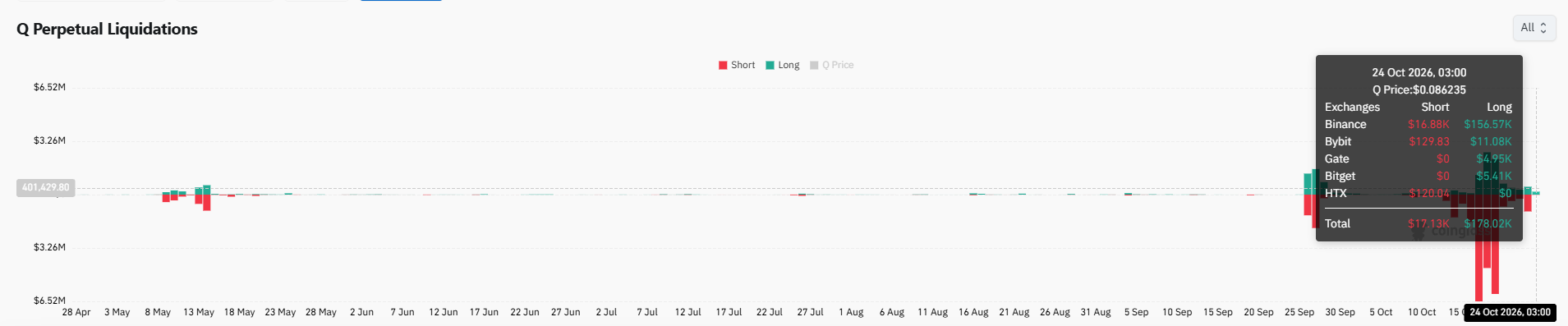
Generally, such a significant decline, together with the falling prices, indicated that traders were closing positions instead of aggressively opening new ones. To be specific, leveraged long positions may have faced pressure during the decline, with long liquidations hitting $178.02K against just $17.13K in short liquidations.
Meanwhile, the reduction in prevailing positions additionally coincided with a notable shift in positioning among Binance’s top traders.
Binance top traders favor shorts over longs
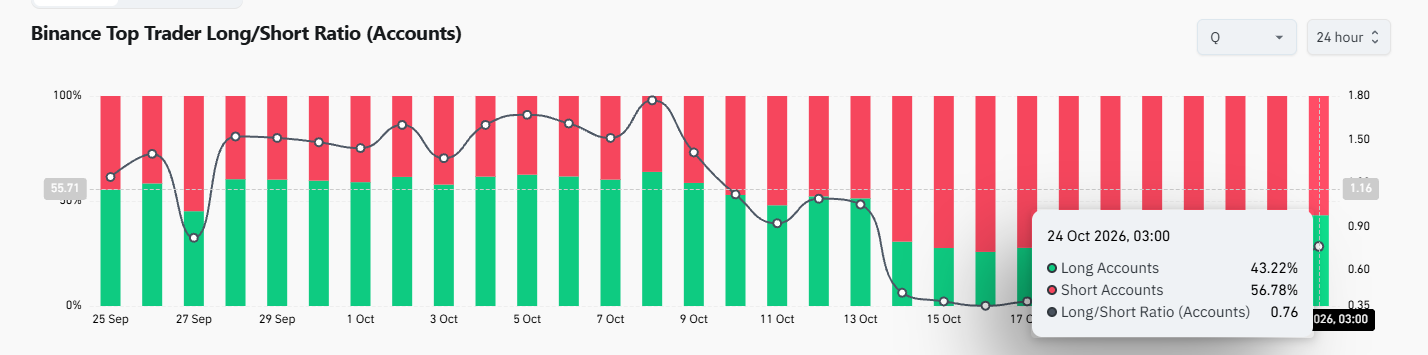
Accordingly, Binance’s top trader’s Long/Short Ratio suggested a clear bearish bias as short accounts gained the upper hand.
At the time of writing, the short accounts accounted for 56.78% of top traders, while long accounts accounted for 43.22%, bringing the ratio to 0.76. This recent reading highlighted a notable departure from early October, where the long accounts consistently preserved the majority.
The ratio, in fact, previously climbed above 1.50 before declining rapidly during the second half of the month. Therefore, this shift reflected a growing bearish sentiment among the top traders as Quack AI extended its price decline.
What do Q’s charts reveal?
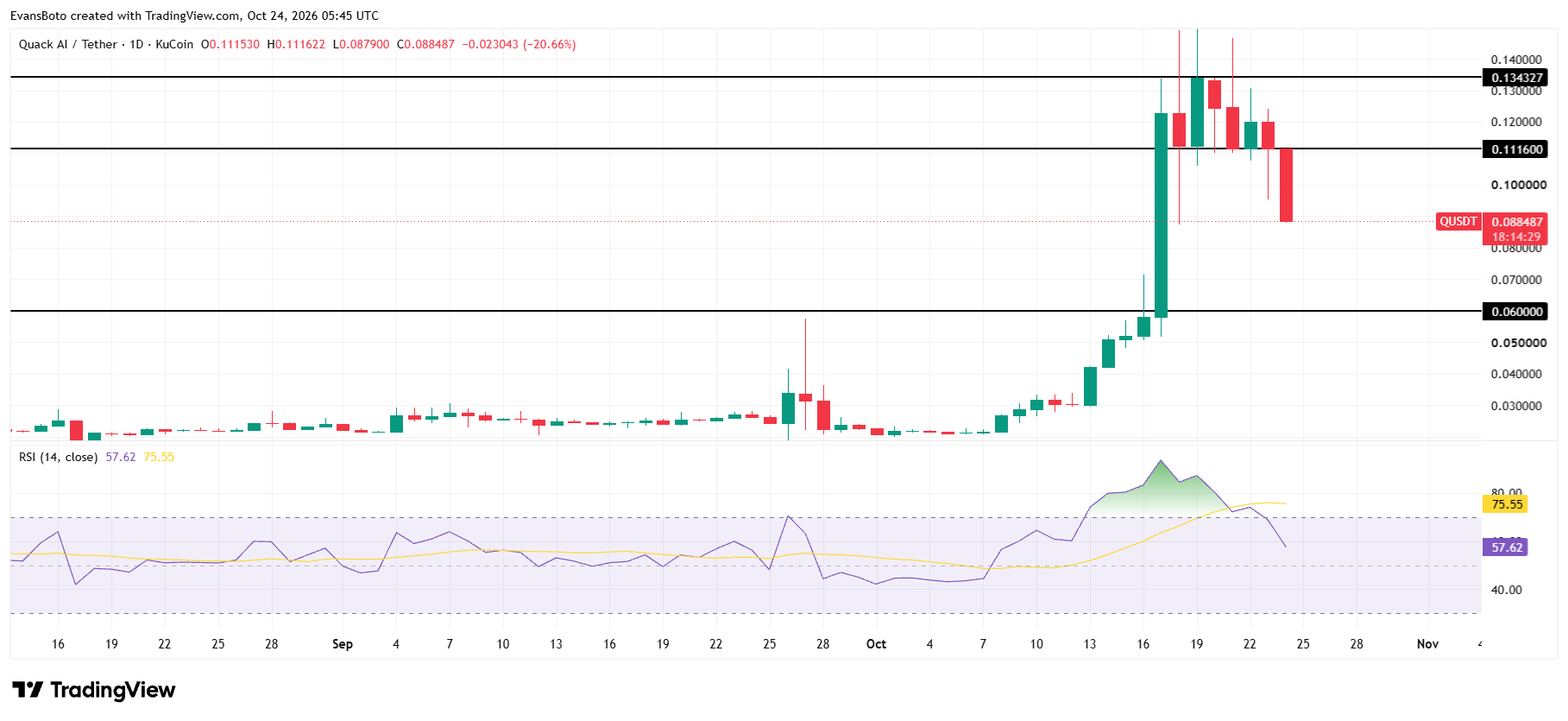
Q’s daily technical structure highlighted a sharp price reversal after the token faced resistance around the $0.134327 area.
After several unsuccessful recovery prospects, the bears pushed the price below the $0.111600 level, flipping this former support into resistance. The recent daily candle notably extended losses towards the $0.088487 area, while its intraday low had reached $0.087900 at press time.
Meanwhile, the RSI indicator dropped to 57.62 as of writing, as it retreated from its previous overbought territory. Its decline below the RSI moving average of 75.55 further highlighted weakening buying strength.
Even though the indicator remained above the neutral 50 level, the steep downturn suggested that the bullish control was drastically weakening. The persistent selling pressure below the recent low therefore could deepen the price correction, potentially exposing the distant $0.060000 support unless buyers step in aggressively.
Final Summary
- Quack AI’s 21.71% decline triggered heavy long liquidations as derivatives traders reduced their exposure.
- Q lost $0.1116 support, with a weakening RSI leaving further declines toward $0.06 possible.