Inside BC token’s economic model: How BC Engine connects users, rewards, and ecosystem growth


Platform tokens have long been a staple of the crypto industry; however, their role and the conversations around them have gradually shifted past simple price movements and market speculation. Increasingly, projects are exploring ways to give their native assets a more meaningful role within their ecosystems, connecting them to user participation, platform activity, and long-term engagement rather than treating them solely as tradable tokens.
BC.GAME has adopted this approach. Since its launch in 2017, the platform has developed an ecosystem that integrates blockchain technology with casino games, sports betting, esports, original titles, and crypto-based rewards. Its native token, BC Token ($BC), sits at the center of this ecosystem, underpinning the platform’s reward and participation model. Supported by BC Engine, the platform’s main participation and reward system, and an economic model that connects user activity, rewards, and ecosystem growth, $BC is designed to play an active role within the platform rather than exist solely as a tradable asset. Together, these mechanisms offer a closer look at how BC.GAME is developing a powerhouse strategy to make its token more than just another tradable asset.
About BC.GAME
Founded in 2017, BC.GAME is a crypto-native online entertainment platform that leverages blockchain technology to offer casino games, sports betting, esports, and original titles. The name “BC.GAME” reflects its blockchain foundation and iGaming focus. Today, BC.GAME is a leading crypto iGaming platform with over 9 million registered users, support for more than 165 cryptocurrencies, and a library of over 10,000 games.
From the very beginning, BC.GAME has always viewed digital assets as more than an alternative payment method, using blockchain technology to enhance transparency, efficiency, and user engagement. The platform focuses on linking user participation to platform growth and ecosystem value, rather than viewing players solely as customers. This approach led to the development of the BC Token ($BC) and BC Engine, which form the core of the platform’s ecosystem.
Why BC.GAME created the $BC token
BC.GAME’s decision to launch a native token didn’t happen overnight. By the time BC.GAME introduced its native token, $BC, at the end of 2024, the platform had already spent several years building a crypto-native iGaming ecosystem around blockchain payments, digital assets, and on-chain participation. In many ways, the token was a natural next step rather than a standalone product launch.
From the beginning, BC.GAME’s view was that cryptocurrencies could play a much bigger role than simply helping users deposit and withdraw funds. As the platform grew, so did its reward systems, community initiatives, and user base. Introducing $BC created a common asset that could tie the different parts of the ecosystem together, giving users a more direct connection to platform activity rather than limiting the token’s role to trading alone.
Today, $BC sits at the center of that ecosystem. It underpins platform rewards, staking, and participation, while also supporting a broader economic model that connects user activity, engagement, and long-term ecosystem growth. Instead of being a separate token, $BC is part of the user experience. This role is especially clear with BC Engine and its supporting features.
BC Engine: BC.GAME’s reward
BC Engine is BC.GAME’s main participation and reward mechanism, in which users earn, stake, and receive rewards through the $BC. Introduced in April 2026, BC Engine makes the platform’s native token more than just a one-time incentive by integrating it more deeply into the wider ecosystem.
The way BC Engine works reflects that objective. Users earn $BC through eligible activity on the platform, and those tokens are automatically allocated into BC Engine. From there, they become part of the platform’s reward system, with rewards distributed based on users’ holdings at each settlement. Rather than treating rewards as the end of the user journey, the mechanism is designed to encourage continued participation by giving users an ongoing role within the ecosystem.
That distinction is key to BC.GAME’s broader vision for $BC. Instead of functioning purely as a reward token or a tradable asset, the token becomes part of a continuous cycle that connects platform activity, user participation, staking, and reward distribution. As users remain active and continue participating through BC Engine, $BC circulates more naturally within the ecosystem, reinforcing the platform’s focus on long-term engagement rather than one-off incentives.
The model has already begun to take shape in practice. Since its launch, BC Engine users have received more than 3.17 million $BC in cumulative rewards, which is equivalent to approximately $3.17 million. While the figures show the scale of activity within the system, they also illustrate the underlying idea behind BC Engine: creating an ecosystem in which participation is designed to generate ongoing value rather than ending with a single reward.
Understanding BC.GAME’s three-layer economic model
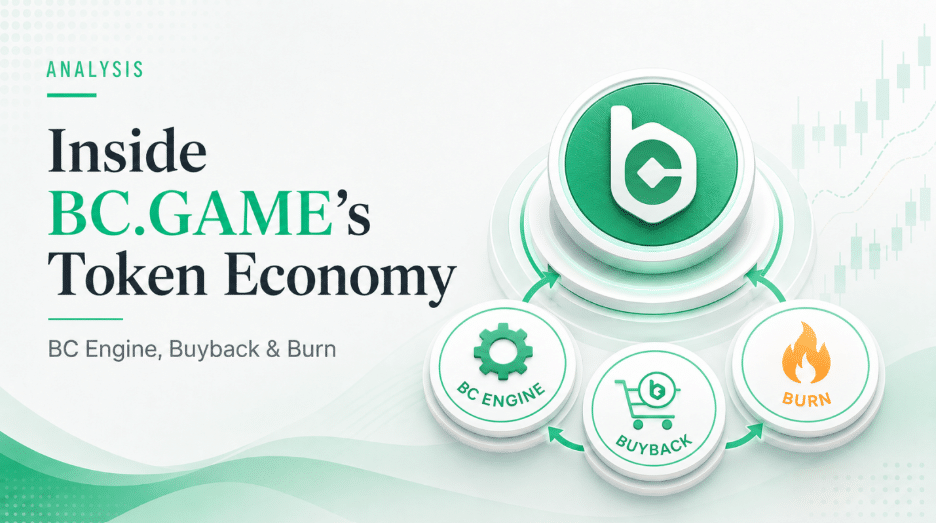
BC Engine, BC.GAME’s participation and reward mechanism introduced the participation layer of the platform’s ecosystem, but it represents just one part of the platform’s broader token economy. To support how $BC moves through the ecosystem over time, BC.GAME has built its model around three interconnected layers, each designed to connect user participation, token utility, and long-term ecosystem development.
Layer one: BC Engine, the participation layer
As the first layer of the model, BC Engine connects gameplay activity, $BC accumulation, staking, and reward distribution. It gives the token an active role after it’s earned, allowing users to continue participating in the ecosystem rather than treating rewards as a one-off incentive. In doing so, BC Engine establishes the link between platform activity and token utility that creates the foundation for the wider economic model.
Layer two: Buyback, the value recycling layer
The second layer shifts the focus from participation to value circulation. Activated on June 1, BC.GAME’s buyback mechanism has operated daily, executing up to 72 purchase cycles based on platform activity instead of fixed price levels.
One of the more notable aspects of the mechanism is what happens after the buyback. Rather than removing the repurchased $BC from circulation, the platform redistributes those tokens to active users as instant rewards. In effect, value generated through platform activity is channeled back into the ecosystem, reinforcing the connection between engagement, rewards, and the wider ecosystem.
Layer three: Burn, the supply management layer
The final layer focuses on managing token supply. Unlike the buyback mechanism, the burn process operates independently and is triggered by user behavior within BC Engine. If users unstake their $BC before completing the required seven-day staking period, a 1% fee is applied, with those tokens entering the burn mechanism.
By tying the burn process to early unstaking, BC.GAME has separated supply management from its reward and buyback systems while encouraging longer-term participation within BC Engine. Together, the three layers each perform a distinct function, but they’re ultimately designed to support the same goal.
How the ecosystem works together
Rather than operating as standalone features, BC Engine, the buyback mechanism, and the burn mechanism are designed to function as parts of a single ecosystem. Platform activity allows users to earn $BC. BC Engine connects those tokens to ongoing participation and reward distribution; the buyback mechanism returns ecosystem-generated value to active users; and the burn mechanism supports long-term supply management. Together, they connect platform performance, user participation, token utility, reward distribution, and supply management within a single economic model.
The result is a system where each layer complements the others. Instead of rewarding activity in isolation, BC.GAME’s approach is designed to keep participation, value circulation, and supply management working in tandem, with each mechanism reinforcing $BC’s broader role across the ecosystem.
The bottom line
BC.GAME’s token design goes beyond simply launching a native asset or reward features. Using BC Engine, buyback, and burn mechanisms, the platform has established an economic model that links platform activity, user engagement, reward distribution, and supply management within a unified ecosystem.
As platform tokens evolve, projects are now assessed by the practical role their assets serve in circulation. For BC.GAME, $BC remains integrated with the platform through ongoing participation, providing utility beyond trading and supporting daily ecosystem operations.
For more information about BC.GAME, please visit their official website: https://bc.game/
FAQs
What is BC Token ($BC)?
BC Token ($BC) is the native token used across BC.GAME. It was designed to support active, continuous participation by connecting users to rewards and staking, rather than simply functioning as a tradable asset.
What is BC Engine?
BC Engine is the main way users take part and earn rewards on BC.GAME. When users join eligible activities, they earn $BC, which the system automatically adds to their account. These tokens let users join regular reward distributions, based on how many tokens they have at each settlement. By connecting rewards to user activity, BC Engine helps make the platform’s token a bigger part of the BC.GAME experience.
What can BC Token ($BC) be used for?
$BC can be used in several ways on the platform. You can use it to place bets, stake it through BC Engine to earn rewards, trade it on supported on-chain markets, and unlock benefits like VIP features and other incentives. As BC.GAME grows, the team plans to add even more uses for the token.
How are BC Engine rewards distributed?
Users can earn $BC by participating in specific activities on BC.GAME. Once they earn tokens, they are automatically added to BC Engine. Rewards are paid out on a set schedule, and how much a user gets depends on how many BC Tokens they hold in the system. This setup is designed to keep users engaged over time, not just for a single reward.
How does BC.GAME’s three-layer economic model work?
BC.GAME’s token economy has three main parts that support users and help the ecosystem grow.
- First, BC Engine connects your activity to BC Token ($BC) rewards.
- Second, the buyback system gives tokens bought back by the platform to active users instead of removing them.
- Third, the burn system controls the token supply by charging a 1% fee if you unstake your BC Tokens before seven days. Together, these parts link platform activity, user rewards, token use, and supply management.
Disclaimer: This is a paid post and should not be treated as news/advice.