Is Ethereum’s retail influence fading? What the data says
Ethereum increasingly evolved into institution-driven infrastructure as retail conviction weakened.



Ethereum’s [ETH] supply conditions increasingly tightened as institutional buyers accelerated accumulation across shrinking exchange liquidity throughout 2026.
Market behavior also shifted gradually because larger capital pools now absorb ETH faster than the available supply replenishes exchanges.
BitMine later accumulated well over 5 million ETH, representing roughly 4.5% of the circulating supply beneath current conditions. Weekly purchases also frequently exceeded 40,000 to 100,000 ETH, while exchange reserves hovered near multi-year lows.

That imbalance increasingly reflected ETH migrating toward staking, treasury reserves, and long-term institutional custody structures. Meanwhile, cumulative Spot ETF inflows surpassed roughly $11 billion, reinforcing sustained demand beneath tightening liquidity conditions.
However, concentrated institutional ownership may also amplify future volatility if larger buyers eventually reduce accumulation pace or begin distributing supply into weaker markets.
Ethereum staking tightens supply-side market structure
That tightening supply structure increasingly extended beyond institutional accumulation as staking participation steadily removed ETH from actively tradable circulation.
Market participants also started recognizing how reduced liquid supply could intensify future price reactions during stronger capital inflows.
Ethereum’s staking market capitalization later stabilized near roughly $82.7 billion while controlling nearly 53.5% of broader Layer-1 staking dominance.
More than 39 million ETH also moved into staking contracts, locking nearly 30% of circulating supply beneath current conditions.

That migration increasingly reduced liquid exchange balances as long-term holders prioritized staking rewards over active market rotation.
Meanwhile, shrinking tradable supply strengthened Ethereum’s sensitivity to demand shocks because fewer coins remained available across exchanges.
Still, lower liquidity and concentrated staking participation may also amplify sharper volatility if broader market sentiment weakens suddenly.
Retail conviction weakens as value capture shifts beyond ETH
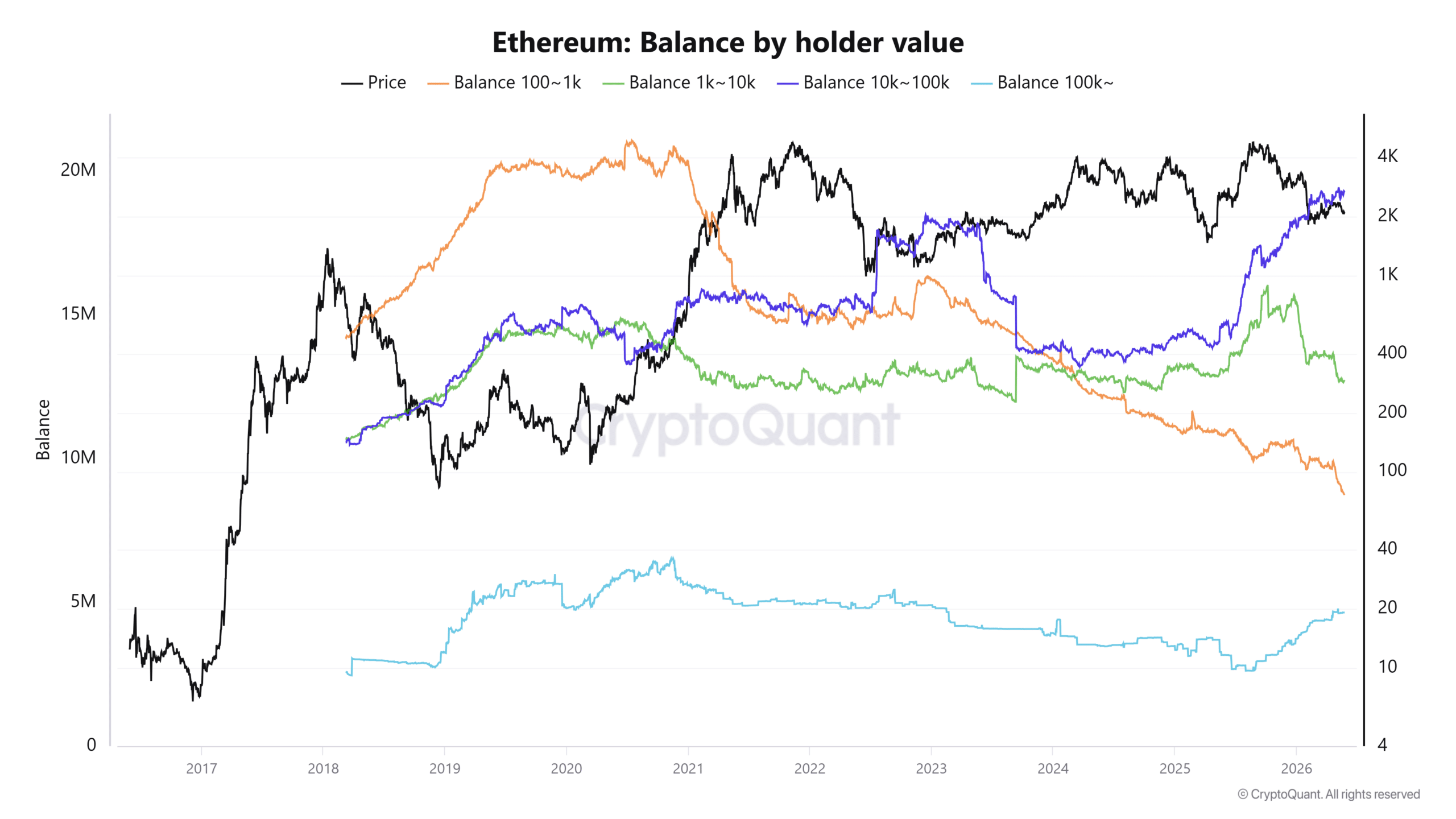
Ethereum’s holder structure increasingly shifted away from retail dominance as smaller wallets steadily reduced exposure throughout recent market cycles.
Market behavior also changed because growing Ethereum adoption no longer translated directly into stronger ETH accumulation narratives.
Wallets holding between 100 and 1,000 ETH later dropped to roughly 8.75 million ETH from nearly 16.2 million during 2023 peaks.