‘Issuers should have control’ – Robinhood CEO defends tokenized stocks
But is Robinhood actually taking too much control over tokenised stocks?


A new kind of debate has surfaced in the crypto community, which revolves around tokenisation of stocks.
Robinhood CEO Vlad Tenev argues that public companies should not automatically control blockchain products referencing their shares. The dispute followed AMC CEO Adam Aron’s criticism of Robinhood’s tokenised AMC exposure.
What upset AMC’s CEO?
This comes after AMC CEO Adam Aron slammed Robinhood for creating tokenised AMC exposure without AMC’s approval. From AMC’s perspective, this can look like Robinhood is effectively creating a new way for people to invest in AMC without AMC having a direct relationship with those investors.
Expressing frustration on the matter, Aron took to X last week and said,
I find this practice to be contemptible, outrageous, disgusting, detestable, inexcusable, vile. How can it possibly be legal? We have no connection to this at all, and do not condone it in any way.
Robinhood CEO’s stance on tokenisation
However, Tenev has defended his stance in a recent conversation with CNBC’s Squawk Box when he said,
Issuers should have control and do have control over the rights and obligations of the stock that they issue, but that doesn’t mean they control everything about it. In particular, they don’t control other companies issuing their own securities that reference those shares.
Here, his argument is simply based on the fact that once a company’s shares are publicly traded, investors who own those shares have certain property rights.
Tenev argued that blockchain distribution should not give the original company additional veto powers. Under Robinhood’s structure, each token represented a separate instrument backed 1:1 by shares held within traditional markets.
However, besides Aron, Fairmint co-founder and CEO Joris Delanoue also took to X to slam Tenev when he said,
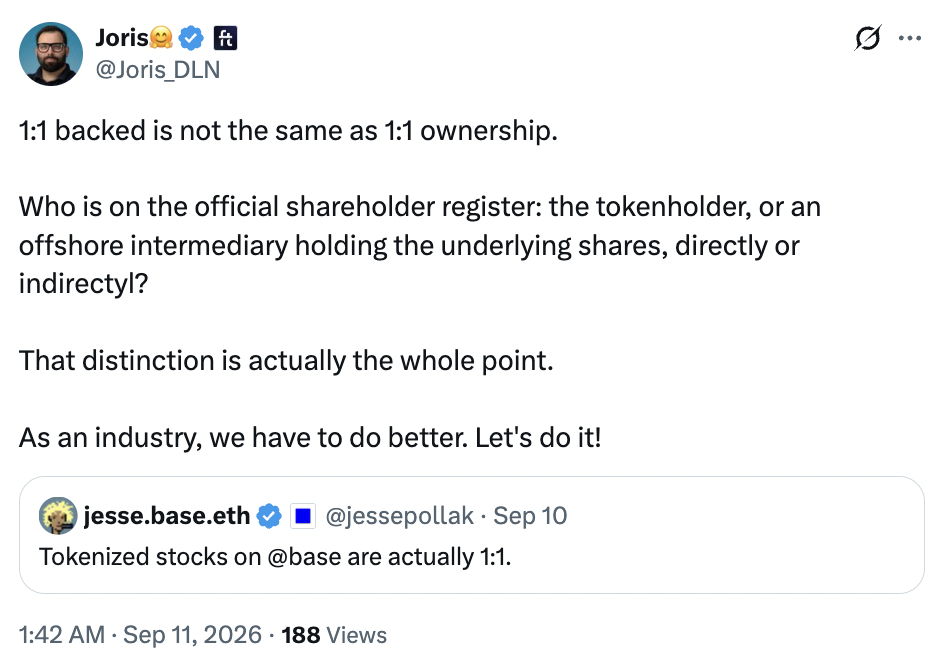
All about Vlad Tenev’s idea on tokenisation
Hence, amidst such criticisms, Tenev has therefore proposed a basic test. Wherein, the issuer approval should be necessary if the token actually changes the rights associated with the underlying stock.
But if the token is simply a separate financial instrument backed by existing shares and doesn’t modify those underlying rights, Tenev says the issuer’s permission shouldn’t automatically be necessary.
Issuer consent depends on what exactly you’re doing and in the case of Robinhood stock tokens – which are tokenised securities that are issued by a separate entity that are backed by underlying shares – those should not automatically require issuer consent.
Traditional vs. digital recordkeeping
Tenev also argues that tokenisation could make U.S. stocks accessible to people around the world.
To make things more clear, he even referred to the 1960s paperwork crisis wherein the U.S. securities industry struggled because enormous amounts of stock certificates had to be physically processed. As a result, the industry eventually moved toward electronic recordkeeping and book-entry settlement.
This coincided with the SEC’s new proposal to allow blockchain ledgers to become the official legal record of securities ownership, potentially replacing the need for separate on-chain and off-chain ownership records.
Final Summary
- AMC CEO slammed Robinhood for creating tokenised AMC exposure without AMC’s approval.
- Robinhood CEO Vlad Tenev believes that the issuer approval should be necessary.