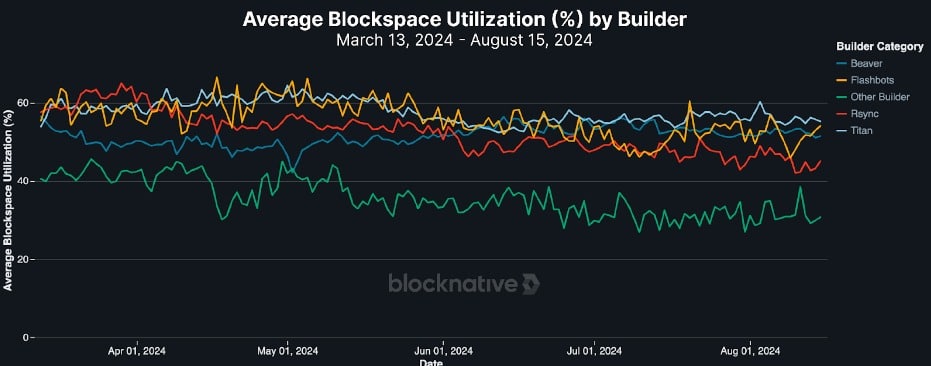
More Ethereum users turn to private transactions: Effect on ETH?
Ethereum users are turning to private transactions to avoid frontrunners. How is this affecting ETH?



- ETH users turn to private transactions over frontrunning
- Private transactions comprised 30% of the total volume, but consumed 50% of Ethereum’s gas.
Throughout the year, crypto markets have experienced significant changes, development, and increased volatility.
Amidst these market changes, Ethereum [ETH] has witnessed growth in network activity, revenue, and address. Equally, the past year has seen a considerable surge in private transaction order flow.
Ethereum users prefer private transactions
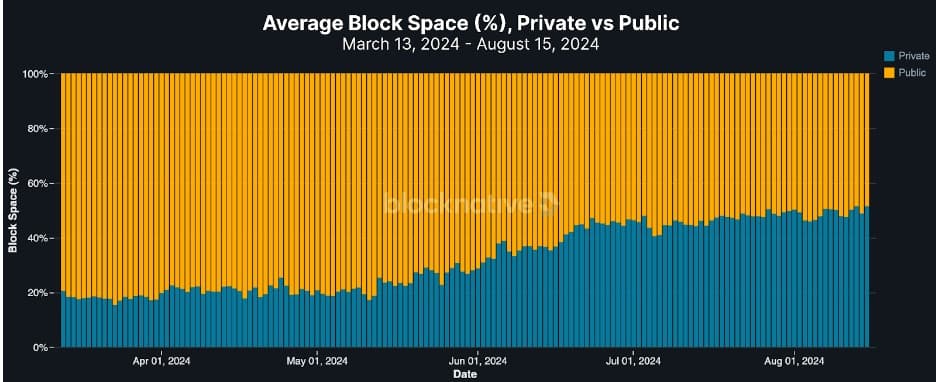
According to research by Blocknative, the Ethereum network has witnessed a high increase in private transaction order flow.
Data indicated that private transactions consumed more than 50% of total ETH L1 block space based on gas usage. But despite this, private transactions only make up 30% of all transactions within the ETH L1 block.
Users choose to transmit transactions privately for MEV protection, especially when conducting complex transactions.
Such transactions are essentially gas intensive and thus consume more gas per transaction than non-MEV transactions.
Essentially, gas used directly relates to the economic value of block space. Therefore, every unit of gas represents a share of the block’s capacity and economic growth.
Base fees volatility increases
The increase in private transactions and gas use has affected ETH’s base fees. The 2021 EPI-1559 upgrade changed the dynamic base fees, which would change based on the space’s size.
Therefore, the increased private transactions have influenced base fees, increasing volatility. Therefore, private transactions result in “vanilla blocks,” making the base fees volatile.
Such volatility is a disadvantage for network users, as increased private transactions affect base fees, especially when dealing with major users such as Titan, Rsync, Beaver, and Flashbots.
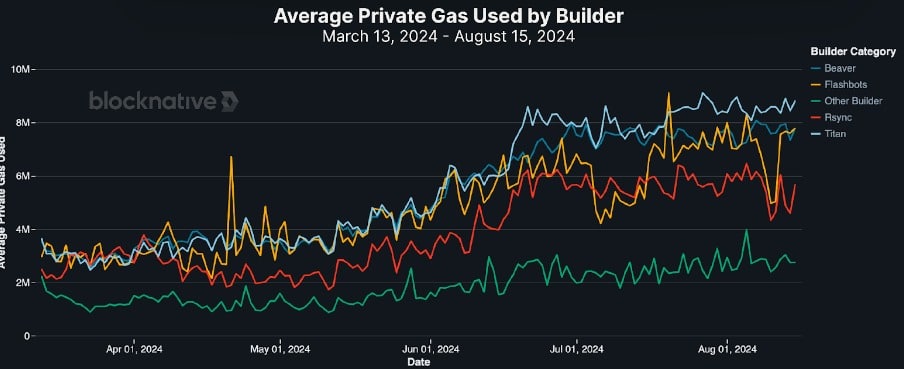
For instance, top builders have increased their private transactions throughout the year.
As reflected in the chart above, Titan increased their gas usage from 3.5 million to 8.5 million through private transactions from March.
Is your portfolio green? Check out the ETH Profit Calculator
Other top players, such as Beaver, have increased their usage from 3 million to 7.5 million, and Rsync from 2.5 million to 6 million.
This surge has huge implications, pushing many users out of the game. This is evident as small builders are declining gas usage as most struggle to reach 15 million set by the 2021 EIP-1559 upgrade.