


Stablecoin supply is expanding rapidly across the XRP Ledger [XRPL], strengthening the financial infrastructure underpinning Ripple’s [XRP] ecosystem. For much of 2025, capitalization remained below $100 million, suggesting liquidity growth was still limited.
That changed in November when supply pushed above $200 million and entered a sustained expansion phase. Growth continued into 2026, lifting stablecoin capitalization to roughly $762 million, including a 22% increase in recent weeks.
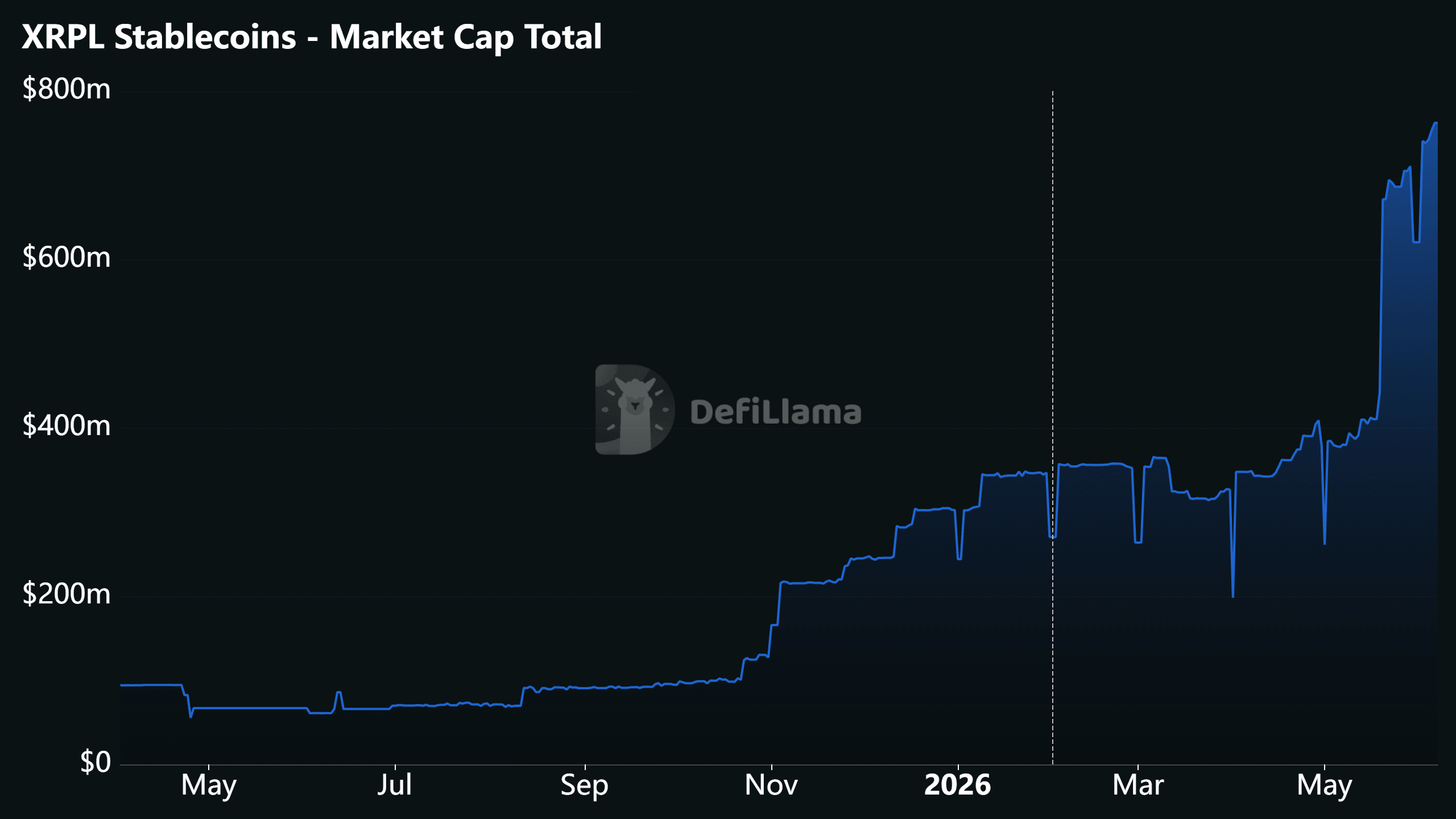
Ripple USD [RLUSD] has driven most of that growth, reflecting rising demand for on-ledger settlement liquidity. As more capital remains within the XRP ecosystem, payment and settlement activity can scale more efficiently. If supply keeps rising, network utilization may follow.
XRPL’s RWA expansion gains momentum
XRPL’s tokenization push is gaining momentum as more capital and assets move onto the network. The represented asset value has reached $3.57 billion, while the distributed on-chain asset value stood at $385 million. That growth indicated that institutions are increasingly using XRPL for asset issuance rather than payments alone.
Recent institutional pilots reinforce that trend. Ondo Finance’s tokenized U.S. Treasury redemption test involved JPMorgan’s Kinexys platform, Mastercard, and Ripple. XRPL facilitated tokenized asset transfers, while cash settled off-chain.
The pilot highlights growing interest in using XRPL for tokenized financial infrastructure. Supporting this shift, stablecoin capitalization surged 77% to $888.5 million, while transfer volume jumped 123% to $4.71 billion over the past month.
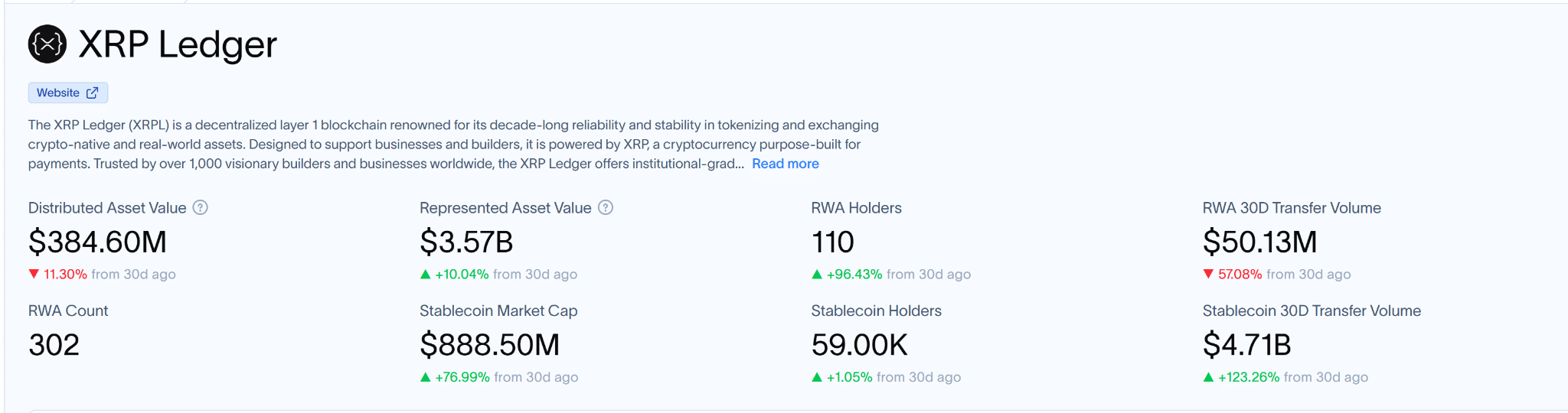
Those flows provide the liquidity needed for settlement and asset transfers. However, RWA holders rose to just 110, indicating adoption still lags issuance. The challenge is no longer creating tokenized assets but attracting enough capital and participants to use them.
XRPL’s growth is no longer coming from payments alone. Stablecoins, tokenized assets, and other financial applications are beginning to occupy a larger role across the network. That shift suggests usage is gradually broadening beyond its traditional cross-border settlement focus.
While payments remain the foundation, newer sources of activity are expanding alongside them. If that trend continues, XRPL could generate a larger share of network demand from financial services rather than transaction processing alone. The pace of that transition will likely determine how quickly the network evolves beyond its payment’s identity.
Final Summary
- XRPL stablecoin liquidity continues expanding, strengthening the network’s role as a settlement layer for financial activity.
- XRPL tokenization growth is accelerating, though broader adoption must catch up with asset issuance to sustain momentum.