


A network proves its strength by processing transactions efficiently.
Solana’s latest milestone reinforces that. With the Alpenglow upgrade, Solana reduced finality to 100–150 ms, allowing the network to confirm transactions instantly and move closer to Web2-level responsiveness.
Notably, those improvements are already translating into higher network activity.
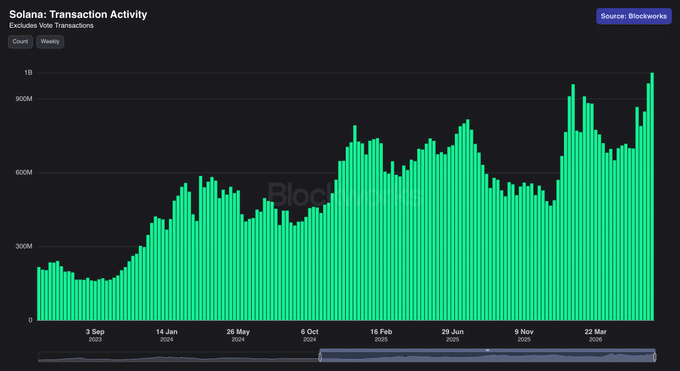
As the chart below shows, Solana processed 1 billion non-vote transactions over the past week, marking the first time the network has crossed that threshold. The milestone underscores Solana’s ability to sustain high throughput at scale.
To put the milestone into context, it’s worth comparing Solana’s [SOL] execution performance with other L1s.
According to Chainspect, Solana is currently processing nearly 1,500 transactions per second (1H average), roughly 41x Ethereum’s throughput.
Finality also remains significantly lower, with transactions settling in around 12.8 seconds versus 12 minutes 48 seconds on Ethereum, a 98.3% reduction in confirmation time.
Against this backdrop, Solana’s latest milestone of 1 billion non-vote transactions reinforces the network’s underlying execution strength and suggests that the Alpenglow upgrade is already translating into higher on-chain throughput.
Yet, the market still hasn’t priced in those network improvements, raising the question of whether Solana’s fundamentals remain undervalued.
After 1 billion transactions, Solana faces its next test
Solana no longer needs to prove it can scale. The next frontier is market efficiency.
As noted earlier, Solana already leads the L1 landscape in throughput, with the recent 1 billion non-vote transaction milestone reinforcing that in real time. The focus is now shifting to how efficiently capital moves across the network.
Projects like Jito are building the “market layer” to improve liquidity, transaction execution, and capital efficiency without changing the underlying execution layer.
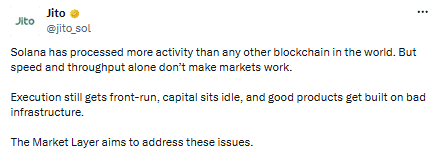
Jito echoed this view in a recent post on X, arguing that Solana’s next growth phase will come less from higher throughput and more from a stronger market layer.
Circle has already minted more than $64 billion in USDC on Solana, highlighting the network’s growing role in stablecoin settlement. As liquidity continues to deepen, efficiently deploying that capital becomes just as important as processing transactions quickly.
At the same time, the conversation is also shifting toward Solana’s tokenomics.
Despite the network’s execution gains, SOL remains one of the more inflationary major Layer 1 assets.
According to on-chain data, Hyperliquid has an annualized supply growth rate of 0.14%, while Ethereum stands at 0.83%. Solana, meanwhile, remains higher at 3.76%. This puts SOL at a relative disadvantage, as higher token issuance continues to weigh on its tokenomics despite improving network fundamentals.
Therefore, while Solana’s 1 billion non-vote transaction milestone reinforces the network’s execution strength, its market layer and tokenomics still trail its infrastructure.
How quickly those two areas mature could determine whether SOL’s valuation begins to reflect the network’s underlying fundamentals.
Final Summary
- Solana crossed 1 billion non-vote transactions, showing strong network growth and faster execution.
- The next focus is improving market efficiency and tokenomics to support SOL’s long-term value.