Solana outage knocks 90 validators offline – Was the network at risk?
Solana maintained finality through a major routing failure as distributed validators kept blocks moving while affected nodes recovered.


Solana’s [SOL] latest disruption exposed how quickly infrastructure issues can spread across validators sharing common dependencies. A routing failure pushed 28.83% of staked SOL offline, affecting roughly 90 validators for about 33 minutes.
This left only 4.51 percentage points, or roughly 19.9 million SOL, before hitting the crucial 33.34% finality threshold. Despite this setback, transactions continued finalizing, showing consensus remained functional despite losing nearly a third of participating stakes.
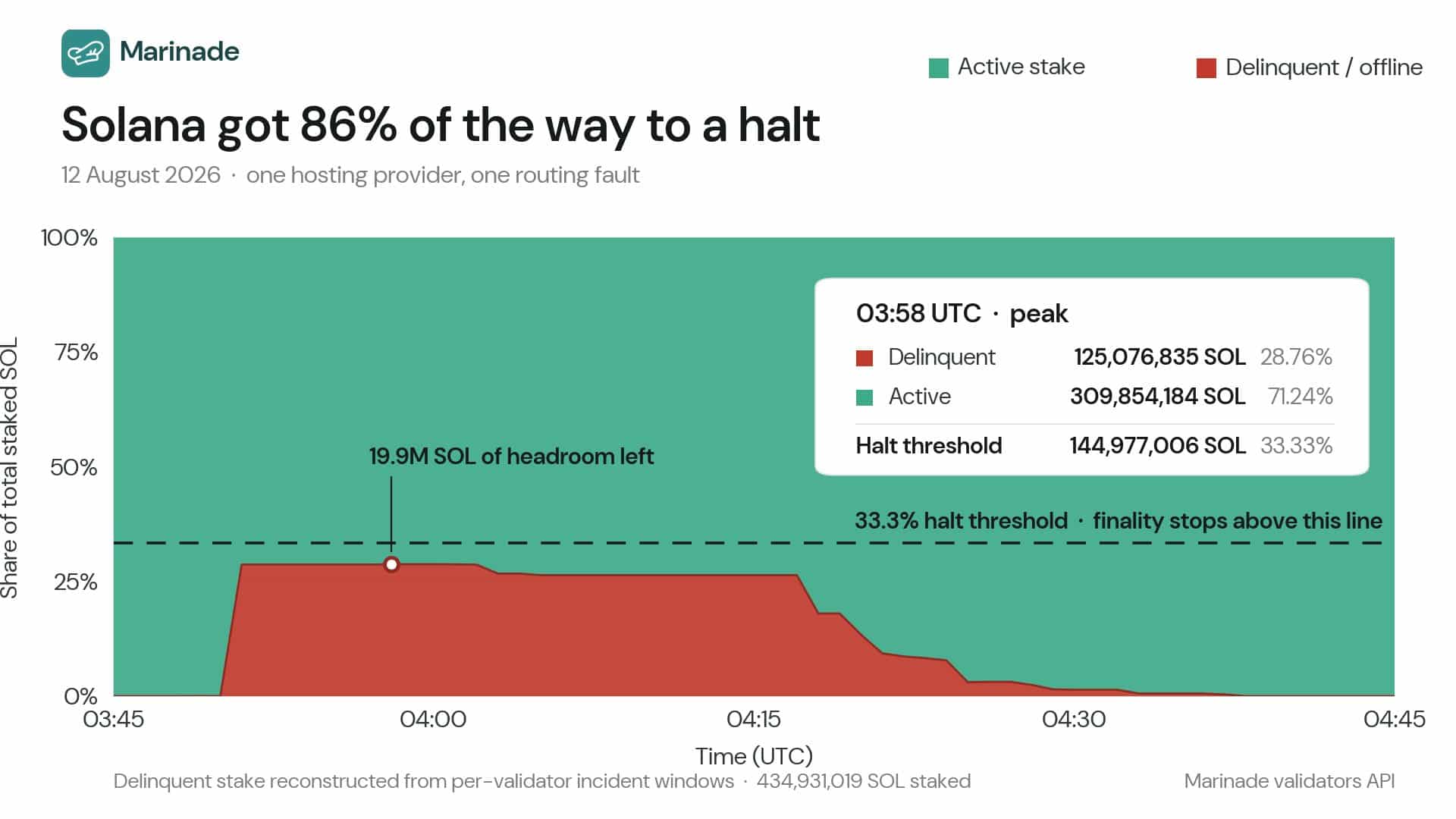
As routing recovered, delinquent stakes gradually fell toward zero, preventing broader disruption for users. However, validators lost around 333 SOL in rewards, creating a direct economic cost from the outage.
More importantly, the near-halt exposed correlated infrastructure risk, making validator hosting diversity and automatic failover critical safeguards against another routing failure.
Solana stays above the 33.34% finality threshold
That infrastructure weakness ultimately tested whether Solana could retain enough voting power to keep confirming transactions. Despite 28.83% of the stake going offline, another 71.17% remained active, keeping participation above the two-thirds requirement.
As such, transaction finalization did occur, which prevented a user from experiencing a delay on their pending transactions. In addition, the Solana network had just narrowly avoided being unable to provide that level of finalization.Therefore, the probability of a second correlated outage occurring simultaneously increased significantly.
As validators recovered, voting participation improved, and the immediate threat faded without disrupting block production. Still, maintaining finality under pressure does not remove the underlying risk.
Another correlated outage affecting additional stakes could cross the 33.34% threshold, turning infrastructure disruption into a network-wide halt.
Validator diversity contains routing failure
The ability to survive this outage was in part due to validation services outside the impacted routing group continuing to function as normal while connections were restored in all areas.
Even though AS20326 had more than 25% of the total SOL staking pool online at the time of the outage. This accounted for approximately 94% of their stake failing.
Nonetheless, since validators were distributed across many providers and geographies, they maintained connectivity, preventing the failure from cascading. In total, there were 699 validators with stakes on Solana at the time of the outage.
However, as a direct result of the failure, 597, or 85% of them, continued to vote for blocks.
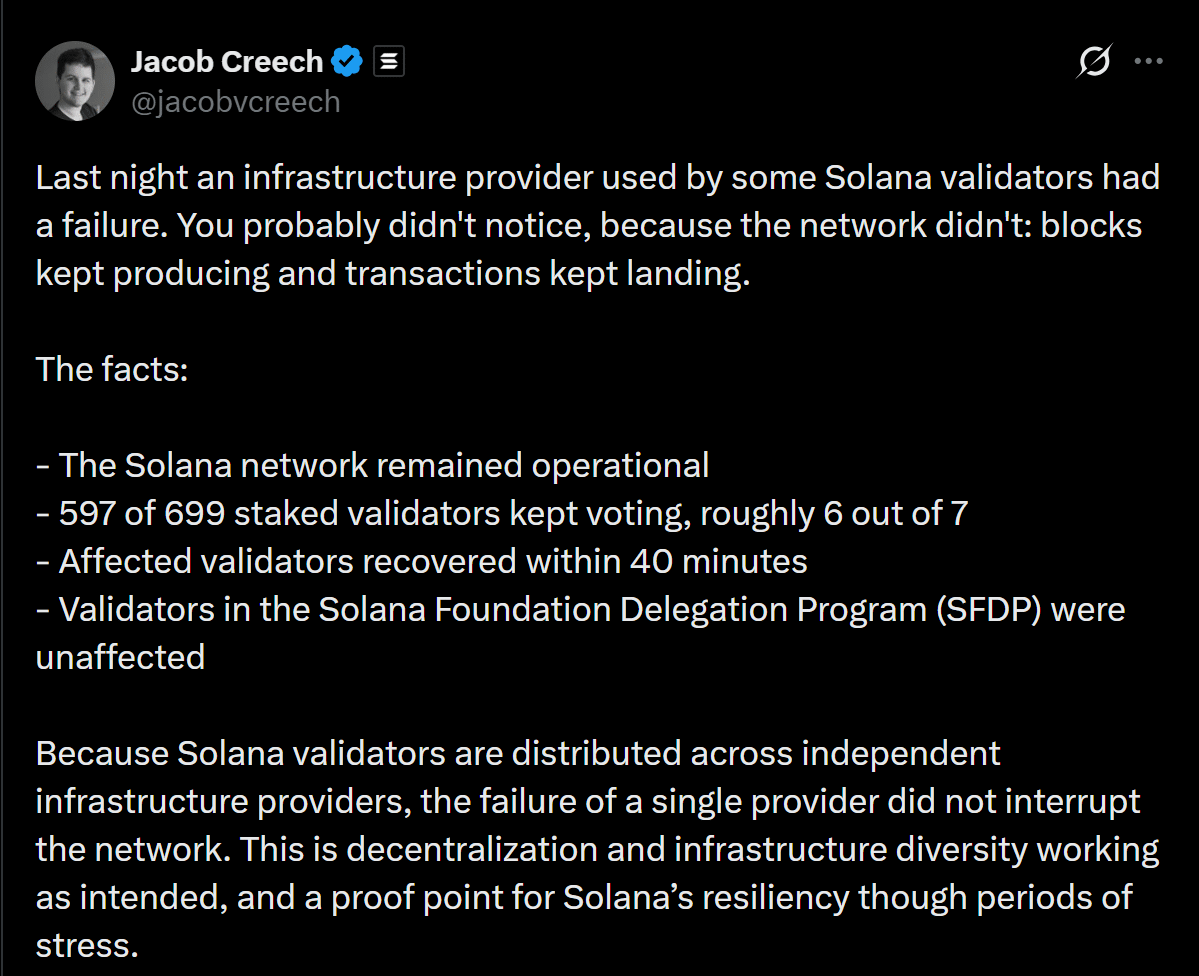
Recovery then strengthened this buffer, as affected validators gradually rejoined within roughly 40 minutes. This restored voting participation before another infrastructure failure could compound the disruption.
Therefore, geographic and provider diversity limited the outage, while rapid recovery prevented concentrated infrastructure exposure from becoming systemic.
Final Summary
- Solana kept finalizing transactions despite 28.83% of staked SOL going offline during the routing failure.
- Validator diversity and rapid recovery prevented the outage from crossing the 33.34% threshold and halting finality.