Skip to content
Active Currencies: 17,347
Market Cap: $2.214T
Bitcoin Dominance: 55.85%
24h Market Cap Change: $-2.35

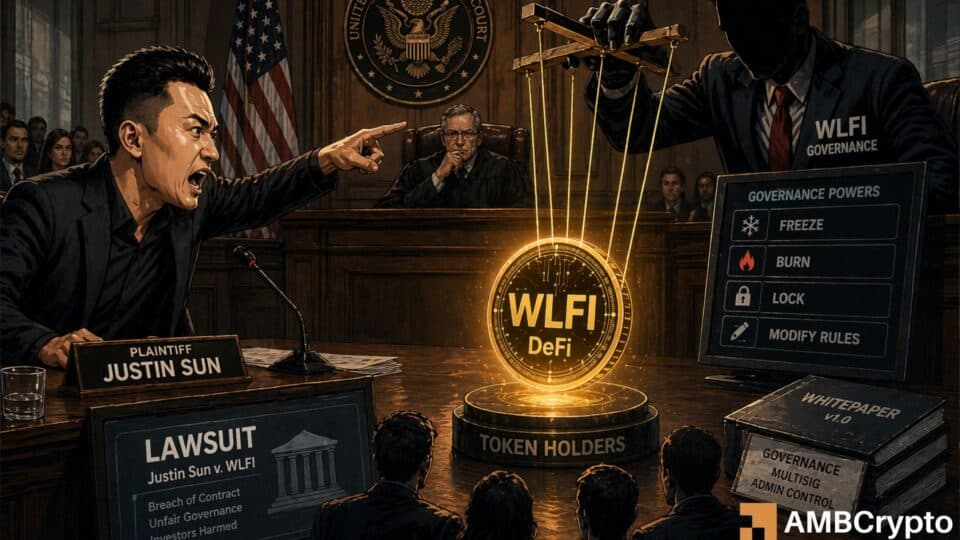
‘Stripped me of my right to vote’ – Justin Sun takes WLFI to court

WLFI exposes how control can override expectations, affecting trust, liquidity and user confidence.

Justin Sun files lawsuit against WLFI, shifting focus to DeFi governance flaws

The conflict between Justin Sun and World Liberty Financial [WLFI] is evolving into a legal challenge for DeFi. In April 2026, Sun alleged that a hidden blacklist function had frozen over $100 million, raising concerns about control.

Source: X

This structure highlights a more profound issue, as protocols favor control and speed over decentralization.

Still, these controls often exist to manage risk and protect liquidity during stress. However, this creates tension because protective tools can also restrict users.

As legal pressure builds, courts may define whether tokens represent ownership or access. This outcome may reshape trust, pricing, and liquidity across markets.

WLFI coercive governance reveals hidden control

The dispute between TRON’s Justin Sun and World Liberty Financial is exposing how control functions shape DeFi governance in practice. Sun pushed back, stating, “Not voting, this is coercion,” which reframes governance as enforced compliance rather than choice.

This followed WLFI’s proposal to restructure over 62.28 billion tokens, where early supporters holding more than $17 billion face a two-year cliff and extended vesting.

As this develops, such forced timelines begin to reshape supply dynamics, as locked tokens reduce immediate sell pressure but increase future overhang risk.

This structure also signals that participation can be altered after entry, which challenges predictability.

Rather than decentralization, control shifts toward those managing vesting and execution, which may push users to reassess governance risk before committing capital.


Governance risk drives market repricing

The lawsuit is beginning to shift how markets interpret governance risk across DeFi. As legal pressure rises, tokens with admin controls begin trading at a discount, as investors now factor in the risk of override.

This shift explains why capital is rotating, as 2026 data shows flows moving toward “Hard DeFi” systems with no upgradeability. Meanwhile, hybrid protocols face liquidity outflows, which reflect declining confidence in flexible governance models.

As governance rules prove mutable, trust begins to shift from code toward issuer credibility.

Looking ahead, the court’s decision may define token rights and operator liability, potentially reshaping valuation models and long-term capital allocation.


Final Summary

  • World Liberty Financial [WLFI] shows how hidden control layers can override decentralization, as governance power and forced vesting reshape supply and limit user certainty.
  • WLFI also reflects a market shift where governance risk drives pricing, as capital favors immutable systems while flexible models face liquidity pressure.
Disclaimer: AMBCrypto's content is meant to be informational in nature and should not be interpreted as investment advice. Trading, buying or selling cryptocurrencies should be considered a high-risk investment and every reader is advised to do their own research before making any decisions.

Muriuki Lazaro

Journalist

Muriuki Lazaro is a on-chain data analyst with a B.Sc. in Data Science. Muriuki specializes in dissecting complex on-chain data into clear and accurate insights for readers in the crypto ecosystem, with a particular focus on Bitcoin.

AMBCrypto was founded in 2018 with a mission to simplify and bring the latest blockchain and cryptocurrency news to our readers. We have quickly grown into the digital news source for an emerging generation of cryptocurrency enthusiasts, reaching more than a million readers on a monthly basis, across the globe.