‘Strong growth in euro-denominated stablecoins’ – Why ECB is watching closely
Stablecoin growth could generate $1 trillion in new demand for U.S Treasury bills, per Standard Chartered bank


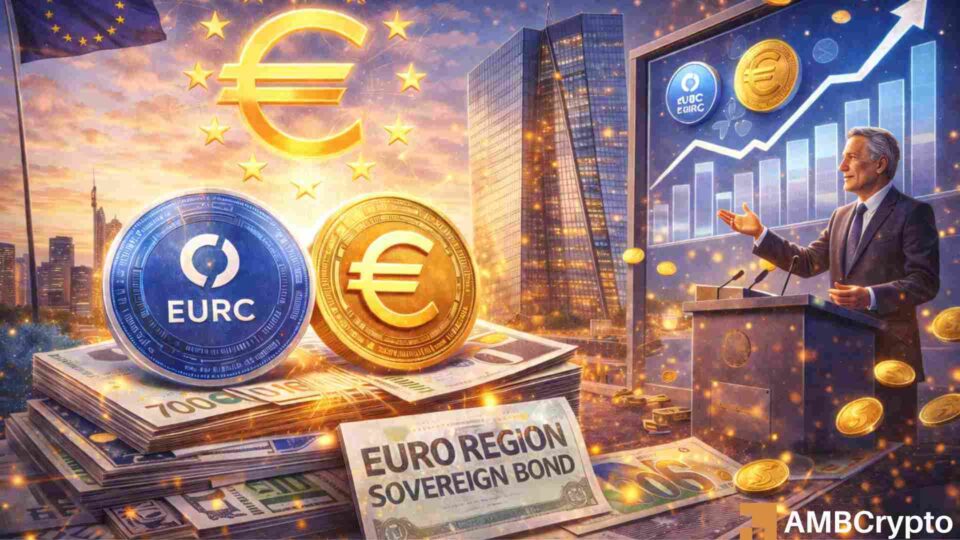
Euro-based stablecoin could be a crucial demand line for European Union (EU) area sovereign bonds.
In its latest report, the European Central Bank (ECB) drew parallels to the impact of USD-based stablecoins on U.S. Treasury bill demand, and added,
Strong growth in euro-denominated stablecoins could increase their relevance for euro area sovereign bond markets.
At the time of writing, the Euro-based stablecoins market supply has hit $701 million, up nearly three times from the $250 million in early 2023.
Over the same period, USD-based stablecoins, led by Tether’s USDT and Circle’s USDC, have grown 2.3x from $135 billion to $319 billion.
In other words, Euro-based stablecoins have grown slightly faster than their USD-based rivals over the same period.
Impact of stablecoins on U.S Treasury bills demand
In a February report, the U.S. Treasury noted that Tether and Circle’s demand for Treasury bonds has grown 35% annually since 2022.

The Treasury noted that these key stablecoin issuers hold about 53% of their reserve assets in T-bills, translating to about a $70B increase in debt demand since 2022.
In fact, Standard Chartered projected that the stablecoin market could hit $2 trillion by 2028 and drive about $1 trillion in net new demand for U.S Treasury bills.
According to the ECB, under the current regulatory framework, the growth of Euro-based stablecoins could drive similar demand for regional bond markets. But the bank cautioned,
The impact of such growth on sovereign bond markets will depend on the composition of stablecoin issuers’ reserves, whether stablecoins are issued by banks or EMIs, and the liquidity management preferences of those banks and EMIs.
Here, EMI stands for Electronic Money Institution, or a regulated fintech that issues a stablecoin, primarily for retail users. On the other hand, bank-issued stablecoins are focused on bank deposit tokens for wholesale and institutional purposes.
Even so, the ECB still believes that stablecoins could pose significant risks to the traditional financial system unless proper mitigation measures are in place.
That said, the non-USD stablecoins have picked up traction, with Circle’s Euro-based stablecoin, EURC, recording the highest P2P transfers in March. The P2P volume surged to $2.3B, a 33% jump on a month-to-month (MoM) basis.

Final Summary
- ECB projected Euro-based stablecoins could be key demand drivers for the region’s sovereign bonds, depending on the diversification of issuers’ reserve assets.
- Circle’s EURC P2P volume has hit a record monthly level of $2.3 billion.