U.S. House unable to ‘override’ Biden crypto veto on ‘ill-conceived SEC rule’
Will traditional banks join the crypto custody space? Here's what's going on with SAB 121.


- US House failed to override Biden’s veto on SAB 121 resolution.
- Reportedly, the SEC has made concessions on crypto accounting for banks and brokerages.
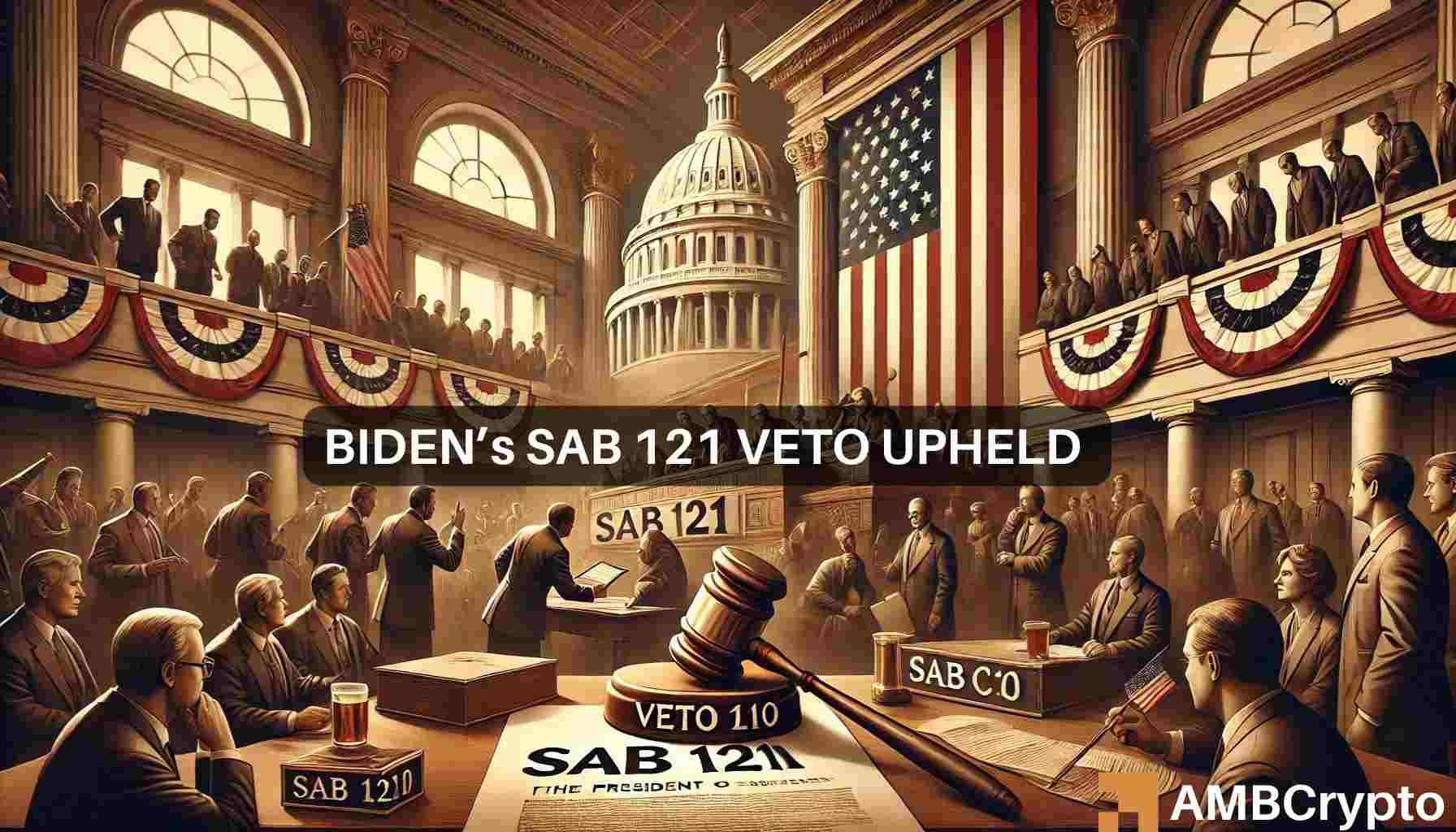
The U.S. House of Representatives failed to reverse President Joe Biden’s crypto veto on the SEC’s accounting guidance.
The SEC’s accounting guidance, Staff Accounting Bulletin 121 [SAB 121], was not erased as the U.S. House failed to achieve the 2/3 majority vote on Thursday to overturn Biden’s veto.
Reacting to the disappointing update, Kristin Smith, CEO of the collective crypto advocacy group Blockchain Association, said,
“While we are disappointed that the resolution to override the president’s veto of the bipartisan SAB121 Congressional Review Act did not achieve the required two-thirds majority for passage, the fight to stop this ill-conceived SEC rule will continue.”
Reported concessions on Biden crypto veto
SAB 121 was the SEC’s response to mitigate against events like the FTX saga and associated platform risk. Per SEC, it aimed to address users’ funds being locked during bankruptcy proceedings.
As a result, per the guidance, firms dealing with crypto, especially banks, were expected to include the same on their balance sheet as assets and liabilities, which could extend capital requirements.
However, market observers stated that SAB 121 meant more risk, compliance, and operational costs for most banks that wished to enter the crypto custody side of the business.
In short, some of the largest banks, like JPMorgan, Citi, or New York Mellon, can’t offer crypto custody businesses like Coinbase.
Having a limited number of crypto custodians could also compound concentration risk, among other things.
In light of these challenges, the US Congress, both the House and Senate, voted and rejected the SAB 121 policy on a bipartisan basis.
However, Biden vetoed the resolution in May, stating that,
“Appropriate guardrails that protect consumers and investors are necessary to harness the potential benefits and opportunities of crypto-asset innovation.”
Nevertheless, the opposition against the SAB 121 has seen some reported concessions to accommodate brokerages and banks.
According to a recent Bloomberg report, the SEC will allow some concessions to crypto accounting compliance.
This means that banks and certain brokerage firms could bypass the strict balance sheet reporting for crypto custodians.
It remains to be seen whether other major traditional banks and brokerage firms, such as JPMorgan, BNY Mellon, and others, will enter crypto custody with the above-reported concessions.