


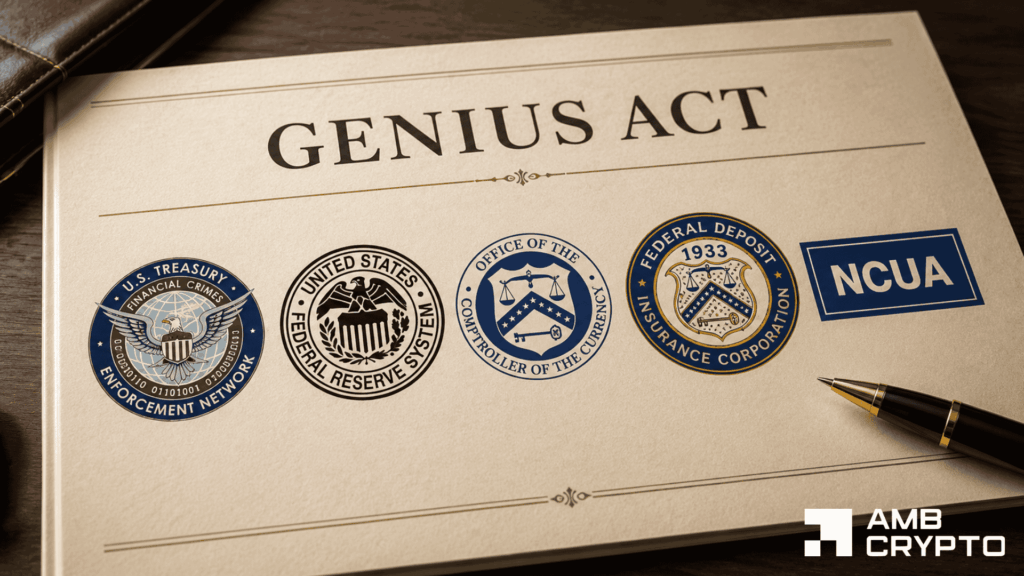
U.S. financial regulators have proposed new customer identification requirements for stablecoin issuers under the GENIUS Act. Stopping short of extending those requirements to wallet-to-wallet transfers and other secondary-market activity.
FinCEN, the Federal Reserve, the OCC, the FDIC, and the NCUA issued the joint proposal. It would require permitted payment stablecoin issuers [PPSIs] to establish Customer Identification Programs [CIPs]. This is similar to those already used by banks and other financial institutions.
The rule forms part of the implementation framework for the GENIUS Act’s stablecoin provisions.
While the proposal would introduce stricter compliance obligations for issuers, regulators also distinguished between direct customer relationships and secondary-market transactions. This move could ease concerns about broader identity requirements across blockchain networks.
Stablecoin issuers would face bank-style customer checks
Under the proposal, permitted payment stablecoin issuers would be treated as financial institutions for purposes of customer identification requirements under the Bank Secrecy Act framework.
Issuers would be required to collect and verify information from customers who establish accounts directly with them. This includes names, addresses, dates of birth or formation, and identification numbers.
The agencies said customer identification programs help financial institutions form a reasonable belief that they know their customers’ true identities while supporting anti-money laundering and counter-terrorist financing efforts.
The proposal would apply to both federal and state-qualified stablecoin issuers operating under the GENIUS Act framework.
Proposal excludes secondary-market transfers
A key feature of the proposal is what it does not require.
The agencies distinguished customers who interact directly with stablecoin issuers and individuals who acquire or transfer stablecoins through secondary markets.
That means wallet-to-wallet transfers, trading activity on exchanges, and other secondary-market transactions would not automatically create customer identification obligations for stablecoin issuers.
Regulators noted that treating every stablecoin holder or blockchain transaction as a direct customer relationship would be difficult to implement. Also, it could undermine the practical operation of stablecoin networks.
Instead, the proposal focuses compliance requirements on the relationship between issuers and their direct customers.
The approach seeks to apply traditional financial safeguards to stablecoin issuance while preserving stablecoins’ ability to circulate across public blockchain networks.
Final Summary
- U.S. regulators have proposed bank-style customer identification requirements for stablecoin issuers under the GENIUS Act framework.
- The proposal targets direct issuer-customer relationships and does not extend identification requirements to wallet-to-wallet transfers or other secondary-market activity.