Why Aave’s $98M cleanup signals a shift from ‘deploy everywhere’ DeFi
Will Aave risk approach make other network become "ghost chains"?



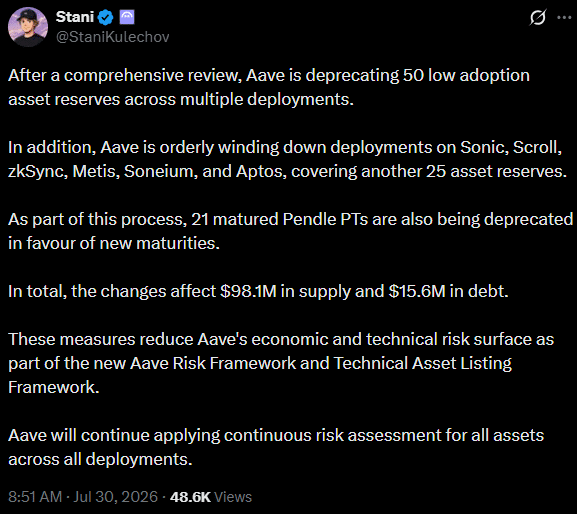
Stani Kulechov, founder of the DeFi lending protocol Aave, said that they plan to scrap 50 reserve assets with low adoption and wind down deployments on six chains.
Aave will wind down its deployments on Aptos, Sonic, Scroll, zkSync, Metis, and Soneum in an orderly manner. Similarly, the project will axe support for Pendle PTs (principal tokens). Collectively, the clean-up would affect $98 million in supplied assets and $15.6 million in debt.
In a statement on the 30th of July, Kulechov said the move is aimed at reducing the protocol’s risk exposure.
These measures reduce Aave’s economic and technical risk surface as part of the new Aave Risk Framework and Technical Asset Listing Framework.
The aforementioned Aave risk framework was formed in June by LlamaRisk, the protocol’s risk service provider. It was a response to the KelpDAO attack that drained $292M due to avoidable blind spots, especially from downstream vulnerabilities like external asset backing.
It covers active monitoring, chain, bridge, and asset risk profiles. This is the first major application of the risk framework since its debut, and the implications could be far-reaching.
Will other DeFi players follow Aave’s cleanup move?
Other protocols could follow Aave’s steps and cut exposure to contain risk impact. Reacting to the update, Solana Foundation’s Head of Risk, Seraphim Czecker, offered similar suggestions.
The era of indiscriminate deployments on every flashy chain is over. Time for DeFi to follow Aave: consolidate, make concentrated bets, and advance market share.
For others, this meant other players may avoid deploying the chains that Aave plans to axe.
Put differently, the ripple effect could drive away current deployers and keep new players from setting up shop in chains like Aptos, Scroll, and others. If so, more networks could become “ghost chains” if other DeFi players adopt the Aave playbook.
Meanwhile, AAVE jumped about 3% after the update. But the $100 level remained a key upside resistance that could determine if the Q2 rally extends.
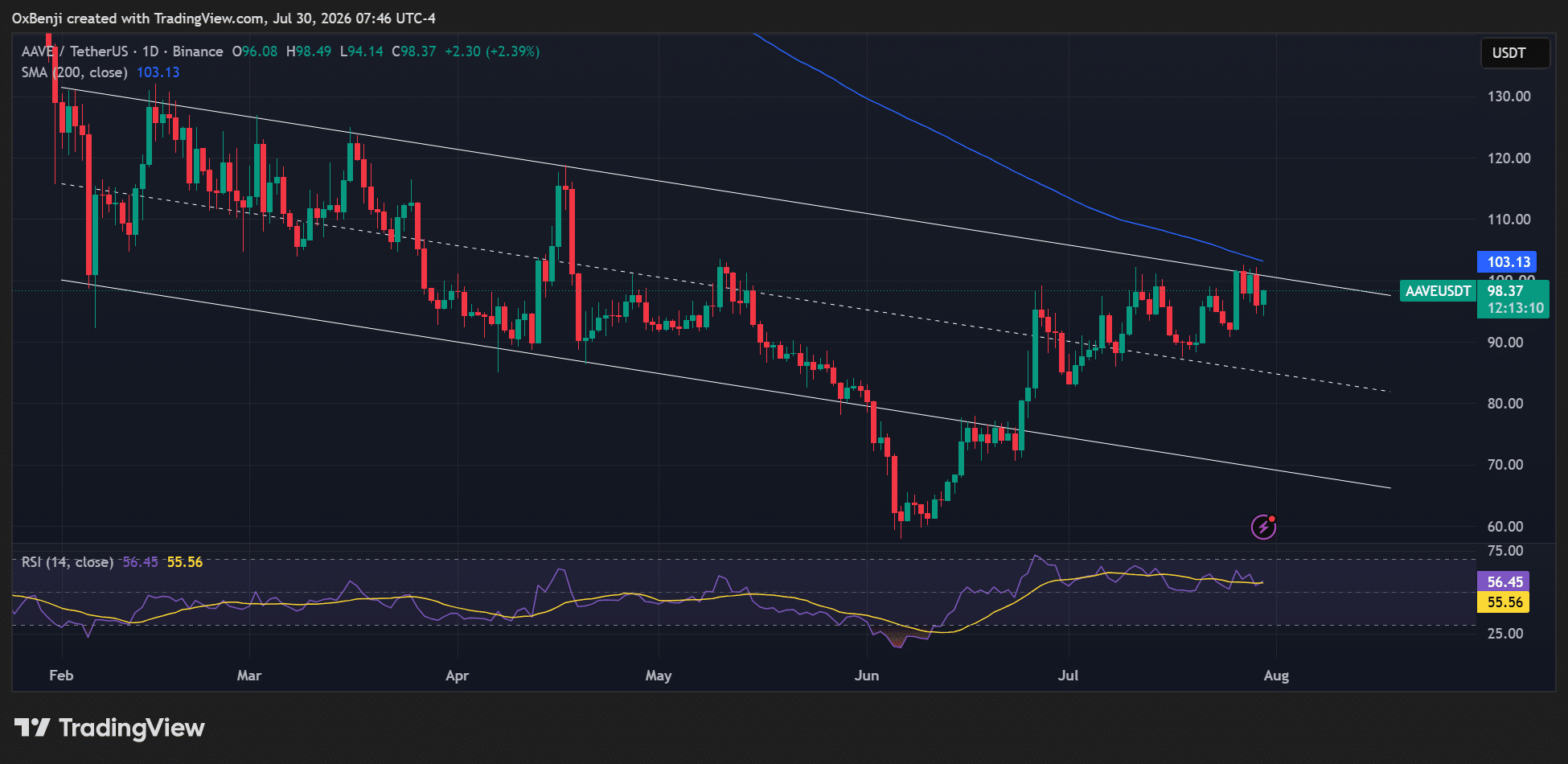
Overall, Aave’s aggressive application of its risk framework could help reinstate trust in the lending protocol after the KelpDAO exploit. In fact, it could boost overall DeFi security. However, the cleanup could make some blacklisted networks become “ghost chains.”
Final Summary
- Aave’s founder said the project is planning to axe 50 low-reserve assets and wind down deployments across six chains.
- Analysts viewed the move as net-positive for DeFi security and urged other players to follow suit.