Why Cardano’s 57% staked supply signals resilience despite ADA price dip
The relatively quiet ADA dormant circulation, compared to May-June, was interesting given the market-wide pessimistic sentiment.



Coinbase data showed that 57% of the Cardano [ADA] supply was staked. The estimated reward rate ranges from 1.30% to 3.00% APY, with Coinbase’s rate at 1.38%. The high-staked supply showed network resilience and strong conviction from holders.
In other news, Node 11.2 is live on the mainnet and has brought core upgrade features. AMBCrypto reported that node configs came in a new “envelope” format that nodes older than 11.2 would not be able to read, which means operators will have to upgrade.
Despite the news, the price reaction has been minimal so far.
Cardano holders underwater once more
The MVRV ratio measures how much profit or loss the average investor is sitting on. Santiment data also tracks MVRV data across different rolling timeframes, such as 30-day (short-term holder) and 180-day (long-term holder).
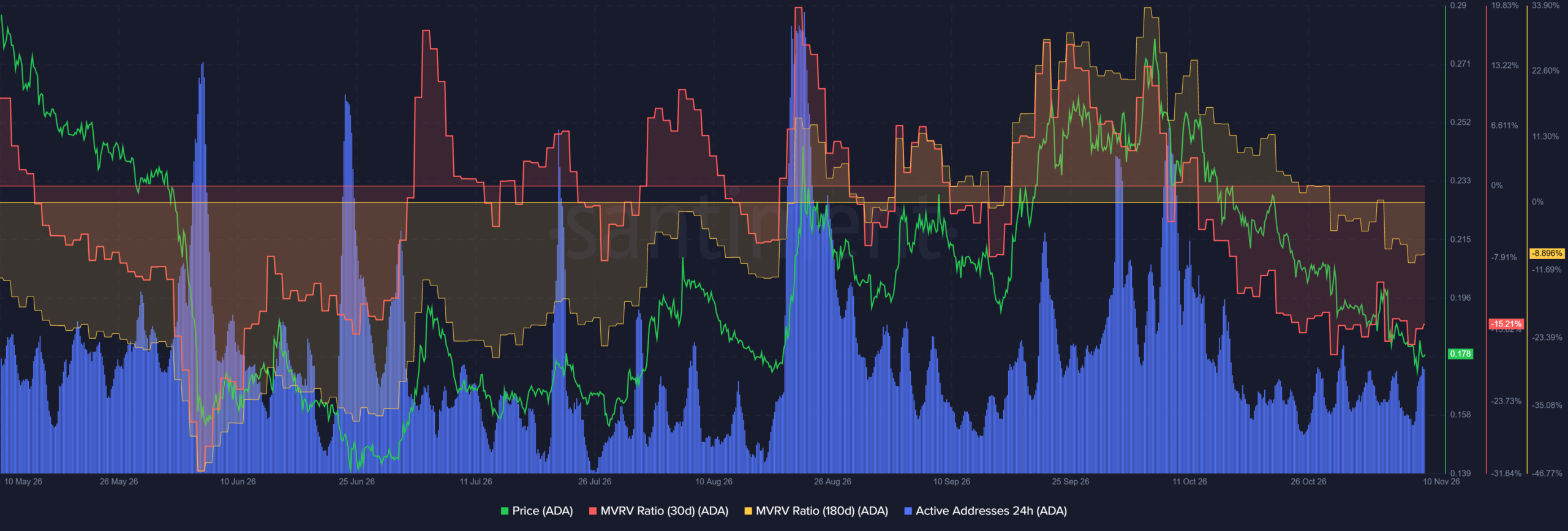
The data showed that both the 30-day and 180-day MVRV ratios were below zero. In other words, these holders were facing losses, on average, of 15.21% and 8.9%, respectively.
The September rally saw the MVRV ratios reach highly positive territory, especially for the 180-day cohort. It was expected that this would prompt profit-taking and selling pressure. The sustained ADA price losses below $0.20 were also due to crypto market-wide fear as Bitcoin faced rejection below $80k.
The daily active addresses numbers have tumbled compared to levels registered in the first half of October too, from a peak of 29k to just 12k-14k in recent days.
THESE signals accumulation, not capitulation
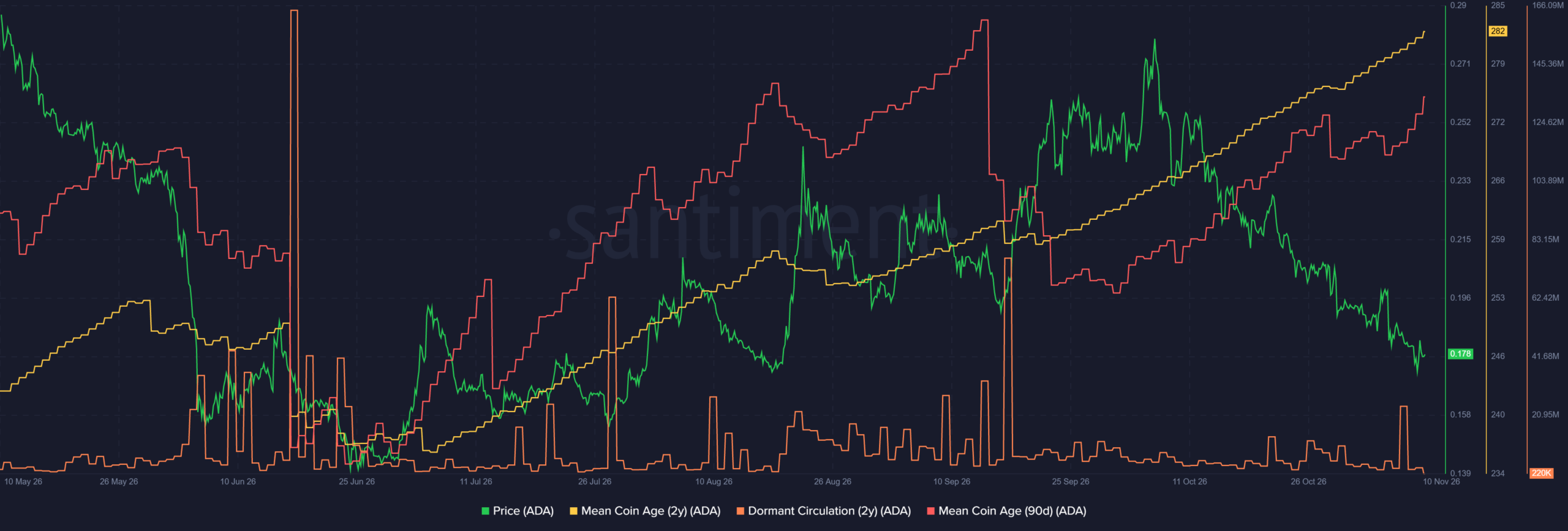
The price correction to $0.194 in mid-September saw the 2-year dormant circulation spike, and also caused a minor dip in the 2-year mean coin age.
These metrics measure the amount of tokens not transacted for a specific period of time, and the average number of days all ADA tokens were in their addresses, in a rolling window of the chosen time period (for example, 90 days).
Over the past six weeks, while Cardano was in steady decline, both the 90-day and 2-year MCA have trended higher. Meanwhile, the dormant circulation was relatively quiet.
This relative quiet was markedly different from the panicked offloading seen in June. Back then, Cardano prices were crashing towards the $0.14-$0.15 lows. Dormant circulation was high, and the mean coin age was in freefall.
Therefore, despite the steady drawdown in recent weeks, the sentiment was likely quite different, as the evidence at hand shows.
Final Summary
- Cardano’s Node 11.2 has hit the mainnet, bringing core features, and Coinbase metrics showed 57% of the supply was staked.
- The steady ADA losses in recent weeks have not yet given way to panicked selling.