Here’s why Zcash’s Orchard flaw puts pre-disclosure trading under the spotlight
Fresh market data is raising new questions about Zcash's trading activity before the Orchard vulnerability surfaced.



Developers recently revealed that a four-year-long vulnerability in Orchard may have enabled unlimited counterfeit Zcash [ZEC] until an emergency patch was issued. However, fresh market data has raised further questions regarding events before the discovery.
Allium Labs, after reviewing trade history, identified unusual trading activity. On the 26th of May, ZEC’s trading volume surged 12–13 times above its average. Researchers privately uncovered the defect three days later, on the 29th of May.
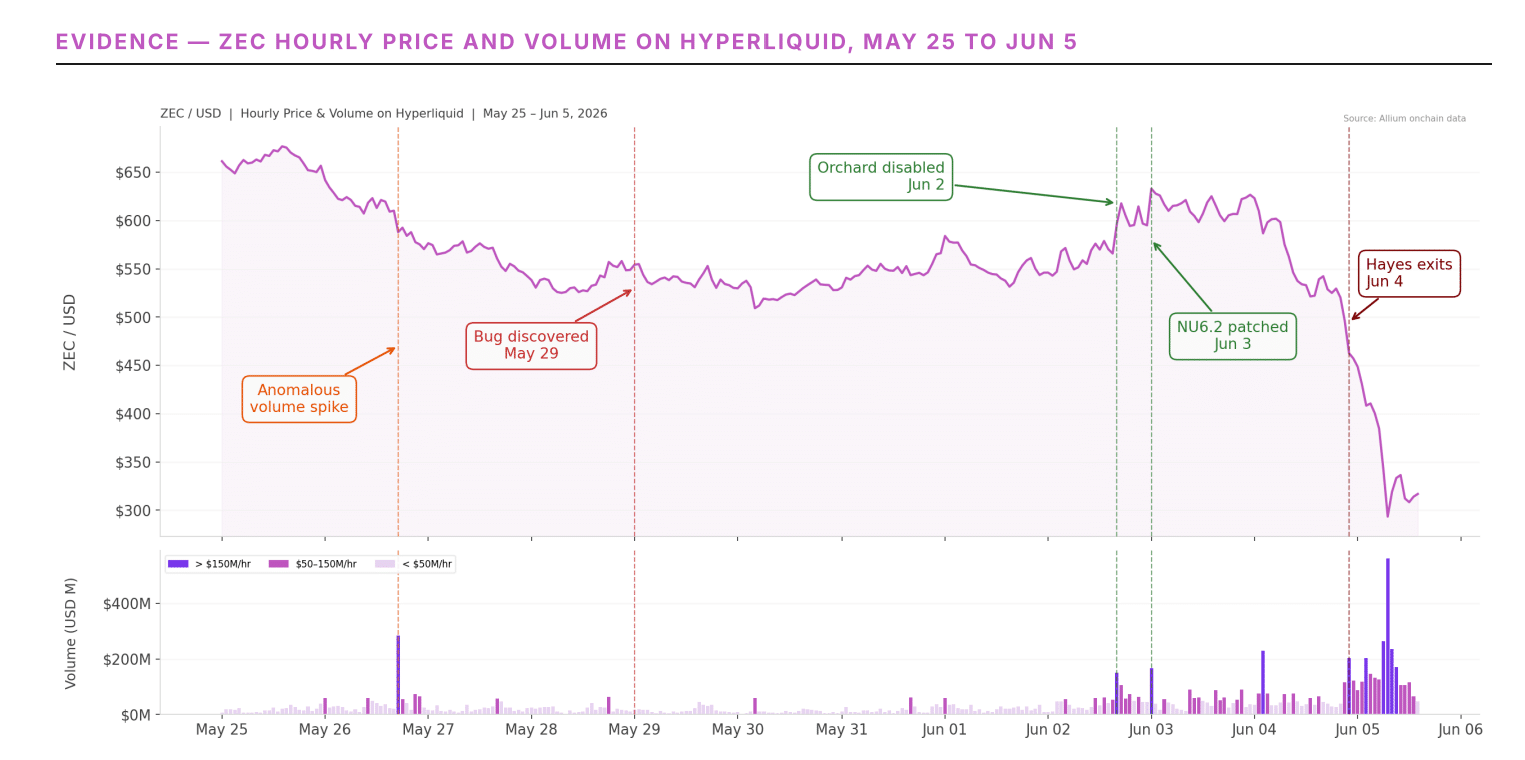
While researchers were identifying the defect, ZEC declined from approximately $660 down to $530, indicating increasing selling pressure. The developers disabled Orchard on the 2nd of June and issued a patch on the 3rd of June, yet confidence continued fading.
By the 5th of June, ZEC had fallen by 64 percent from $685 to $247 with hourly trading at $560 million.
Early positioning fuels market suspicion
The uncertainty in the aftermath of this issue also led to further review of which parties were actively trading in the market ahead of the issue becoming apparent. Allium found that traders opened the most profitable positions on the 25th and 26th of May.
This occurred days before the private discovery of the Orchard flaw. More importantly, traders opened these large positions before researchers privately disclosed the flaw on the 29th of May. Notably, the largest wallet had a short position worth $34.5 million and, as a result, made approximately $998,000 in profits.
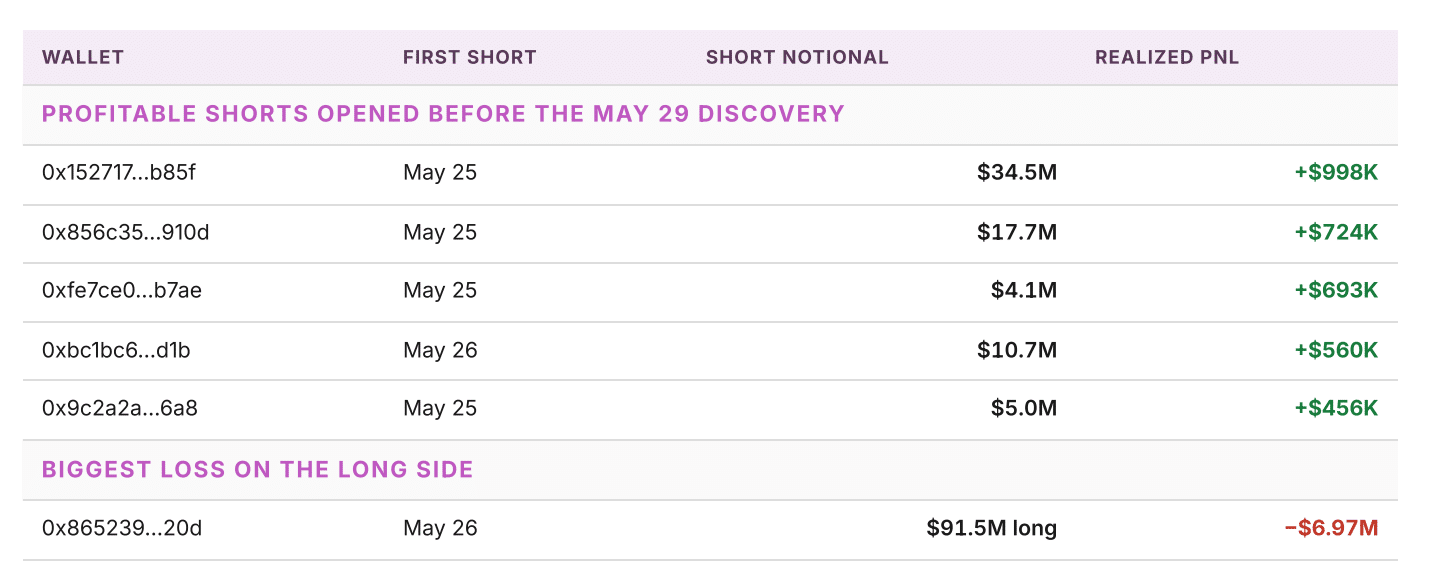
A second short position worth $17.7 million accrued profits of approximately $724,000. These high profits raised questions about whether traders anticipated the sell‑off.
However, the data does not provide sufficient evidence to prove such claims. In futures markets, all shorts are offset by an equal number of longs. Therefore, simply showing profitable positions is insufficient to establish that those positions existed due to prior knowledge.
That balance became evident when the largest $91.5 million long position ultimately lost $6.97 million. Meanwhile, Zcash’s privacy model prevents anyone from verifying whether the flaw was ever exploited. This left markets to price on probabilities instead of certainty and kept confidence fragile despite the completed patch.
Final Summary
- Allium Labs flagged unusual ZEC trading before the Orchard flaw discovery, fueling suspicion of informed positioning.
- Profitable shorts raised questions, but lack of evidence and Zcash privacy kept confidence fragile.