Arbitrum One is a Layer-2 blockchain built on Ethereum [ETH]. Its native governance token is ARB.

The network was launched on the 31st of August, 2021, after being developed by Offchain Labs. The company was co-founded by Steven Goldfeder, who serves as CEO; Ed Felten, Chief Scientist; and Harry Kalodner, Chief Technology Officer [CTO].

Offchain Labs later moved Arbitrum toward a decentralized governance model through the Arbitrum DAO.

Arbitrum was designed to make Ethereum transactions faster and cheaper. It does this through Optimistic Rollups, Optimistic Assumptions and Fraud Proofs. These mechanisms allow the L2 blockchain to process transactions off-chain while inheriting security from Ethereum’s main network.

Before launch, Offchain Labs raised capital across several funding rounds. Its Series B round raised $120 million, led by Lightspeed Venture Partners. Other early backers included Pantera Capital, Polychain Capital, Coinbase Ventures and Mark Cuban.

Capital has continued flowing into the Arbitrum ecosystem. Arbitrum Gaming Ventures committed about $10 million to game developers, alongside institutions such as Paradigm and Framework. Other major names linked to the blockchain’s ecosystem expansion include BlackRock, Franklin Templeton, PayPal, GMX and Aave.

Arbitrum launched ARB with a fixed total supply of 10 billion tokens. The Arbitrum DAO Treasury received 42.78% of the supply. The team, future teams and advisors received 26.94%. Investors received 17.53%, individual wallets received 11.62%, and ecosystem DAOs received 1.13%.

According to current CoinMarketCap data, ARB’s unlocked circulating supply stood at 5.57 billion tokens. This represented 55.71% of the total supply. By April 2027, the unlocked supply is expected to reach 66.46%.

ARB does not have an automatic burn mechanism because Arbitrum uses ETH for gas fees. However, ARB has a 2% annual inflation rate, which began in March 2024 to fund ecosystem growth and development. Separately, ARB buybacks using excess ETH accumulated by the Arbitrum DAO are permanently burned.

After its mainnet launch in August 2021, Arbitrum introduced a major upgrade called Arbitrum Nitro in August 2022. Nitro reduced fees and improved Ethereum Virtual Machine compatibility by moving the execution engine to a WebAssembly architecture.

In March 2023, Arbitrum launched its governance token, ARB. In August 2024, Arbitrum Orbit went live, allowing developers to build Layer-3 chains using ARB or ETH.

Several developments are currently shaping Arbitrum’s roadmap. Arbitrum Stylus has expanded smart contract development by allowing builders to use languages such as Rust, C, C++ and Move, instead of relying only on Solidity.

Another key upgrade is Bounded Liquidity Delay, or BoLD. It enables permissionless block validation while reducing the risk of delay attacks. The platform is also expanding into institutional finance and real-world assets through tokenized asset integrations.

The broader roadmap aims to improve cost efficiency during traffic spikes through the ArbOS “Dia” implementation. Other planned upgrades include the Decentralized Sequencer Framework, which would move Arbitrum away from a single centralized transaction orderer.

Trustless Bridging is another major roadmap item. It aims to upgrade Arbitrum’s current seven-day rollup bridge into a fully decentralized asset transfer system, reducing bridge-related risks.

The L2 blockchain has also faced security incidents and ecosystem-level exploits. In September 2022, the team prevented the Arbitrum Nitro Bridge Bug, which could have allowed attackers to impersonate users and steal incoming ETH deposits.

In January 2025, the Moby Trade liquidity app was exploited. The attacker withdrew WETH and WBTC, although a programmer reportedly intercepted the hacker and rescued $1.47 million in USDC.

In January 2026, the TMX project was exploited for $1.40 million. The attacker minted and staked TMX LP tokens using USDT, then sold and extracted USDG stablecoins.

In April 2026, KelpDAO Bridge was reportedly exploited for $292 million through LayerZero. The Arbitrum Security Council later intervened and froze 30,766 ETH worth around $71 million.

VIEW MORE

Overview

Market Cap
$462.38M
-0.2%
Volume (24H)
$48.93M
Volume (7D)
$286.09M
-12.6%
Max Supply
10,000,000,000 ARB
Circulating Supply
6,362,841,042 ARB
All-Time High
$2.39
-97.0%
All-Time Low
$0.070738
+2.5%
(above ATL)

Prediction Analysis

Current Price
$0.07
Sentiment
Bearish
50-Day SMA
$0.10
Price Prediction
$0.02
-74.20%
Fear & Greed Index
200-Day SMA
$0.13
Green Days
10 / last 30 (34.5%)
Volatility
3.42%
Moderate
14-Day RSI
22.16
Oversold

Profit Calculator

Select asset
%
%
Total Profit
$0
(0%)
Total Exit Amount
$0
Total Investment Fee
$0
Total Exit Fee
$0

Arbitrum Price Prediction

Current Price
$0.07
2031
$0.00
2036
$0.00
2041
$0.00
2046
$0.00

Results are based solely on your predicted price change. They are not indicators of future performance and do not take into account different performance scenarios, historical data, or the effect of fees or other charges.

VIEW MORE

Short-Term Arbitrum Price Targets

Date Prediction Change
Jun 27, 2026 $0.07 -0.76%
Jun 28, 2026 $0.07 -1.52%
Jun 29, 2026 $0.07 -2.28%
Jun 30, 2026 $0.07 -3.02%
Jul 01, 2026 $0.07 -3.76%
Jul 02, 2026 $0.07 -4.50%
Jul 03, 2026 $0.07 -5.23%

For short-term traders, the first bullish target sat near $0.25. This marked the last significant swing low. However, ARB first needed to close above $0.15 to confirm stronger upside momentum. The more optimistic short-term targets were $0.64 and slightly above $1. These levels were last seen in early 2025. If bearish market conditions continued, ARB could still move lower. This would align with weakness across the broader crypto market, including Bitcoin [BTC] and Ethereum.

VIEW MORE

Monthly Arbitrum Price Prediction

May 31, 2026
$0.10
Jun 26, 2026
$0.07
Highest in Jun
$0.10
Lowest in Jun
$0.07
Overall Performance
Falling

Long-Term Arbitrum Price Prediction

Month Price AVG Price Max Price Change
Jun $0.05 $0.06 $0.06 -31.19%
Jul $0.04 $0.04 $0.04 -44.96%
Aug $0.03 $0.03 $0.03 -58.72%
Sep $0.02 $0.02 $0.02 -72.48%
Oct $0.01 $0.02 $0.02 -86.24%
Nov $0.01 $0.01 $0.01 -86.24%
Dec $0.01 $0.01 $0.01 -86.24%
For long-term holders, ARB’s ultimate recovery target remained its previous peak near $2.40, or potentially higher. However, this outlook depended on a broader market recovery. ARB would also need to reclaim short-term resistance levels and turn them into support. At the time of analysis, ARB was still more than 96.52% below its peak. The $1.50 level served as a midpoint target. ARB would first need to reclaim $1 as a demand zone before attempting a move toward $2 and $2.40.
VIEW MORE

Historical Price Performance

Year Highest Price Lowest Price
2026 (to date) $0 $0
2025 $1 $0
2024 $2 $0
2023 $2 $1

Historical data shows that ARB has spent most of its existence in a downtrend, despite long-term optimism from parts of the crypto market. Several events contributed to major price declines. These included the March 2024 cliff unlock, the August 2024 market deleveraging, early 2025 all-time low capitulation, the October 2025 liquidation cascade and the extended 2026 downtrend. ARB’s strongest bullish phase came in January 2024, when broader market optimism pushed the token to a peak near $2.40. Other positive catalysts included ARB’s correlation with Ethereum in April 2024 and a major TVL jump in August 2025. The latter triggered an 18% rally in a single day.

VIEW MORE

Technical Analysis

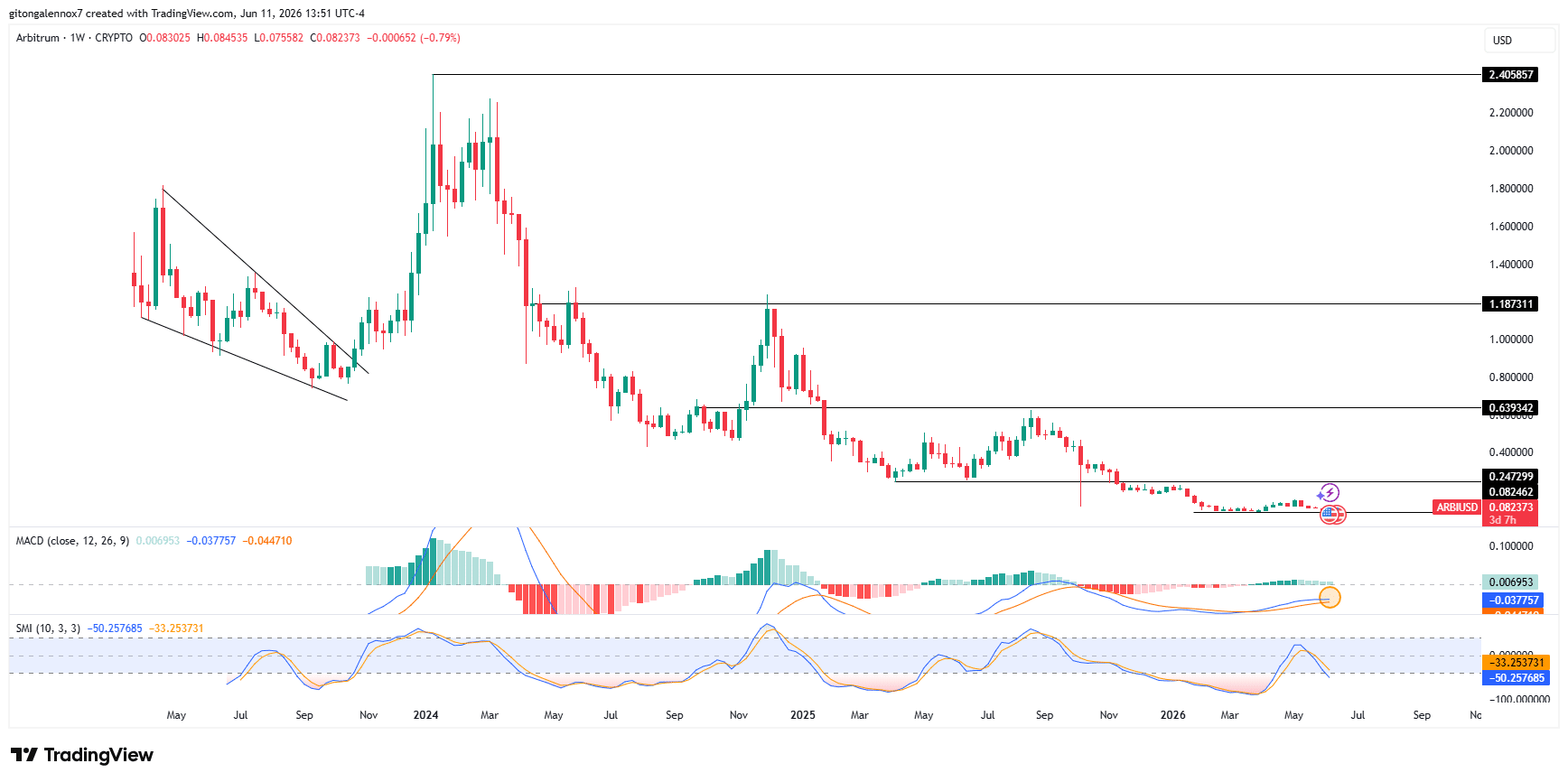
ARB’s weekly chart showed a long decline after a bullish phase that started in late 2023 and extended into Q2 2024.

Before that rally, ARB had consolidated inside a falling wedge after the token launch. The token later broke above that structure, triggering upside momentum.

After peaking near $2.40, ARB entered a persistent downtrend. The asset continued forming lower resistance levels after each new low. At the time of analysis, ARB was trading near the $0.08 level, which had held since the start of 2026.

Source: ARB/USD weekly price chart on TradingView

The MACD had turned green, suggesting buyers were stepping in around the 2026 low. A bullish crossover was also approaching.

The Stochastic Momentum Index was in oversold territory, with a reading near -50. This zone is often associated with mean-reversion attempts.

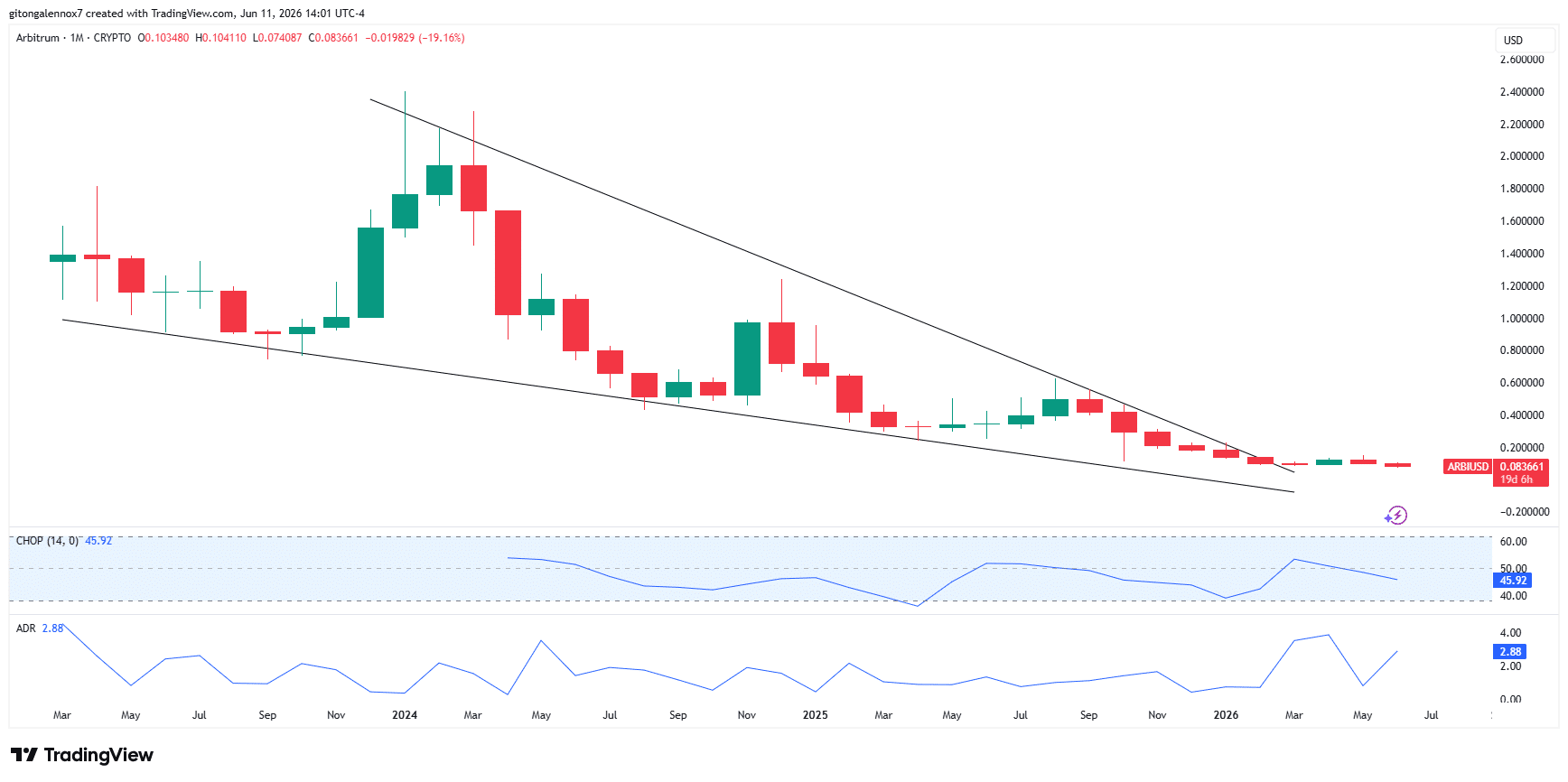
On the higher timeframe, ARB had broken out of a large falling triangle pattern. However, the breakout had failed to produce a strong upside continuation. Instead, the token had moved sideways.

Meanwhile, the Choppiness Index was falling, suggesting that the downtrend remained defined rather than range-bound.

The Advance/Decline Ratio showed a potential divergence. The ADR was rising, with a reading of 2.88, while price and CHOP were declining. This hinted at a possible reversal setup if buyers reclaimed key levels.

Source: ARB/USD monthly price chart on TradingView

Guides

How to Read Arbitrum Charts and Predict Price Movements?

Most traders use candlestick charts, as they provide more information than a simple line chart. Traders can view candlesticks that represent the price action of Arbitrum with different granularity – for example, you could choose a 5-minute candlestick chart for extremely short-term price action or choose a weekly candlestick chart to identify long-term trends. 1-hour, 4-hour, and 1-day candlestick charts are among the most popular.

Let’s use a 1-hour candlestick chart as an example of how this type of price chart gives us information about opening and closing prices. The chart is divided into “candles” that give us information about Arbitrum’s price action in 1-hour chunks. Each candlestick will display the asset’s opening price, closing price, as well as the highest and lowest prices reached within that period.

Arbitrum Price Prediction Indicators

Moving averages are among the most popular Arbitrum price prediction tools. As the name suggests, a moving average provides the average closing price over a selected time frame, which is divided into a number of periods of the same length. For example, a 12-day simple moving average is calculated by summing the closing prices over the last 12 days and dividing the result by 12.

In addition to the simple moving average (SMA), traders also use another type of moving average called the exponential moving average (EMA). The EMA gives more weight to recent prices, and therefore reacts more quickly to changes in market conditions.

What Affects the Price of Arbitrum?

Just like with any other asset, the price action of Arbitrum is driven by supply and demand. These dynamics can be influenced by fundamental events such as block reward halvings, hard forks, or new protocol updates. Regulations, adoption by companies and governments, cryptocurrency exchange hacks, and other real-world events can also affect market sentiment.

Technical indicators such as moving averages, RSI, and trading volume are also used by traders to anticipate price movements and identify potential trend reversals.

FAQs on Arbitrum Price Predictions

As of today, Arbitrum (ARB) is trading at $0.072669. The current market sentiment is Bearish, with RSI at 22.16 (Oversold) and volatility classified as Moderate.
Based on our technical analysis and projected annual growth rate, Arbitrum could reach $0.018749 by 2027. This estimate assumes continued market momentum and adoption trends.
According to our technical analysis indicators, the Arbitrum price prediction is forecasted to reach $0.000083 within the next five years (by 2031). Over the last 30 days, Arbitrum recorded green days 35% of the time.
Based on multiple technical indicators, the current outlook for Arbitrum in 2026 is Bearish. RSI currently sits at 22.16, which indicates Oversold momentum. However, investors should evaluate both technical signals and fundamental developments before making any investment decisions.
Long-term forecasts indicate that Arbitrum may continue to grow over the next decade if adoption, technology development, and global crypto demand continue to expand.
While Arbitrum's future value depends on various factors, technical indicators suggest it could experience both bullish and bearish cycles over time. Long-term investors typically monitor RSI levels, moving averages, and broader market sentiment when evaluating ARB's future trajectory.
Disclaimer

AMBCrypto's content is meant to be informational in nature and should not be interpreted as investment advice. Trading, buying or selling cryptocurrencies should be considered a high-risk investment and every reader is advised to do their own research before making any decisions.