ICP crypto price jumps 8%: Can Caffeine AI and Mission 70 support a recovery?
ICP’s high-volume breakout improves its short-term outlook, but network data shows that token burning still trails historical issuance.



Internet Computer [ICP] jumped 8.1% to $2.34 on August 10, accompanied by its strongest daily trading volume since July.
The move strengthened ICP’s short-term technical structure. Longer term, Caffeine AI and the proposed Mission 70 tokenomics changes could improve demand and reduce issuance, although current burn data shows that the network still has a sizeable historical issuance gap to overcome.
ICP price breaks above the Ichimoku cloud
ICP climbed from an opening price of $2.17 to $2.34, while trading volume increased to approximately 1.07 million ICP during the session.
The rally pushed the token above the Ichimoku cloud, providing an early indication that short-term momentum is improving.
The Tenkan-sen near $2.18 also crossed above the Kijun-sen around $2.17, strengthening the bullish short-term signal.
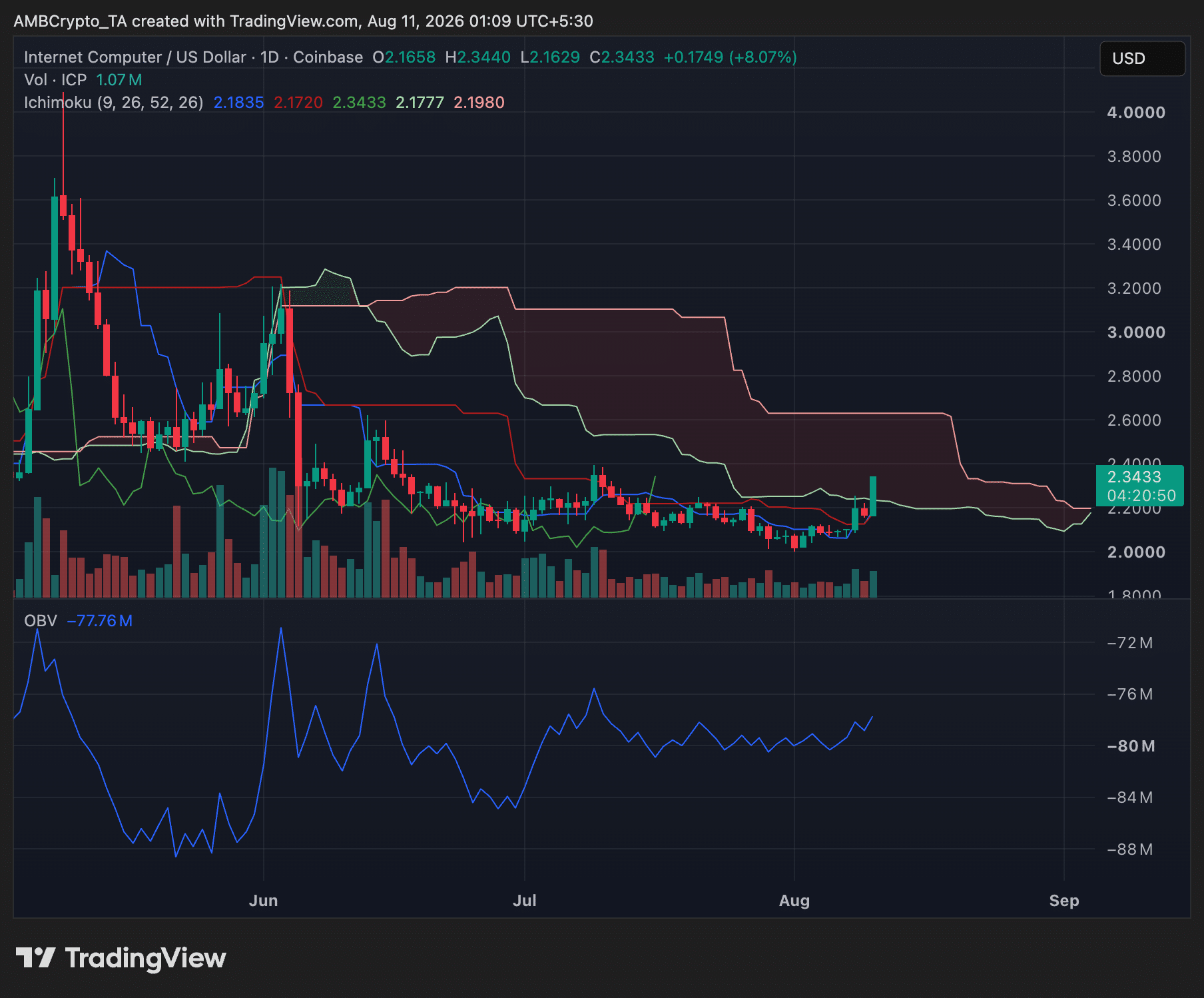
Meanwhile, On-Balance Volume [OBV] climbed to -77.76 million. The absolute negative value matters less than its direction, with the increase showing that recent price gains have coincided with improving volume pressure.
ICP now needs to hold the $2.17-$2.20 region to preserve the breakout structure.
The next resistance sits around $2.40. Clearing that level could open a move towards $2.60, where sellers previously entered the market.
A drop back below the Ichimoku cloud, however, would weaken the breakout case.
Could Caffeine AI create new ICP demand?
Caffeine could provide a fundamental source of demand if adoption grows.
The platform allows users to build and deploy applications on the Internet Computer using conversational prompts. Customer payments can be used to purchase ICP, which is then converted into cycles required to power applications.
Those cycles are consumed as applications use network resources, effectively removing the corresponding ICP from supply.
That creates a direct economic link between Caffeine usage, network activity, and ICP demand.
The question is whether that activity can become large enough to affect tokenomics materially.
Internet Computer’s tokenomics dashboard shows approximately 2.85 million ICP burned historically.
By comparison, around 63.96 million ICP has been minted through distributed voting maturity, while cumulative node-provider rewards stand at approximately 25.03 million ICP.
The dashboard also records roughly 112.06 million ICP in undisbursed voting maturity. These tokens are not equivalent to immediately circulating supply, but they remain relevant when assessing potential future issuance.
Mission 70 targets ICP’s issuance problem
The proposed Mission 70 reforms could address the other side of the equation.
Its governance proposals include changes to staking and node-provider rewards alongside measures intended to increase demand for ICP.
Reducing issuance while increasing network-driven burns could improve ICP’s supply dynamics over time.
However, the outcome depends on which proposals receive governance approval, how they are implemented, and whether products such as Caffeine generate meaningful network usage.
For now, the cumulative data shows that historical minting has substantially exceeded token burns. Caffeine and Mission 70 provide potential mechanisms for narrowing that gap, but neither has yet established that ICP is moving towards sustained net deflation.
Final Summary
- ICP’s 8.1% rally strengthened its short-term structure, with $2.40 and $2.60 becoming the next levels to watch if $2.17-$2.20 holds.
- Caffeine could create recurring ICP demand and burns, while Mission 70 targets issuance. However, current data does not yet show that these mechanisms have reversed ICP’s historical minting imbalance.