XLM price drops 13.5% as Stellar’s RWA value reaches $3B – Can $0.1874 hold?
XLM’s sharp pullback tests its breakout as Stellar’s growing RWA ecosystem strengthens its fundamentals.



Stellar’s pullback has brought the August breakout back to the level where buyers first took control. After peaking at $0.2228, Stellar [XLM] fell to $0.1926 and slipped beneath the 23.6% Fibonacci level at $0.1957.
As of writing, the price was trading at 0.1926, up just 2% in 24 hours. This is after retracing from the recent highs at $0.2227.
That said, the price has surrendered about 85% of the gains from $0.1874, making this a deep retracement. This pullback erased most late-entry profits, resulting in the recent buyers being exposed near structural support.
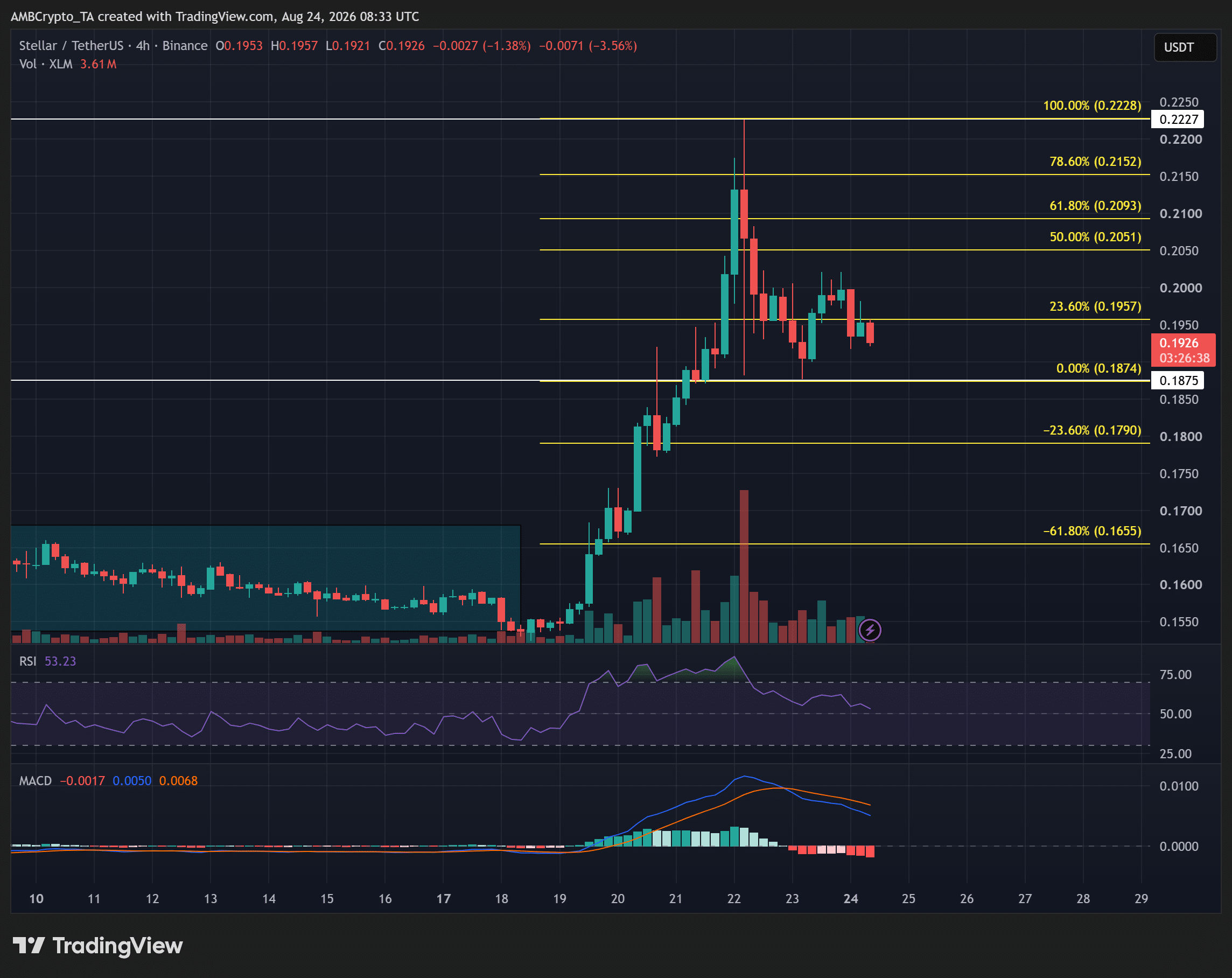
Even so, the original breakout base remains intact, keeping the broader structure steady for now. Putting it into perspective, bulls must first recover $0.1957, it being the nearest resistance before testing the midpoint at $0.2051.
Beyond the $0.2051 midpoint, resistance strengthens at $0.2093 and $0.2152 because earlier buyers may sell as the price approaches their entry levels. Meanwhile, RSI has cooled to 53.23, while the bearish MACD crossover shows that near-term momentum still favors sellers.
However, declining volume shows limited urgency behind the retreat. That makes support the next decisive test. A four-hour close below $0.1874 would break support, shifting attention toward $0.1790 and then $0.1655.
XLM bulls defend the breakout zone
The support test becomes clearer when price swings and volume are considered. XLM fell 13.5% from $0.2228, moving far beyond its recent $0.01 average range. This confirmed a strong correction, rather than a brief pause.
Selling volume increased while large red candles erased about two-thirds of the earlier rally gains. Later on, the price then returned to the $0.1874–$0.1957 zone where trading was previously concentrated.
At this point, however, XLM’s last four-hour candle sizes have decreased. That indicates selling pressure is decreasing, but there hasn’t been enough buying activity to gain control over the market yet.
Holding within the zone would keep the breakout structure intact. A wider decline below $0.1874 would instead show sellers remain dominant and open a deeper pullback.
RWA activity strengthens XLM
In contrast to XLM testing support, Stellar’s growing activity shows that there is increasing interest in the underlying demand for the service. Stellar’s RWA increased dramatically from $1.09 billion in January to $3.05 billion at the end of June, according to its Q2 report.
Growth accelerated after March, climbing from $1.52 billion to $2.30 billion in April, before later reaching $2.89 billion in May. This pace was four times faster than the wider tokenization market, which expanded about 50%.
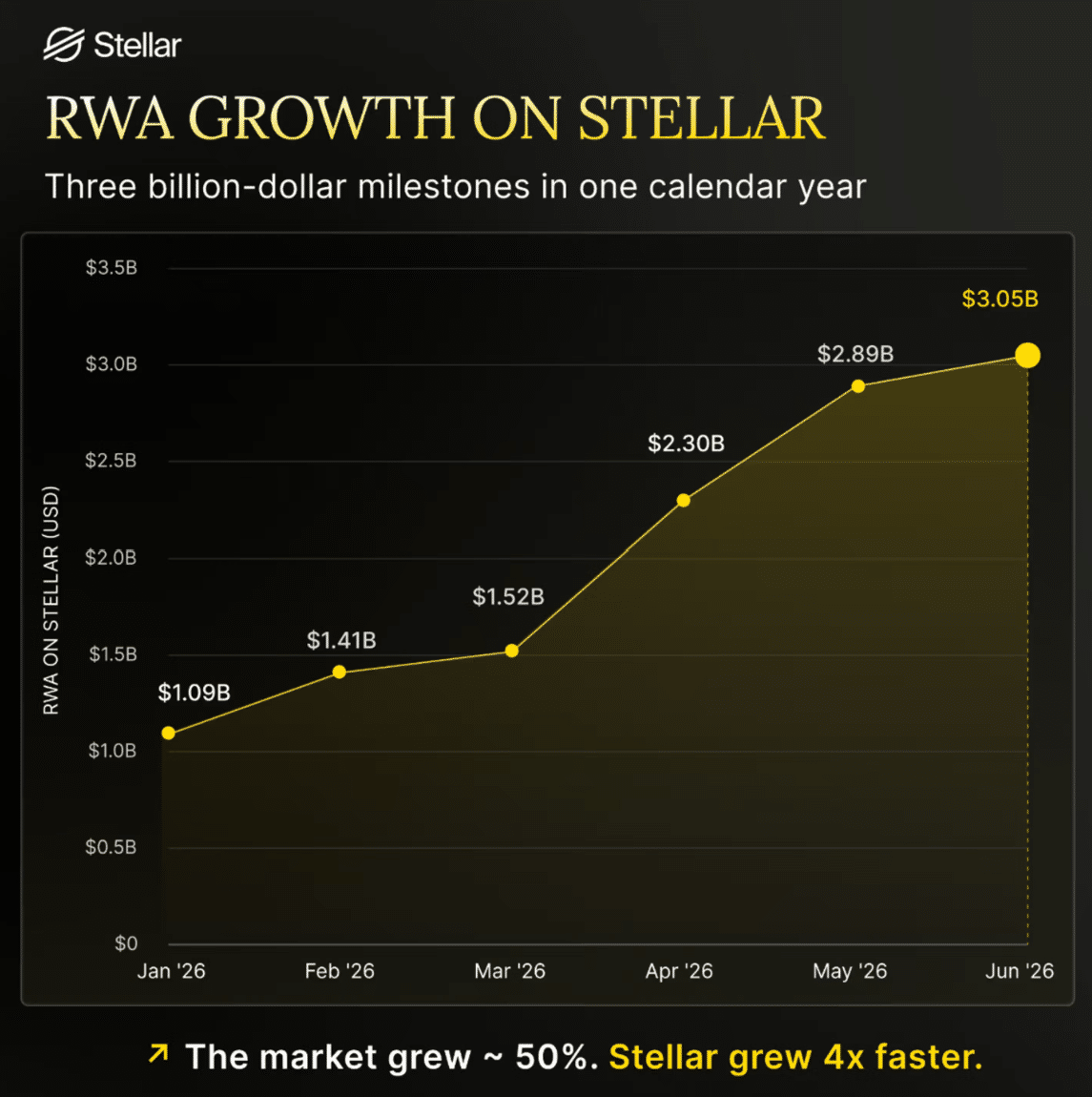
Notably, growth covered Treasuries, sovereign bonds, private credit, money-market funds, and tokenized gold, reducing reliance on one asset class.
At the same time, the transfer of stablecoins hit an all-time high of $11.4 billion during Q2 and had grown 72% per quarter. All in all, rising assets and faster transfers show Stellar gaining both stored value and active financial use.
Final Summary
- XLM holds its $0.1874 breakout base, but reclaiming $0.1957 is crucial for recovery.
- Stellar’s RWA value hit $3.05 billion as Q2 stablecoin transfers reached $11.4 billion, strengthening network activity.