Solana is about to make transactions 3.3× bigger. That matters more than the number

Crypto loves a speed headline.
Transactions per second. Finality. Block times. Fees.
But one of Solana’s more interesting upgrades is about something less glamorous: room.
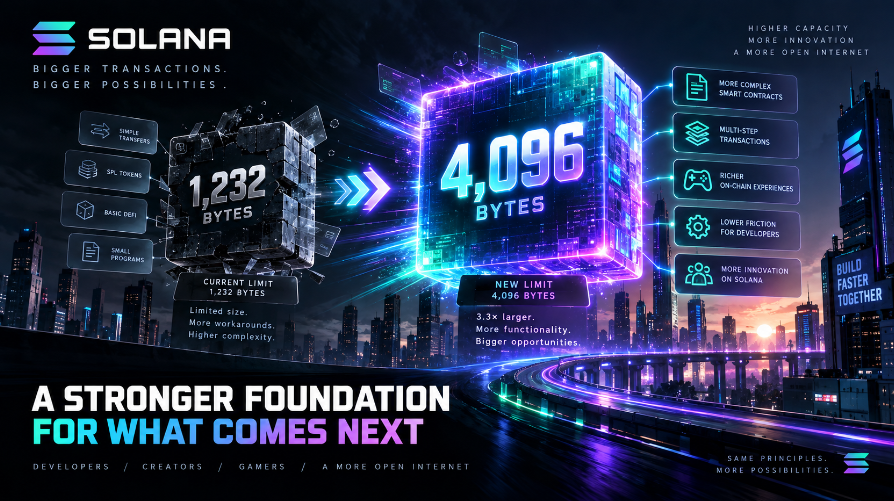
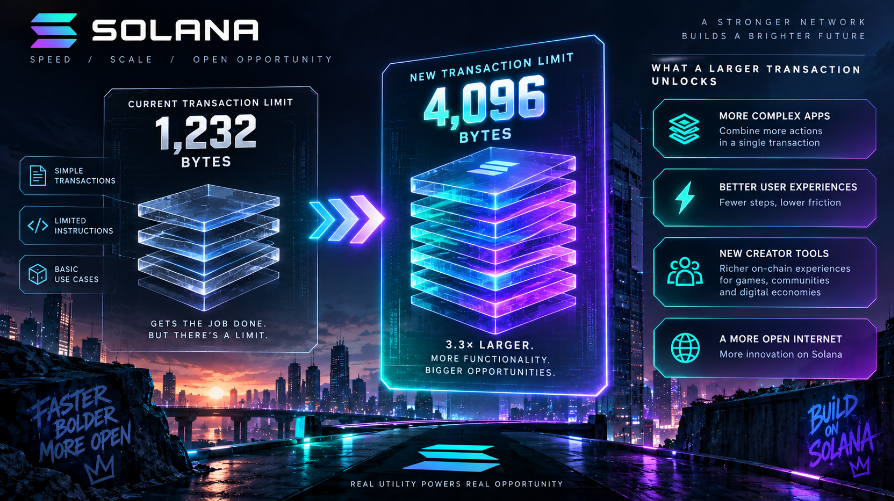
The Solana Foundation is preparing a new v1 transaction format that raises the maximum transaction size from 1,232 bytes to 4,096 bytes—roughly 3.3 times the current ceiling. Legacy and v0 transactions remain unchanged, while developers who need the additional space can opt into the new format.
That sounds like an engineering footnote. It is not.
A transaction is the container that carries instructions, account information, signatures, and other data through the network. Making that container larger does not automatically make Solana faster, but it can let developers package more sophisticated operations into one atomic action instead of splitting them into several coordinated steps.
The old limit was a networking constraint, not an economic law
Solana’s 1,232-byte ceiling dates back to a practical networking decision.
The chain originally kept transaction payloads small enough to fit within a conservative IPv6 maximum transmission unit after network overhead. That made sense when the protocol was designed, but Solana’s networking stack has since moved to QUIC, giving the network more flexibility in how it handles larger payloads.
SIMD-0296 proposes a 4,096-byte maximum. The accompanying v1 transaction format is designed to carry that larger payload while keeping legacy and v0 transactions working as they do today.
The Solana Foundation says the extra room is aimed at workloads such as zero-knowledge proofs, larger multisignature schemes, BLS signatures, and other operations that can be difficult or impossible to fit inside the existing limit.
The key word is atomic.
If several dependent actions can fit into one transaction, they either succeed together or fail together. That can reduce the coordination problem created when a developer has to break one logical operation into multiple transactions and then manage the states between them.
For users, the improvement may eventually feel like nothing happened. That is usually a sign infrastructure is doing its job.
More room does not mean unlimited complexity
A 3.3x larger transaction is not a blank cheque for developers.
Solana’s proposed v1 format still preserves important constraints. Account and instruction limits do not suddenly disappear. Developers also have to adopt the new format; applications that continue using legacy or v0 transactions keep the old size ceiling.
There is another trade-off: v1 transactions do not use address lookup tables in the same way v0 does. Instead, the larger envelope makes it possible to carry more addresses directly inside the transaction.
That is why the upgrade should not be read as “Solana can now do 3.3x more of everything.” It is better understood as a removal of one specific bottleneck. The network is giving developers more space to express a complex action without forcing the action into several pieces. Whether that matters depends entirely on what developers build with it. And that leads to the part token markets often skip.
An upgrade is not a price catalyst until somebody uses it
Infrastructure upgrades create capability. Markets create value only when capability turns into demand.
A larger transaction format can make Solana more attractive for applications using zero-knowledge systems, complex security schemes, or heavier multi-step logic. But it does not automatically create users, fees, liquidity or demand for SOL.
Even the Solana Foundation’s own upgrade page treats the feature as an implementation milestone rather than a promise of economic impact. Developers need to update. Wallets, RPC providers, and indexers need to understand the new format. Applications need a reason to use it.
That distinction matters for anyone evaluating crypto infrastructure.
Blockchains are increasingly competing not just on raw speed, but on how much complexity they can hide from the end user.
The winning consumer application may not advertise that it uses a 4,096-byte transaction. It may simply let a user complete something that previously required several approvals, multiple signatures, or awkward intermediate steps.
The technical upgrade matters most when the user stops noticing it.
Consumer crypto is moving toward invisible infrastructure
That is especially relevant for gaming, creator platforms, and other consumer-facing applications.
Most users do not want to understand transaction formats. A creator completing a campaign wants to know what the brief is, whether the submission was approved, and when the reward arrives. A gamer wants the application to work. A sponsor wants a reliable workflow.
The blockchain can handle ownership, settlement, access, or token utility underneath that experience without becoming the experience itself.
Wanted Network is one example of a project taking that approach.
The platform is building a creator campaign network around Missions, submissions, creator reputation, and advertiser-funded opportunities. Heat is the creator score used for reputation, ranking, and eligibility. WNTD is documented separately as the planned Solana SPL utility token for creator rewards, platform access, promotional activity, and broader ecosystem participation.
None of those current or planned mechanics depend on Solana’s v1 transaction format, and the larger transaction limit does not suddenly change Wanted Network’s product.
The connection is more structural.
Projects like Wanted Network are using Solana as an economic layer beneath a product whose users may care far more about creators, campaigns, and rewards than transaction serialization. As the underlying chain becomes more flexible, developers have more room to build sophisticated systems without forcing blockchain complexity into the foreground.
That is a much more mature Web3 proposition than making every user interaction feel like a blockchain demo.
The real test starts after the upgrade
Solana’s move from 1,232 to 4,096 bytes will be easy to turn into a big-number headline. The more important question is whether developers actually use the space. If v1 transactions make zero-knowledge applications simpler, multisig systems cleaner, complex consumer flows more atomic, or new application architectures practical, then the upgrade will have done something meaningful. If developers do not adopt it, the larger number will mostly remain a technical capability waiting for demand. That is the pattern worth watching across crypto.
Networks are getting faster, cheaper, and more flexible. The next competitive advantage may come from what builders can remove from the user experience—not what they can add to the marketing page. For Solana, 4,096 bytes is not the story. What developers manage to fit inside them is.
Explore Wanted Network
Whitepaper
X
Get Seen, Get Paid, Get Wanted
Disclaimer: This is a paid post and should not be treated as news/advice.