Bitcoin at $60K — Why crowd fear and market positioning tell different stories
Bitcoin's recent slip has investors reacting like never before.



There is nothing mathematically special about $60,000. No protocol rule enforces it and no on-chain mechanism defends it. And yet, when Bitcoin slips below this level, the market reacts as if the end is nigh.
The reasons behind these breakdowns are part mechanics and part psychology. This was seen recently as within hours of BTC falling below that level, people stopped discussing macro liquidity and ETF flows. Instead, they moved to existential questions about whether the cycle is over.
However, the biggest problem currently is that the loudest reactions are rarely the most informative.
A sentiment article that simply reports that everyone is panicking adds nothing. The useful question is how sentiment is being measured, which cohorts are actually reacting, and where crowd thinking differs from what traders are doing with their money.
Reading the mood of investors: Some panic, others are apathetic
Let’s start with the Crypto Fear & Greed Index. At press time, it stood at 19, signalling extreme fear in the mood of investors. Here, it is important to note that the market has remained in a “fear” state since 5th November 2026.
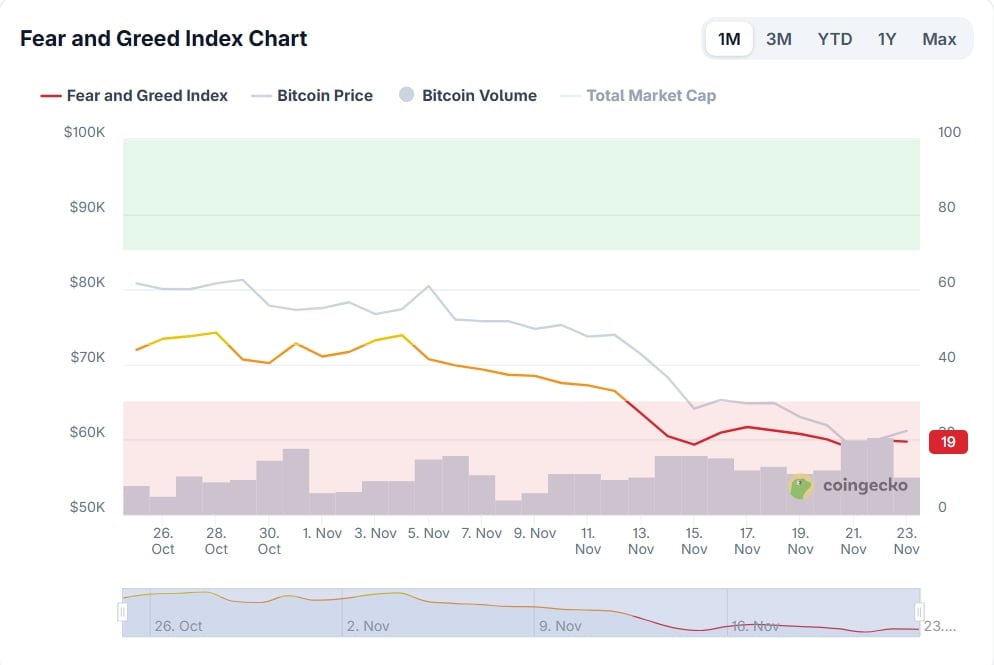
However, when you compare just the index with on-chain data, a more nuanced picture emerges.
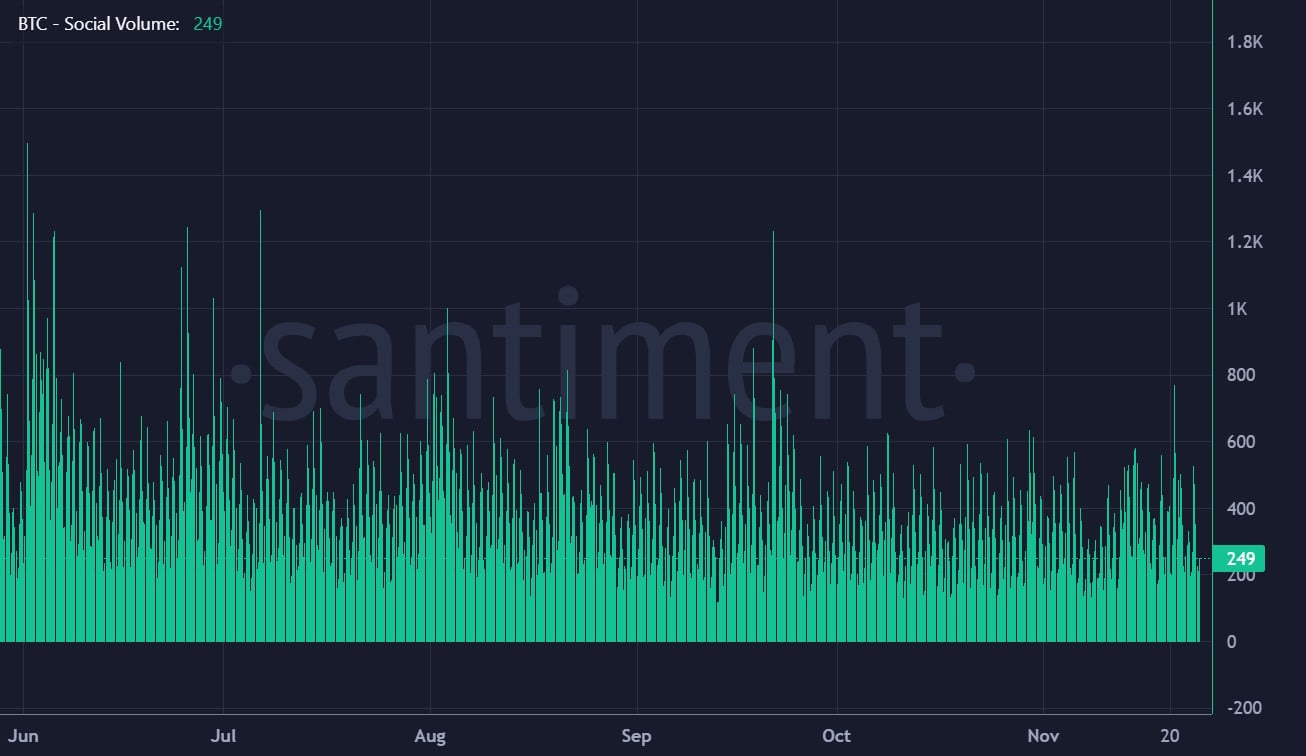
Panic shows up as spikes in social volume due to fearful language, liquidation spikes, and urgent questions about whether to sell. However, apathy looks different — this is seen primarily in Bitcoin’s falling social volume.
Even Twitter, the first place for netizens to voice their concerns, has been either completely silent, panicked, or claims that the crypto market is dead and it’s time to move away.
These two datasets, when seen beside each other, imply very different market states. Panic is often seen in short bursts. However, apathy is infinite. It is more difficult to bring an investor back once they have decided that they are done with the industry.
Moving on, on-chain behavior provides a clear test of whether headline fear matches actual coin movement. Notably, Bitcoin’s exchange netflows recorded nearly 10,000 BTC in net outflows as the price bottomed out.
This divergence — fear in social sentiment paired with aggressive removal of Bitcoin from exchanges — suggested that the heavy withdrawals were, in reality, being met with quiet accumulation.
Historical context and the contrarian trap
Every major psychological threshold has its own narratives, with the prevailing drawdown also inviting comparison with previous breaks.
In several prior cycles, extreme fear readings and depressed Funding Rates coincided with exhaustion rather than the beginning of a multi-year bear trend.
One can assume that the same theory will hold true even now because Bitcoin is not a one-time wonder. This is something it has proven time and again. It is resilient and a market mover, ideally an asset that is here to stay.
Markets can stay fearful longer than expected, false bottoms are common, and extreme fear can precede further declines just as easily as it can mark a reversal. The contrarian trap is assuming that because sentiment is extreme, the move is over.
Conclusion
The break below $60,000 will be remembered, if at all, as a test of narratives rather than a verdict on Bitcoin’s strength. Such price levels are emotional landmarks if anything, but the fear they generate is also quite real.
Social sentiment captures the loudest voices, but on-chain behavior captures the convictions of those who have seen such cycles before.
With Bitcoin [BTC] at a level that has not been seen in the past few years, investors may be tempted to pick the one that confirms their biases. However, the more disciplined approach will be to hold all contrarian theories and accept the fact that they describe different parts of the same market.
Sentiment tells us where the crowd stands emotionally, while positioning tells us where the crowd stands financially. The gap between the two is where the useful analysis lives.
The $60K-break is not the end of a cycle or the beginning of one. It is a moment when psychology and mechanics briefly pull in different directions, and the work of reading the market is to notice which one is leading.
Final Summary
- Bitcoin’s falling social volume is indicative of a high bearish tone, but there have also been emerging signs of active capitulation.
- Extreme fear readings are currently co-existing with long-term holder accumulation and neutral Funding Rates. In such a scenario, investor positioning usually tells the more reliable story.