BIP-110 UASF begins with 2.53% miner support – Bitcoin’s biggest governance test yet
Will miners eventually accept or reject BIP-110?


The BIP-10 debate has taken a new turn.
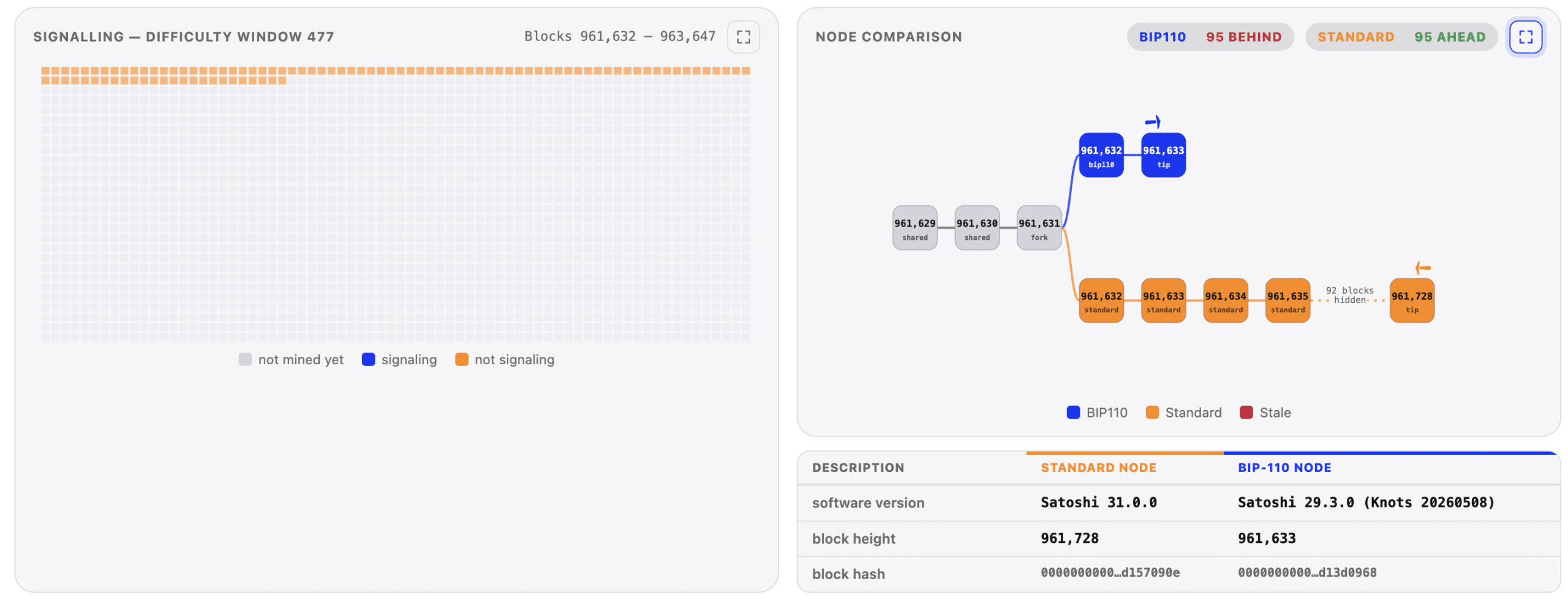
A recent update from the BIP-110 Situation Monitor states that Bitcoin [BTC] has reached block 961,632, the point at which supporters of BIP-110 who were using modified Bitcoin software began enforcing their own regulations.
Under this guideline, miners’ blocks would be rejected unless they used version bit 4 to indicate support for BIP-110.
For context, BIP-110 is an attempt to temporarily alter the rules of Bitcoin to make it more difficult to use Bitcoin block space for non-financial data, such as text, images, and inscriptions.
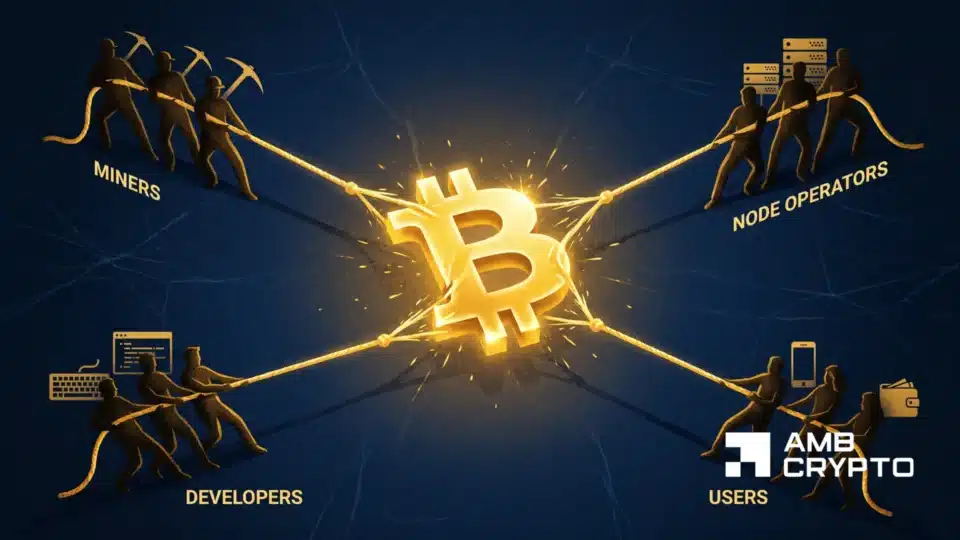
Here, the controversy is not limited to the data restrictions. Rather, it concerns who has the authority to determine the rules of Bitcoin – miners, node operators, developers, or users – and what happens when those groups disagree.
Role of miners in BIP-110
The key difference is that not everyone’s experience with Bitcoin was altered by this new block. Regular Bitcoin nodes that had not embraced BIP-110 kept up with the latest regulations.
In fact, miners were given the chance to indicate whether they supported BIP-110 before the start of this mandatory-signaling phase. Of the 2,016 blocks that came before, only 51 (or roughly 2.53%) indicated support.
Compared to the 55% threshold set by BIP-110 for activation without a contentious chain split, that is incredibly low. Put differently, the miners did not indicate support in large numbers.
This is significant because the processing power, or hash power, that creates Bitcoin blocks is under the control of miners.
Almost all miners will continue to produce blocks that are deemed invalid by BIP-110-enforcing nodes if they continue to do so under the current rules.
This makes it possible for there to be two chains: one that represents the current Bitcoin rules and another that represents the BIP-110 rules.
What does BIP-110 want to change?
For its part, BIP-110 seeks to temporarily restrict the use of Bitcoin for inscriptions and other non-financial data. It would limit some Taproot features, data pushes, witness elements, and some OP_RETURN outputs for about a year.
Proponents contend that doing so would lower the demands on blockchain storage and bandwidth while maintaining Bitcoin’s focus on monetary purposes.
However, opponents contend that anyone who pays the necessary transaction fee ought to have unrestricted access to the block space. In fact, Michael Saylor also listed 110 reasons why he thinks BIP-110 is a bad idea.
Yet, despite this, supporters of BIP-110 are attempting to enforce new regulations through a UASF despite the lack of miner support.
How will this impact Bitcoin?
Although there won’t be much of an immediate effect on Bitcoin, the scenario serves as a live test of Bitcoin governance.
The proposal might become popular if miners eventually accept it. If not, the minority chain might continue to be too weak to compete.
Therefore, the coming weeks will show whether BIP-110 can maintain a minority fork, garner support, or eventually lose steam.
Final Summary
- Out of the 2,016 blocks that came before the mandatory-signaling phase, only 2.53% of miners indicated support.
- Of the many critics, Michael Saylor recently listed 110 reasons why he thinks BIP-110 is a bad idea.