Brazil targets self-custody crypto with $10K reporting rule, 24-hour transfer delay
Growing anti-money laundering pressure is targeting crypto's anonymity and instant transfer features.



Brazil crypto rules are set to get tougher in Q4 2025 and get even stricter from next year.
The Central Bank of Brazil’s order this week formally expands reporting requirements for crypto transfers above $10K across self-custody wallets.
Here, it’s worth noting that the new reporting regime is not strictly on crypto transfers. Any payments or funds transfers via foreign exchange or local cash above R$50,000.00 (about $10K) must be reported.
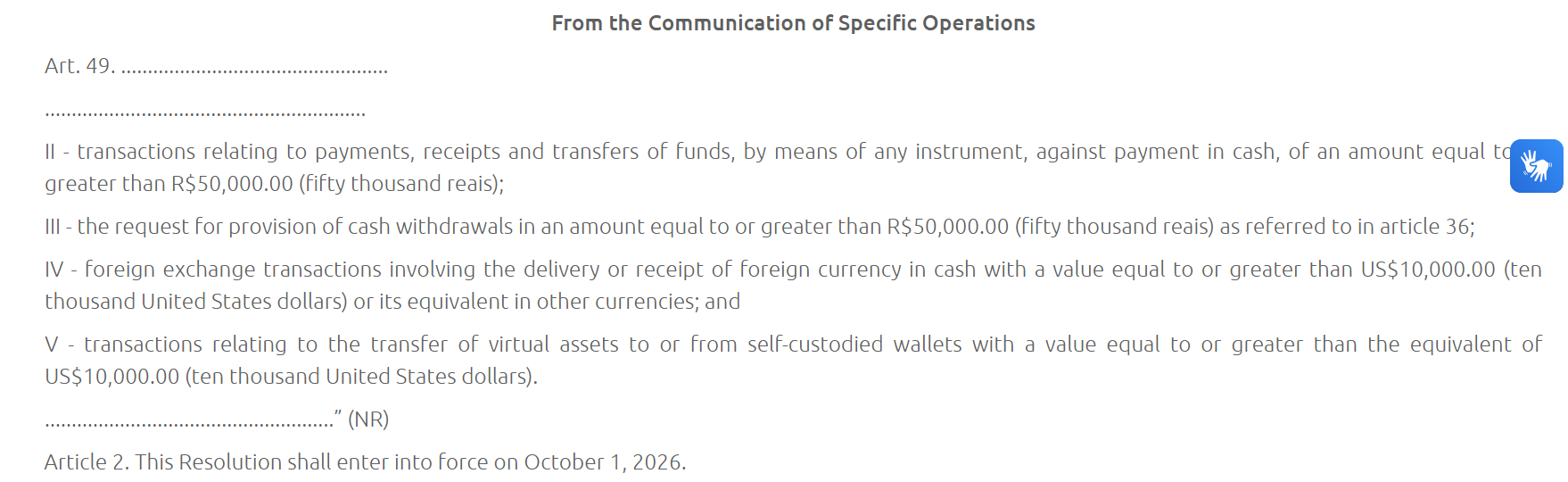
In the statement, the Central Bank of Brazil said the move is aimed at “preventing the use of the financial system for money laundering, concealment of assets or financing of terrorism.” The rule will be effective from 1st October.
However, the scrutiny over crypto assets has intensified.
Brazil imposes 24-hour delay for crypto transfers
Last month, Brazil imposed a mandatory 24-hour delay for crypto transfers. According to the country’s central bank, the move is aimed at minimizing harm to victims of fraud, while also helping law enforcement rein in anti-money laundering (AML) or illicit flows.
It argued that the instant settlement nature of crypto transfers makes it challenging to catch fraudsters and block illicit flows in time. The rule will go into effect in January 2027.
The surprising part, however, is the country’s plan to integrate with the European instant payment system.
In other words, the two are fast-tracking an interconnected Brazil and Euro-area public payment system for fast transfers. And yet, it will throttle crypto transfers to act as an anti-fraud and crime buffer to catch the so-called “money launderers.”
Interestingly, the U.K, Australia, and Singapore also have a similar buffer system with a 24-72 hour delay for outbound and inbound transfers to risky crypto platforms.
The EU, however, relies on the Travel Rule, which mandates crypto exchanges to stop and verify cross-border transfers before clearing them. In fact, this is the model that Bulgaria and Thailand have adopted, and they all touch on self-custody transfers.
The Travel Rule is being widely pushed globally by the Financial Action Task Force (FATF), the international agency that formulates AML and anti-terrorist financing rules.
Overall, crypto’s partial anonymity will be aggressively fought from 2027 amid coordinated global AML pressure.
Final Summary
- Brazil will enforce reporting for +$10K crypto transfers across self-custody wallets from October.
- It will also impose a 24-hour mandatory crypto transfer delay as an anti-fraud and crime buffer.