EU targets $54B DeFi sector as Aave slams Morpho’s vault proposal as ‘self-serving’
Here's how EU approach to crypto lending regulation differs from the U.S.



The European Union [EU] wants to bring crypto lending within the scope of the MiCA framework. In a recent policy review, the European Banking Authority (EBA) said that DeFi lending and borrowing should be regulated.
EBA crafts policy and regulates the EU-wide banking sector to ensure financial stability and user protection.
According to EBA, crypto lending, either via an intermediated interface of crypto asset service providers (CASPs) or DeFi protocols, can offer regulatory arbitrage for stablecoin yields.
MiCA banned stablecoin yield, but some, such as Circle’s USDC and EURC, still earn yield via DeFi strategies. For EBA, this could cause more problems,
Thus, the activities (DeFi lending) may pose regulatory arbitrage risks. Additionally, the EBA and ESMA have identified a series of potential consumer protection risks.
The consumer protection risks highlighted by the watchdog include over-leverage, contagion risks, hacks, and fraud.
To mitigate against these risks, EBA proposed a few considerations, including leverage caps, disclosure requirements, and cyber resilience-based certification for DeFi protocols.
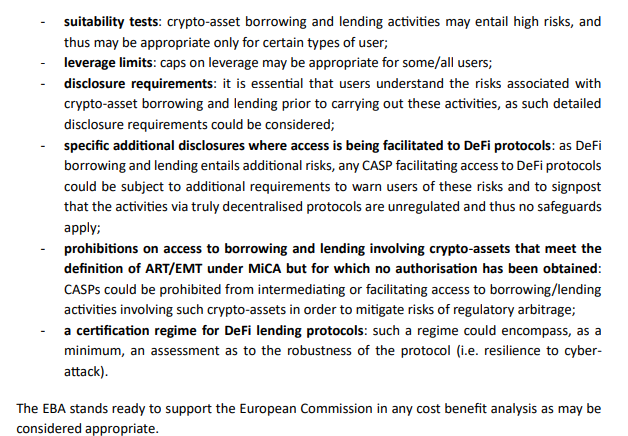
Additionally, the proposed rules could bar unlicensed stablecoins such as USDT from DeFi lending. Regulators would likely focus on platforms that give users access to DeFi protocols through intermediated lending and borrowing.
The proposed EU approach differs from the U.S. Securities and Exchange Commission’s (SEC) approach. The SEC warned that securities laws could apply when curators actively manage vaults to generate yield. The treatment of fully non-custodial vaults remains less clear.
Still, leading industry players disagree on how regulators should classify on-chain vaults and which rules should apply.
Aave disagrees with Morpho on DeFi vaults
Vaults pool users’ assets and deploy them across lending opportunities. Some follow preset rules; others give curators discretion over where the assets go.
The segment held roughly $10 billion across more than 4,000 deployed vaults, within a $54 billion DeFi lending market.
However, Aave and Morpho, some of the top DeFi lending giants, are undecided on the classification of vaults for regulation.
Why did Aave challenge Morpho’s vault model?
For his part, Morpho CEO Paul Frambot proposed two categories: non-custodial and discretionary vaults. According to him, non-custodial vaults will limit curators’ role and allow user flexibility (including exit capacity or time lock).
In contrast, discretionary vaults should be managed by asset managers, but will trigger the SEC’s securities laws.
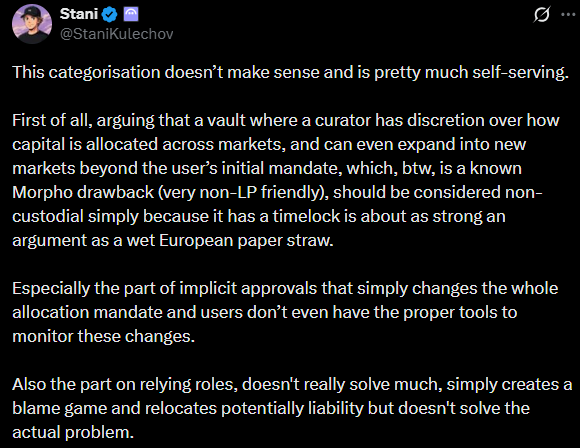
However, Stani Kulechov discredited Frambot’s non-custodial vault proposal as weak.
This categorisation doesn’t make sense and is pretty much self-serving. Vaults that could reasonably be considered non-custodial are those without a manager. There’s nothing inherently wrong with discretionary vaults, as long as the regulatory path is figured out.
Overall, the EU wants to expand MiCA oversight to crypto lending and borrowing, yet the industry is undecided on how to classify vaults.
Final Summary
- European banking regulator wants crypto lending to be regulated under MiCA with leverage caps and DeFi certification.
- Aave’s Kulechov discredited Morpho’s proposed vault classification model for US regulation.