

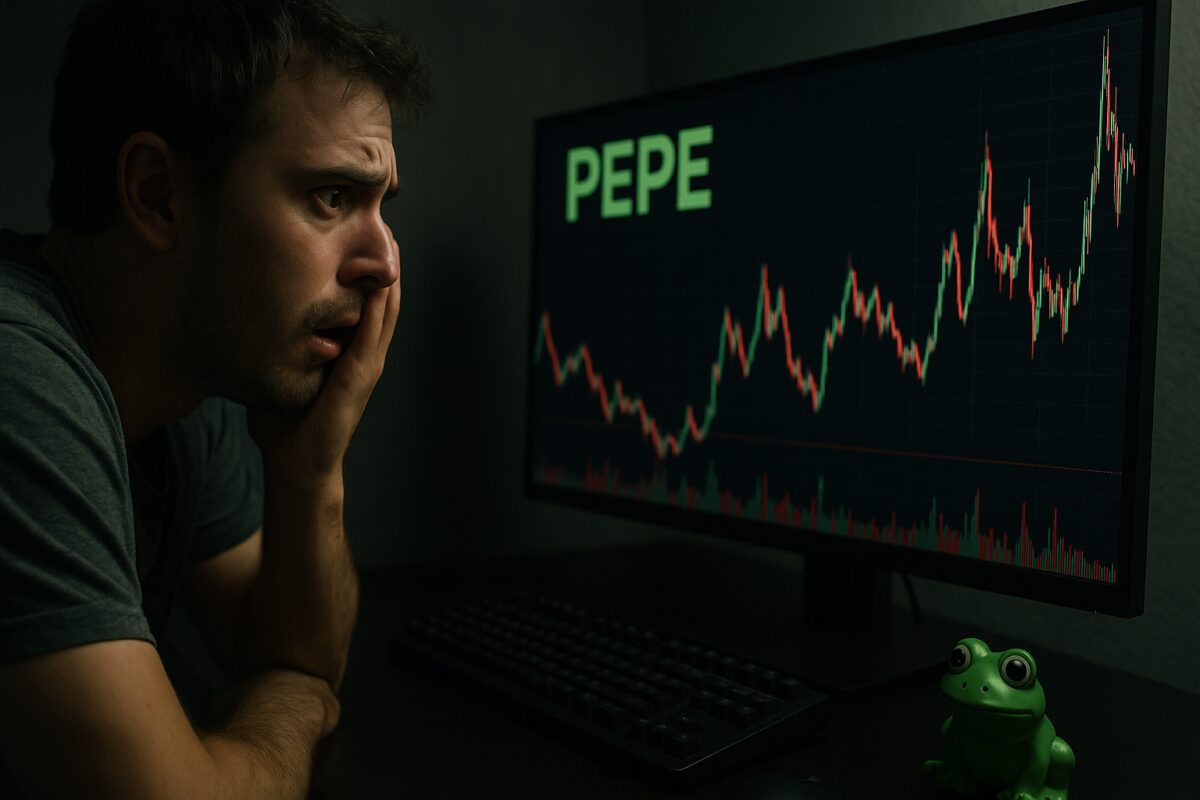
Pepecoin (PEPE): Cracking the Meme Coin Code – A Gamble Worth Taking?
Pepecoin (PEPE) shot onto the Ethereum scene in April 2023, a meme coin blatantly piggybacking on the internet-famous “Pepe the Frog.” Its creators weren’t shy about their goal: to chase the wild, viral rides of tokens like Dogecoin and Shiba Inu. PEPE quickly made a splash, becoming a hot trade almost overnight. Some say it hit a market cap over $1 billion just weeks in, with wilder tales of a $5 billion peak. But is all this frenzied buying anything more than a shot in the dark?
The Frog That Hopped Across the Internet
Pepe the Frog wasn’t born a crypto mascot. He first appeared in Matt Furie’s 2005 comic, “Boy’s Club.” Around 2008, this green, human-like frog started his internet takeover, popping up on Myspace, Gaia Online, and 4chan. By 2015, you couldn’t scroll through 4chan or Tumblr without seeing him – “Sad Frog,” “Smug Frog,” or just his classic “Feels Good Man” face, all used to show how people felt online.
A Meme Sullied by Hate
Though Pepe started as just a funny frog, around 2015, the alt-right grabbed his image. Suddenly, he was linked to white nationalism and antisemitism. This hijacking got so bad that in 2016, the Anti-Defamation League (ADL) listed Pepe the Frog as a hate symbol, even though they admitted most uses were still harmless. The frog’s face even showed up during the 2016 U.S. presidential election, sealing his controversial reputation.
Matt Furie, the guy who drew Pepe, has loudly condemned this misuse. He’s taken legal action against those twisting his art for hateful ends and even tried to “Save Pepe” with campaigns to bring back the frog’s innocent vibe. Despite his best efforts, the meme remains a touchy subject. Ironically, pro-democracy protestors in Hong Kong also adopted Pepe, giving him a completely different symbolic life.
Pepecoin’s Playbook: All Meme, No Promises
The shadowy figures behind the Pepecoin (PEPE) crypto are quick to say their coin has nothing officially to do with Matt Furie or his frog. They hype PEPE as “the most memeable memecoin in existence,” while flat-out admitting it has zero real value and won’t make you rich. “For entertainment purposes only” is their constant refrain.
Pepecoin’s story is pure internet meme culture and the wild-west speculation that defines meme coins. Its lightning-fast climb was all thanks to social media going nuts and a die-hard group of early believers.
What Made the 2023 PEPE Token Tick?
- It’s an ERC-20 token, meaning it lives and breathes on the Ethereum blockchain.
- Some PEPE versions try to shrink the supply; they “burn” a tiny bit of every transaction, hoping fewer coins mean higher value.
- Others claim to kick back a slice of transaction fees to people holding the coin, encouraging them not to sell.
- Certain PEPE flavors also boast about having no transaction taxes, a lure for frequent traders.
Two Frogs, Two Coins: 2016 Original vs. 2023 Upstart
Don’t mix up the PEPE token that blew up in 2023 with an older, totally separate crypto also called Pepecoin, born in 2016. That first Pepecoin was a Layer 1 blockchain you had to mine, like Bitcoin or Dogecoin. It got tangled in the Pepe the Frog controversies, even getting renamed “Memetic” on some exchanges. Some old-school crypto folks call the 2023 Ethereum PEPE an “imposter,” whispering about a “Pepening” where the 2016 original might try to outshine the newer, flashier version. And just to muddy the waters more, there’s Pepe 2.0, another rival to the 2023 PEPE, which slaps a 1% tax on every trade.
So, the Pepecoin (PEPE) everyone was talking about in 2023 is an Ethereum meme coin riding the coattails of the Pepe the Frog image. While the meme itself has a messy, controversial past, the crypto project sells itself as a pure gamble, a digital toy for its community in the meme coin sandbox.
Tokenomics Deep Dive: PEPE (ERC-20) vs. Pepecoin (Layer 1)
When you hear “Pepe” in crypto, you need to ask: which one? There’s Pepe (PEPE), the ERC-20 token on Ethereum, and then there’s Pepecoin (PEPECOIN), its own Layer 1 blockchain that kicked off back in 2016. They’re not the same beast.
1. Pepe (PEPE) – The Ethereum Meme Sensation
- Supply Story: PEPE has a mind-boggling 420.69 trillion tokens, and every single one is supposedly out there floating around.
- How It Got Out: No presale games here. 93.1% of all PEPE tokens went straight into a liquidity pool when it launched. The team keeps the other 6.9% in a multi-signature wallet, saying it’s for future exchange listings, building bridges to other cryptos, and beefing up liquidity pools.
- The Burn Factor: PEPE tries to be deflationary. A tiny piece of each transaction gets zapped out of existence. The idea? Fewer tokens, more scarcity. When it launched in April 2023, word was that half the total supply (around 210 trillion tokens) got torched right away to create this scarcity. Yet, the circulating supply often matches the max supply, hinting that “burned” tokens might reappear, new ones could be minted, or they’re being dished out for staking and rewards.
- Inflation or Deflation? It’s built to be deflationary because of the token burn, hoping to push up the value by shrinking the supply.
- Other Tricks:
- Sharing is Caring? They say a bit of every transaction gets sprinkled back to existing holders, a nudge to keep people from selling.
- Tax-Free Trading: PEPE boasts about having zero taxes on its transactions.
2. Pepecoin (PEPECOIN) – The Original Layer 1 Blockchain
- Supply Numbers: The old-timer, Pepecoin (PEPECOIN), aims for a cap of roughly 133.77 million tokens. Right now, about 107.82 million exist, with nearly all of that (107.06 million) actually circulating.
- Mining and Moving: Launched in 2016, PEPECOIN later shifted gears to work with Ethereum’s smart contracts and decentralized exchanges (DEXs). You can mine it alongside Litecoin, Dogecoin, and Bellscoin. Miners get 500,000 PEPECOIN per block, but that reward will shrink over time through halvings, eventually down to 10,000 PEPECOIN.
- Burning This One Too: Recently, PEPECOIN also started burning a small bit of each transaction to become deflationary. Burning PEPECOIN can supposedly earn “brain credits” for something called the BasedAI network.
- Inflation to Deflation Shift: It used to be inflationary, adding new coins each year (like Dogecoin, where the inflation rate drops as a percentage of the total over time). Now, with the burn, it’s deflationary.
- What Else?
- Its Own Chain: Unlike the ERC-20 PEPE, this one runs on its own blockchain.
- Building an Ecosystem: The Pepecoin project claims several apps: PepeOS, Pepe Paint (for NFTs), Kek Bot (an AI trading tool), BasedAI (a Layer 1 for something called zk-LLMs), and Pepe Messenger.
Bottom line: if you’re looking at “Pepe” crypto, double-check which one you’re dealing with. It’s easy to get them mixed up.
The Mystery Men (and Women?) of Pepecoin: Anonymous and Accused
The crew behind the big-splash meme coin Pepecoin (PEPE) has mostly stayed in the shadows, a common but sketchy habit in crypto. This kind of secrecy can scare off investors who want someone to hold accountable.
Pepecoin popped up in April 2023 without any early sales or an Initial Coin Offering (ICO). Its makers used Twitter and Telegram to whip up a community and get the word out. The official Pepecoin website is very clear: no link to Matt Furie, and $PEPE is just a meme coin with no real value or promise of riches. They even say it doesn’t have a proper team or a plan.
Things got messy in August 2023. A Twitter personality, KOL Pauly, pointed fingers at landscape photographer Zachary Testa, claiming he was the brains behind Pepecoin. Pauly said Testa and his buddies made a fortune from PEPE, possibly without giving Matt Furie a dime. Right around then, a huge stash of about 16 trillion PEPE tokens moved from the team’s multi-signature wallet to big crypto exchanges. Pepecoin’s price nosedived over 15%, and people started screaming “rug pull!”
Trying to calm things down, the Pepecoin team supposedly announced a new advisory board in October 2023 to steer the project, telling everyone the remaining money was safe. Still, some folks weren’t buying it.
It’s tough to judge the team’s reputation when they’re anonymous and dogged by controversy. Pepecoin’s quick launch and rocket ride to a billion-dollar market cap in three weeks showed they knew how to use social media and meme magic to create buzz. But the accusations and big token dumps seriously hurt the coin’s price and people’s trust.
Their official line – “no formal team or roadmap” and “completely useless and for entertainment purposes only” – makes it hard to judge them by normal standards. Some point out Pepecoin has stuck around longer than newer meme coins, having launched in 2023 and seen some big price jumps. It’s also true the Pepe the Frog meme itself has a checkered past, hijacked by alt-right groups, though its creator fought to clean up its image.
Pepecoin itself is an ERC-20 token on Ethereum. It burns tokens with each transaction to be deflationary and supposedly gives some back to holders. It also brags about a “no-tax policy.” But the anonymous team, the crazy ups and downs of meme coins, and the admission of no real value or use are huge red flags for anyone thinking of jumping in.
So, while they initially showed a talent for building hype, the mostly unknown Pepecoin team’s image has been battered by controversy over token sales and a general lack of openness. Their own claims of uselessness, mixed with the usual meme coin dangers, are big things to consider before getting involved.
PEPE’s Price: A Wild Ride on the Hype Train
Pepecoin (PEPE), the meme crypto that hit Ethereum in April 2023, has been on a financial rollercoaster, marked by insane climbs and brutal drops. Social media buzz and general market mood dictate its price, not any real value or purpose.
- Blast Off (April-May 2023): Pepecoin started tiny in April 2023, around $0.000000001. Fear Of Missing Out (FOMO) kicked in hard, and by May 2023, it exploded to $0.000004. Early birds saw a mind-blowing 1000x return, making it one of the hottest meme coins around.
- The Hangover (June-December 2023): After the initial frenzy, PEPE’s price chilled out, hovering around $0.0000008 by June and pretty much staying there through December 2023.
- Bouncing Back (Early-Mid 2024): As the broader crypto market picked up, PEPE slowly climbed in early 2024, hitting about $0.0000015. A fresh wave of interest in meme stuff, like NFTs and GameFi, gave PEPE another boost in March 2024, briefly shoving its price past $0.000007.
- New Peaks (Late 2024 – Early 2025): Reports claim that from November to December 2024, good market vibes pushed PEPE past its old all-time highs, supposedly reaching a stunning $0.00002835 on December 9, 2024.
- Lately (May 2025): As of mid-May 2025, PEPE is trading somewhere between $0.000010 and $0.000014. Over the past year (May 2024 to May 2025), its price jumped over 20%. In the month before mid-May 2025, it shot up by more than 80%. Daily trading volume stays huge, often over $1 billion. Depending on who you ask, its all-time high is around $0.00001717 (May 2024) or $0.000028, while its lowest point was $0.00000005514.
Pepecoin’s history is littered with “pump and dump” schemes, a classic meme coin problem. These are shady efforts to jack up the price, usually with social media hype and influencer shilling, before big holders cash out, crashing the price and often screwing over smaller investors. That May 2023 surge? Likely a massive FOMO-driven pump. Another big one reportedly went down in November 2024.
Wild price swings are Pepecoin’s signature. It’s a meme coin, so its value is tied to online chatter and gambling, not solid fundamentals. Price jumps often happen when social media is buzzing; when the hype dies, people sell off fast. The project’s own website admits it has no real value or promise of financial returns, famously saying, “The coin is completely useless and for entertainment purposes only.” This honesty just underlines how speculative and jumpy PEPE is. Analysts constantly point out how much PEPE reacts to market sentiment.
What moves PEPE’s price? Community feelings, market hype, speculative trading, general crypto market direction, and getting listed on big exchanges like Huobi and Gate.io, which made it easier to buy. But those listings don’t make it any less risky. Anyone thinking about investing needs to get that Pepecoin, like other meme coins, is a super high-risk gamble prone to sudden, massive price changes, and past wins don’t mean future success.
PEPE’s Market Pulse: Cap, Volume, and Where the Coins Flow
Pepecoin (PEPE), the meme coin that’s certainly made waves, has market numbers—capitalization, trading volume, liquidity—that everyone watches like a hawk.
Around mid-May 2025, Pepecoin’s market cap was a hefty $4.3 billion to $5.76 billion, give or take, depending on the exact moment and source. That parks it in the top 30 cryptocurrencies worldwide, usually bouncing between #23 and #31 on sites like CoinMarketCap and CoinGecko. You get that market cap by multiplying PEPE’s current price by how many coins are out there. And speaking of coins, the circulating supply is always listed as 420.69 trillion PEPE tokens – which is also its total and maximum supply. So, 100% of PEPE tokens are supposedly in play, meaning its fully diluted valuation is the same as its market cap.
In the 24 hours before May 15, 2025, anywhere from $780 million to $1.24 billion worth of Pepecoin changed hands. Some even said it was closer to $1.48 billion. This shows a market that ebbs and flows; sometimes volume drops, signaling traders are stepping back. For a bit of perspective, PEPE’s 7-day trading volume was once a massive $8.53 billion, and earlier figures showed 30-day volumes hitting around $61.40 billion. Big trading volume usually means traders and investors are paying attention.
Liquidity, or how easily you can trade a crypto without tanking its price, is key. For Pepecoin, it’s generally pretty high on the major exchanges.
You can trade PEPE on tons of centralized crypto exchanges. Some of the big players are:
- Binance: Often the go-to spot for PEPE, with low fees and plenty of trading pairs like PEPE/USDT, PEPE/TRY, PEPE/BTC, and PEPE/ETH. Binance even lets you trade PEPE futures with leverage and has loads of liquidity. The PEPE/USDT pair there often sees huge 24-hour volumes, like $150.76 million.
- Coinbase: Pepecoin is one of the hot cryptos on this major platform.
- Gate.io, OKX, Bybit, KuCoin, and Kraken: These are also popular, high-liquidity spots for PEPE trading.
- MEXC: Another one often mentioned for grabbing Pepecoin.
- Uniswap: If you prefer decentralized exchanges (DEXs), PEPE, being an ERC-20 token, trades on places like Uniswap. DEXs give you more control over your money but sometimes have less liquidity than the big centralized guys.
It’s super important to make sure you’re looking at the main PEPE (the ERC-20 token) and not some other crypto using the “Pepe” name that has way smaller market caps and trading volumes, like “PepeCoin (PEPECOIN).”
The project’s token plan says 93.1% of all tokens went into the liquidity pool. The LP tokens for that pool were supposedly burned and the contract renounced – moves meant to show transparency and security. The other 6.9% sits in a multi-signature wallet, saved for future exchange listings and more liquidity.
As of May 15, 2025, PEPE’s price was somewhere around $0.0000102 to $0.00001367. It’s seen some wild price swings, with its all-time high hitting $0.00001717 on May 27, 2024.
Getting Listed: How PEPE Reached the Masses
Pepecoin (PEPE), the meme coin sensation based on the “Pepe the Frog” internet character, grabbed a lot of attention in the crypto world after its April 2023 launch. This buzz helped it get listed on many major cryptocurrency exchanges, making it much easier for everyday investors to buy in.
You can find PEPE on a whole bunch of centralized crypto exchanges. Some of the top spots include:
- Binance: This is consistently a major hub for PEPE trading, offering tons of liquidity and volume for pairs like PEPE/USDT. Binance.US, its American branch, also lists PEPE. Binance Japan even added a PEPE/JPY pair.
- Coinbase: Another huge exchange that jumped on the Pepecoin bandwagon, boosting its visibility and access for both regular folks and maybe even some bigger players.
- Kraken: A well-known and trusted exchange where you can trade PEPE.
- KuCoin: Famous for low fees and often quick to list new tokens, KuCoin supports PEPE trading.
- OKX: A popular platform for trading PEPE.
- Gate.io: One more exchange where you can actively trade PEPE tokens.
- Bybit, HTX (what Huobi Global is called now), BitMart, BingX, LBank, MEXC: These platforms also frequently pop up as places offering PEPE, adding to its global liquidity.
- Robinhood: Has added PEPE to its crypto lineup, expanding its crypto offerings.
- Upbit: A big South Korean exchange that opened up a PEPE/Korean Won trading pair.
- Bitflyer: A major Japanese crypto exchange that listed PEPE in January 2025 on its Buy/Sell platform.
Getting Pepecoin onto these big exchanges has definitely made it easier for retail investors to get their hands on it. How? More liquidity means it’s simpler to buy and sell without drastically changing the price, which can (sometimes) help stabilize things (though meme coins are always wild). Reputable exchanges have easy-to-use platforms, often with mobile apps, making it straightforward for retail investors to sign up, deposit money, and trade PEPE. Plus, being on major exchanges gives a coin a certain shine of market approval and perceived trustworthiness, attracting more investors. The low price of meme coins, combined with easy trading on these platforms, makes Pepecoin a tempting, though incredibly speculative, choice for both new and seasoned investors. And because these exchanges are global, PEPE is available to retail investors all over the world.
But retail investors absolutely must remember the huge risks that come with Pepecoin. Insane price swings are part of the meme coin package, offering chances for big quick wins but also massive losses. The value of these coins is usually driven by hype and social media trends, not solid fundamentals or real use. The general craziness of the crypto market just adds to these risks. It’s vital for retail investors to do their homework, understand these dangers, invest wisely, and maybe even talk to a financial expert.
Pepecoin’s Purpose: Anything More Than Just a Meme?
Pepecoin (PEPE), which landed on Ethereum in April 2023 riffing off the “Pepe the Frog” meme, comes with a blunt warning from its makers: it’s worthless, won’t make you money, and has no real team or plan. They built it just for kicks.
Even with that honest pitch, Pepecoin has attracted a huge crowd, mostly thanks to internet jokes and social media hype. While most people see it as a pure gamble, some folks occasionally talk about potential uses or features beyond just betting on its price.
A big part of Pepecoin is its community and social scene. The creators say a strong community is what keeps it alive, aiming to make it the “most memeable memecoin” ever. Some fans have even tried building things like tip bots for Reddit and Discord.
The coin’s setup includes a way to shrink its supply: a tiny bit of every transaction gets “burned.” The goal is to slowly reduce the total number of coins, which, in theory, could make the remaining ones more valuable. A redistribution system, where some of each transaction fee supposedly goes back to existing holders, was an early idea to encourage people not to sell, though whether it’s still active can change. The official website also brags about a zero-tax policy on trades.
When it comes to NFTs and digital art, some imagine Pepecoin being used in NFT markets, playing on its famous frog image. Pepe-themed NFTs might grab collectors who are deep into meme culture, and the official website has hinted that users could get exclusive digital goodies like rare memes and art through its platform. Some early, vague plans mentioned an NFT collection down the road.
There’s also some chatter about DeFi uses and using it as money. If it could somehow plug into decentralized finance systems, that might open up new ways for people to use it. Some dream of a future where PEPE could buy stuff on platforms that accept it, but its wild price swings and the fact that almost nobody takes it are major roadblocks. One source did say you could use it for international payments via SEPA on the MEXC exchange.
Now, it’s really important not to confuse the ERC-20 PEPE token with a whole other thing called Pepecoin (PEP), which claims to be its own Layer-1 blockchain. That Pepecoin (PEP) is a spin-off of Dogecoin, trying to be a community-focused, decentralized crypto that supports things like inscriptions, ordinals, and can be mined alongside Litecoin and Dogecoin.
As for the ERC-20 PEPE’s future plans and ecosystem, roadmaps have usually been fuzzy, mentioning phases like “community partnerships,” “exchange listings,” and a “Pepe Academy.” More recent phases have even vaguer names like “Meme,” “Vibe and HODL,” and “Meme Takeover.” You hear occasional whispers about possible play-to-earn games or merchandise. A related project, “PepePad,” says it wants to help new meme tokens launch.
But the “no real value” message is hammered home, even by its creators. As a meme coin, Pepecoin is a rollercoaster of extreme risk and volatility, its price completely at the mercy of social media whims. Clear, widely used real-world applications are pretty much non-existent. The fact that there are multiple “Pepe” tokens and a separate Layer-1 Pepecoin (PEP) just adds to the confusion.
So, while Pepecoin mostly revolves around meme hype and speculative trading, there are some discussions and small attempts at community tools and NFTs. That other Pepecoin (PEP) Layer-1 project is aiming for more direct uses. But for the main Ethereum-based PEPE, any utility beyond gambling is minimal, mostly wishful thinking, and totally dependent on keeping the hype alive and unpromised future developments actually happening.
The Community’s Vibe: How People Feel About Pepecoin
Pepecoin (PEPE), the meme coin whirlwind sparked by the “Pepe the Frog” internet image, really owes its market life and swings to what its community thinks, what’s trending on social media, and what big influencers are saying. Since it popped up in April 2023, getting a grip on this whole dynamic is key to figuring out PEPE’s wild ride.
The general feeling around Pepecoin is that classic meme coin mix: a ton of gambling excitement mixed with a healthy dose of “this could all go to zero.” A loud and busy community, often calling themselves the “PEPE Army,” works hard to get the word out and keep people engaged. But all that hype often runs into worries about its actual worth and if it can last. Depending on when you look, sentiment swings wildly – sometimes gloomy with lots of negative talk, other times super “greedy,” especially when the price is shooting up. It’s worth remembering that the official Pepecoin website has reportedly said PEPE has “no inherent value or expectation of financial gain” and is “for entertainment purposes only.”
Social media, especially X (what Twitter is now), Reddit, and Telegram, are the main battlegrounds for everything Pepecoin. On X, hashtags like #PEPE and #PEPEcoin blast out discussions, memes, and investment chatter, massively yanking the price around. While feelings on X can flip on a dime, it often hovers between neutral and bullish. Reddit has specific subreddits where the community talks PEPE, though sometimes people get confused between the Ethereum PEPE token and that separate Layer-1 Pepecoin (Pepecoin.org). Some Reddit groups have reportedly even tried to orchestrate “pumps” to artificially boost the coin’s price. Telegram is another huge communication hub, with official groups claiming tens of thousands of members, although security scares, like alleged hacks of official channels, have sometimes shaken investor trust.
Online forums, including those on investment sites and crypto-focused platforms, are buzzing with talk about Pepecoin, usually reflecting its crazy volatility and speculative nature. On these sites, users share trading tips, price guesses, and general feelings, which can range from wild optimism to deep doubt.
Influencers and public figures can have a huge, often instant, impact on Pepecoin’s market. Elon Musk, famous for his crypto market-moving tweets, has indirectly nudged Pepecoin’s price with his social media antics; for example, changes to his X profile related to the Pepe meme have reportedly ignited bursts of interest and trading. But this kind of influence is a double-edged sword – a negative comment could send things crashing. Various crypto analysts and social media personalities also chime in, and their predictions can definitely sway how investors feel.
What shapes community sentiment? The ongoing fame of the “Pepe the Frog” meme, how the coin is doing in the market (price surges bring in new gamblers, while drops can cause FUD – fear, uncertainty, and doubt), getting listed on big exchanges like Binance and Coinbase (which can make it seem more legit and easier to get), overall crypto market trends, and any news (or lack of news) from the Pepecoin world. A strong, active, and loyal community is everything for a meme coin to even seem successful.
Despite its popularity, Pepecoin faces a bunch of hurdles: its insane volatility, the admitted lack of real value (it’s an entertainment token, remember?), its reliance on hype that can disappear in a flash, security risks (like those channel hacks), and the constant threat of “pump and dump” schemes.
In the end, how the community feels about Pepecoin is a constantly shifting, complicated mess of social media games, influencer moves, and bigger market forces. While a dedicated fanbase and viral marketing have made it famous, its speculative nature and zero fundamental utility mean investor feelings can turn on a dime.
Dodging Bullets: The Big Risks and Security Worries with Pepecoin
Putting money into Pepecoin (PEPE), a crypto born from the “Pepe the Frog” internet meme, means taking on a boatload of risks common to meme coins and the wild crypto world in general.
1. Insane Price Swings: Meme coins like PEPE are famous for their prices going nuts. Their value is usually tied to social media hype and what the crowd thinks, not any real underlying worth. This means prices can shoot to the moon spectacularly but also crash just as fast, leaving investors with potentially huge losses. For example, PEPE has seen some massive price jumps and drops, including a reported 15% dive to $0.000006575 at one point, right when trading volume surged, hinting investors were getting nervous. More recently, in May 2025, a big whale reportedly bought 141.5 billion PEPE and was down $76,000 in just 8 hours – a stark reminder of this crazy volatility.
2. “Rug Pull” Scares and Shady Insider Moves: The fear of “rug pulls,” where developers bail on a project after grabbing investors’ cash, hangs over crypto, especially for projects with anonymous or secretive teams. PEPE has had its share of allegations and worrying incidents. In August 2023, weird movements in contract addresses and changes to the multi-signature wallet’s rules (suddenly needing only 2 out of 8 signatures instead of 5) set off alarms. Around $16 million worth of PEPE tokens were reportedly moved by some team members to exchanges, looking like they planned to sell. An anonymous founder later claimed three team members stole these funds and ran. These events caused a big price drop and loud accusations of a “rug pull” or insider trading.
3. No Real Value: PEPE, like tons of other meme coins, is often described as having no actual value or real-world use. Its price is mostly driven by gambling and market mood, largely whipped up by online communities and social media stories. The project’s own whitepaper reportedly lists a massive total supply of 420.69 trillion tokens, a number that just screams speculative uncertainty. Financial experts often repeat that PEPE is purely for fun, and investors shouldn’t expect to make any money.
4. Security Holes and Audits: As an ERC-20 token on the Ethereum blockchain, PEPE gets some security benefits from Ethereum itself. But it’s not bulletproof. While some audits of PEPE’s smart contracts, like those by CertiK and SolidProof, reportedly found no major problems (CertiK gave PEPE a high security score of 91.15/100), other looks have pointed out weaknesses common in basic ERC-20 setups, like unchecked transfers and weak permission controls. The official PEPE Telegram channel has also reportedly been hacked before, which can shake investor confidence. Worries about the security of the developers’ multi-signature wallet got worse after they lowered the signature threshold. It’s also worth remembering that even if audits find some problems, they don’t guarantee future safety or protect against every kind of risk, especially team-related ones.
Other Big Things to Watch Out For: Meme coins can be easy targets for market manipulation, including “pump and dump” schemes. While PEPE has sometimes seen huge trading volume, there’s always a risk that liquidity could dry up, making it hard to sell tokens at the price you want, especially if interest fades. The rules for crypto are always changing, and new regulations could hit meme coins like PEPE hard. Finally, the value of meme coins totally depends on keeping the hype alive and the community engaged; if that interest disappears, the price can crash fast.
In short, while the dream of quick, big profits from meme coins like Pepecoin can be tempting, investors need to be super aware of the massive risks. These include wild price swings, the chance of scams and shady insider deals, a lack of real value, and possible security flaws. Doing your homework and having a clear-eyed view of these many risks is absolutely essential before even thinking about putting money into PEPE or similar cryptos.
Meme Coin Face-Off: PEPE vs. DOGE vs. SHIB
The meme coin world, a wild and often crazy corner of crypto, has long been ruled by old guards Dogecoin (DOGE) and Shiba Inu (SHIB). But Pepecoin (PEPE) has barged in as a serious challenger. Looking at how they’ve performed, how strong their communities are, and how legit they seem gives us a peek at where they all stand.
When it comes to market moves, Pepecoin has sometimes been surprisingly nimble, occasionally outperforming both Dogecoin and Shiba Inu in short bursts. For instance, during one week in May 2025, PEPE reportedly shot up nearly 68%, while DOGE and SHIB only managed 32% and 21% gains. But the crazy volatility of meme coins means all three have also suffered huge price crashes. By April 2025, Dogecoin was reportedly down almost 59% from its January high, Shiba Inu nearly 67% from its December peak, and Pepe Coin had tanked roughly 75% from its all-time high just months before.
Long-term price guesses? All over the place, as you’d expect. For Shiba Inu, some analysts see big growth, while others are doubtful. Pepe Coin’s future forecasts are just as mixed. Dogecoin, the oldest, has a more solid market presence but faces questions about its long-term growth because it can print unlimited coins. In terms of market size, Dogecoin and Shiba Inu are still way bigger than Pepecoin. As of May 2025, Pepe’s market cap was around $4.3 billion to $5.73 billion. And remember, we’re talking about the ERC-20 PEPE, not other tokens like Pepecoin (PEP), which runs on its own proof-of-work blockchain and has a much tinier market cap. The ERC-20 Pepecoin (PEPE) has shown it can pull in massive trading volume during rallies, sometimes over $2 billion in a day.
All three meme coins have strong, active communities behind them. Pepecoin’s crowd, though newer, is super enthusiastic and very loud on social media. Dogecoin has a more established, larger, and more varied community, known for its generosity and humor. Shiba Inu’s “ShibArmy” is fiercely loyal and deeply involved in the project’s development and promotion, even having a reputation-based system for making decisions.
How legit are meme coins? That’s a tricky one. Pepecoin (PEPE), launched in April 2023 as an ERC-20 token, tried to be community-driven and decentralized. While its creators say it has no real value and is just for fun, getting listed on big exchanges like Binance and KuCoin has given it some market acceptance. The project reportedly wants to add more utility through DeFi and NFT partnerships. That other Pepecoin (PEP) tries to position itself as a completely independent chain, like Bitcoin in its early days.
Dogecoin, born in 2013, started as a joke but grew into a recognized crypto with its own blockchain and growing uses in payments and tipping. The revival of the Dogecoin Foundation, with big names like Vitalik Buterin as advisors, has boosted its credibility, though worries about its unlimited supply linger. Shiba Inu, an Ethereum-based token created in 2020 as the “Dogecoin Killer,” has been busy building its ecosystem with ShibaSwap (a DEX), NFTs, a metaverse project, and a Layer-2 scaling solution called Shibarium. These efforts are all about adding real utility. Recent deals, like one in the UAE involving federal-level blockchain integration, are seen as making SHIB look more legitimate.
So, Pepecoin has quickly become a major player in the meme coin game, showing impressive short-term market performance and building a super engaged community. While Dogecoin leans on its first-mover status and Shiba Inu actively expands its ecosystem, Pepecoin’s future likely depends on whether it can keep its community excited, develop actual uses, and survive the usual volatility and skepticism that surrounds meme coins.
Riding the Crypto Tides: How Market Moods Push Pepecoin Around
Pepecoin (PEPE), a crypto sensation sprung from the “Pepe the Frog” internet meme, sees its price get massively yanked around by the bigger waves in the cryptocurrency market. Figuring out these forces is crucial to understanding PEPE’s wild price swings.
The general vibe and hype in the crypto world are huge. When big-shot cryptos like Bitcoin and Ethereum are doing well, a positive ripple effect often lifts meme coins like PEPE. But when the market turns sour, it usually drags everything down. PEPE’s value is totally tied to how popular meme coins are as a whole; social media buzz, influencer shout-outs, and overall investor interest in this weird niche can send prices skyrocketing. But this dependence also means that if meme popularity fades or a newer, shinier meme coin comes along, PEPE’s price could plummet. Since PEPE, like many of its kind, has no real use or fundamental value, its price is mostly a guessing game – what everyone collectively thinks it’ll be worth in the future. This makes it incredibly unstable.
Bitcoin’s massive shadow can’t be ignored. As the original crypto, Bitcoin’s price movements often set the mood for the entire market. Most other cryptos, PEPE included, tend to follow Bitcoin up or down. Money in the crypto world often flows from Bitcoin to Ethereum, then to bigger altcoins, and finally to smaller, riskier assets like meme coins. So, a Bitcoin rally can indirectly help PEPE. Historically, Bitcoin halving events, which cut the reward for mining new bitcoins, have often led to good market feelings and price boosts for both Bitcoin and, later, altcoins, potentially creating a bullish wave that PEPE can ride.
The Ethereum blockchain, where PEPE lives as an ERC-20 token, also has its say. This foundation gives PEPE the security and infrastructure perks of the Ethereum network. As a result, PEPE has shown a pretty clear link with Ethereum’s price changes. Things that affect Ethereum, like increased Ether burning after network upgrades, can give PEPE’s value a positive nudge.
Market craziness and price corrections are just part of the crypto game. When major cryptos like Bitcoin take a dive, money can rush out of smaller, more speculative assets like PEPE. After big price jumps, a natural wave of investors cashing in their profits can lead to price drops, a common story for super-speculative assets.
Other things that stir the pot include getting listed on major exchanges like Coinbase and Robinhood, which can seriously boost a meme coin’s visibility, liquidity, and trading volume. A lively and engaged community can keep demand and interest in PEPE alive. However, the meme coin market is a crowded party, with new ones popping up all the time, creating constant competition for PEPE.
Investors absolutely must realize that messing with meme coins like PEPE is a high-stakes gamble because they’re built on speculation and lack real value. Prices are known for dramatic and fast swings. Doing thorough research and only investing what you can afford to lose is super important.
Pepecoin’s Future: Roadmaps, Deals, and Famous Fans
Pepecoin (PEPE), the meme-crypto that launched in April 2023, has, like many projects driven by their communities, seen plenty of talk about its future, involving roadmaps, partnerships, and the clout of celebrity endorsements.
When it comes to roadmaps, Pepecoin’s early plan had three stages: launch the coin and make a splash on X (formerly Twitter), then focus on building the community and partnerships, and finally, create a “Pepe Academy.” A newer version of the roadmap also has three phases, but they’re much vaguer: “Meme,” “Vibe and HODL,” and “Meme Takeover.” Some market watchers think this lack of a solid development plan might worry certain investors. Future dreams reportedly include getting PEPE used more widely on various digital platforms, especially social media and online communities. This could mean integrating it into tipping systems, micropayment tools, and reward programs. Occasional mentions of upcoming goals include more listings on centralized exchanges (CEXs).
In the world of partnerships and collaborations, while you don’t always see big, flashy corporate deals, some sources say Pepecoin has teamed up with various players in the crypto industry. Notably, in 2024, Pepecoin was said to have made key partnerships in Lithuania, including getting listed on Swapex, a Lithuanian crypto exchange, along with workshops to teach users about meme coins. A big collaboration was also mentioned with Pigu.lt, a major Lithuanian e-commerce site, which supposedly started taking Pepecoin for purchases in late 2024. Several smaller Lithuanian businesses were also reportedly accepting PEPE. More recently, Pepecoin was announced as the 6th project on BNSOL Super Stake with Binance, offering PEPE APR Boost Airdrop Rewards to BNSOL holders or those staking SOL via Binance during a specific time in early 2025. Also, ViaBTC, a mining pool, announced it would launch Pepecoin (PEP) and Luckycoin (LKY) mining pools as merged mining options for Litecoin, starting December 10, 2024. Community-led gaming projects, like “Flappy Pepe” (though its play-to-earn feature was reportedly shut down due to fraud) and a “Project Zomboid Pepecoin edition,” have also popped up.
Endorsements, especially from big names, can massively swing the price and popularity of meme coins. Posts from Elon Musk mentioning Pepe the Frog have reportedly sent PEPE’s price soaring, as his apparent interest can attract new investors. Crypto figure Arthur Hayes reportedly backed Pepecoin in September 2024 by pulling a large amount of PEPE from Binance, an act that got investors buzzing. Similarly, Ethereum co-founder Vitalik Buterin’s rumored purchase of a hefty sum of PEPE tokens fueled speculation and was seen by some as a nod of approval.
But it’s crucial to see these things in context. Pepecoin is still a meme coin, and its value is pure speculation, mostly driven by community mood and social media hype, not traditional fundamentals or utility. Wild price swings are a given with these assets. Plus, the creators of the ERC-20 PEPE are largely anonymous. While Pepecoin has made some moves with partnerships and has a roadmap (however fuzzy), its future heavily depends on its meme appeal, community engagement, and what happens in the broader meme coin market.
The Regulatory Web: Meme Coins Like Pepecoin Under the Global Microscope
The rulebook for meme coins like Pepecoin is a tangled mess, still being written and changing fast, with different countries taking wildly different approaches. While some financial watchdogs are starting to put out specific warnings and guidelines, others are still figuring out how to even label and deal with these super speculative and often jumpy digital assets. The big challenge for regulators is to protect investors without squashing innovation in the booming digital asset world.
In a significant move in the United States, the Securities and Exchange Commission’s (SEC) Division of Corporation Finance stated in February 2025 that most meme coins generally don’t count as securities under federal law. This means trading these meme coins doesn’t usually require SEC registration, and buyers don’t get the protections of those laws. The SEC figured that meme coins often don’t fit the “investment contract” bill under the Howey Test, as profits typically come from speculation and market hype rather than someone else’s managerial work. Meme coins are often compared to collectibles, bought for fun, social reasons, and cultural cachet, often with little to no real use. However, the SEC warned that just calling something a “meme coin” won’t save it from securities rules if it actually acts like a security. Also, shady stuff with meme coins, like “pump and dump” schemes, can still get you in trouble with the law. The Commodity Futures Trading Commission (CFTC) might also step in, treating meme coins as commodities.
The European Union is moving towards a full set of rules for crypto-assets with its Markets in Crypto-Assets (MiCA) regulation. While MiCA might not have specific rules just for meme coins, its parts about consumer protection, market honesty, transparency, and anti-money laundering will definitely affect how they operate in the EU. MiCA wants to create a standard legal framework for crypto-assets and their service providers, requiring licenses for these providers, who will have to meet capital requirements and have strong security. The regulation also bans anonymous trading and market manipulation, and is expected to be fully in effect by the end of 2024.
The United Kingdom’s Financial Conduct Authority (FCA) has been more cautious, issuing warnings about how speculative cryptocurrencies, including meme coins, are. The FCA has pointed out that some meme coin platforms might be offering financial services without permission and warned that investors using these unauthorized outfits aren’t protected by the Financial Ombudsman Service or the Financial Services Compensation Scheme (FSCS). In late 2024, the FCA specifically called out a Solana-based meme coin generator, Pump.fun, leading the platform to block UK users. The FCA has also gone after “finfluencers” promoting meme coins, stressing that promotions must be fair, clear, and not misleading.
Singapore, known for being relatively crypto-friendly, generally puts meme coins under Digital Payment Tokens (DPTs), which are covered by the Payment Services Act 2019 (PS Act). Businesses offering payment services for meme coins usually need a license. While there are no specific rules just for meme coins, the Monetary Authority of Singapore (MAS) has repeatedly warned retail investors about the high risks of crypto investments, including meme coins, due to their speculative nature and volatility. MAS has highlighted the commonness of “pump and dump” schemes and is working to beef up anti-scam measures, with some new consumer protection guidelines set to kick in by June 2025.
Other places like Japan have taken a fairly balanced approach, while China still outright bans cryptocurrency trading.
The future of meme coin regulation will likely see more focus on investor protection, struggles with how to classify these assets, a bigger push for transparency and disclosure, potential effects on exchange listings, tougher AML/KYC rules, and the need for countries to work together on regulations. New tech, like AI creating tokens, might also bring new regulatory headaches.
In short, meme coins like Pepecoin are navigating a shifting and uncertain regulatory sea. While the US has offered some clarity, big risks from fraud and market manipulation are still very real. Investors need to be acutely aware of the extreme volatility, speculative nature, and ever-changing rules surrounding these assets.
Expert Guesses & Crystal Balls: Pepecoin’s 2025 Price Story
Pepecoin (PEPE), the meme-crypto born in April 2023, naturally sparks tons of guesswork and analysis about where its price is headed. As an investment, expert opinions and analyst views on Pepecoin are all over the map, highlighting both its potential for huge wins and its massive built-in risks.
Around early to mid-May 2025, Pepecoin was seen trading between $0.000007 and $0.000014. It’s known for wild swings, including a big price jump in 2024 followed by a serious dive in early 2025. For example, after a reported 1,420% surge in 2024, its price dropped 50% by February 2025 from a January high of $0.000019. Despite these ups and downs, the coin has shown it can bounce back. As of May 2025, some analysts saw bullish signs, with PEPE’s price having climbed significantly in the previous month. Its market cap was somewhere between $3 billion and $5.7 billion.
Price predictions for Pepecoin in 2025? They vary wildly:
- Bullish to Super Bullish: Some analysts think PEPE could hit highs from $0.00003582 to $0.00006376. CoinCodex, for instance, guessed it might reach $0.00003231 by the end of 2025. PricePrediction.net had some incredibly optimistic scenarios, with some forecasts suggesting PEPE could trade between $0.0022 and $0.0025. Vikram Subburaj, CEO of Giottus crypto platform, expected a bullish run in 2025 where PEPE might hit around $0.00002 in the first quarter and $0.00005 by year-end.
- Modest Growth Hopes: Changelly was more conservative, forecasting an average price of $0.0000248 for PEPE in 2025, with another guess from them putting it between $0.0000129987 and $0.0000169983. DigitalCoinPrice analysts thought PEPE could reach a high of $0.0000315 in 2025. Telegaon predicted PEPE could climb as high as $0.0000413. Analysts quoted by Janni Olsson on Binance Square suggested PEPE could hit $0.00005 in 2025 if it stays culturally relevant and keeps an active community.
- Bearish or Wary Views: Some analysts saw bearish chart patterns for PEPE in early May 2025, with data showing “smart money” was bailing. Binance’s short-term view as of March 2025 wasn’t too sunny, predicting the coin would stay stable around $0.000006 for a bit. Techopedia called PEPE’s 2025 future a “coin toss,” with some predicting a top price of $0.000005, while warning it could fade if interest dies down.
Several things are seen as pulling Pepecoin’s price strings: market mood and hype are everything for a meme coin. Community engagement, broader crypto market trends (especially Bitcoin’s moves), its deflationary token-burning feature, and potential new rules all matter. On the flip side, its lack of real value and use, extreme volatility, the risk of “pump and dump” schemes, and the impact of big “whale” trades are major things to watch.
Expert opinions on investing in Pepecoin consistently paint it as a high-risk, maybe high-reward gamble. It’s widely seen as a super speculative asset whose success depends almost entirely on hype and public interest. Financial advisors always preach caution, deep research, knowing your own risk limits, and only investing what you can afford to lose. Diversifying is also a common tip. The debate over short-term trading versus long-term holding rages on, with holding long-term being especially risky given the lack of real utility.
Controversies about its uselessness, past security scares with its multi-sig wallet, and the original Pepe the Frog meme’s history with controversial groups also cast a shadow.
In the end, expert views on Pepecoin as an investment are definitely mixed, but a common thread is the stress on its highly speculative and volatile nature. While some analysts predict big price jumps for PEPE in 2025, driven by meme culture and market dynamics, others are wary. A clear understanding of the risks is absolutely vital.
The Investor’s Mind: Why Meme Coins Like Pepecoin Are So Tempting
The fascinating, and often baffling, pull of meme coins like Pepecoin in the investment world comes from a powerful mix of psychological triggers that blend finance, tech, and basic human nature.
A huge driver is the Fear of Missing Out (FOMO). Investors hear stories of massive profits others made in the meme coin casino and feel an overwhelming need to jump in before the chance disappears. This fear can lead to impulsive buys, often pushing aside careful risk checks. Just thinking about potential rewards can light up the brain’s pleasure and motivation centers, creating a strong, almost addictive cycle – something viral social media campaigns for meme coins use expertly.
Hype cycles and wild speculation just crank this up. Meme coins are built to go viral, with social media as their main stage, breeding excitement around new projects. This hype can cause prices to skyrocket fast, luring in more investors eager to ride the wave.
Community stories and the strong influence of social proof also play a big part. Humans naturally look to others for cues on how to act. In crypto, this means online groups forming around specific meme coins. The sheer number of posts, memes, and endorsements can create a sense of widespread support and legitimacy, even for projects with no real-world use. This “informational social influence” can push people to invest just because “everyone else is doing it.” These communities often create a powerful sense of belonging, which can be very attractive. But this togetherness can turn into an echo chamber, where positive stories are amplified, and negative views are shut down, leading to groupthink and a warped view of risk. The built-in humor and cultural relevance of meme coins, tapping into internet culture, make them relatable, especially to younger, tech-savvy crowds, offering a fun alternative to more serious, utility-focused cryptos.
Several mental shortcuts (cognitive biases) also fuel meme coin investing. Investors might struggle with cognitive dissonance, justifying their decision to invest in something with little real value by focusing on community strength or speculative potential. For many, the high-risk, high-reward nature of meme coins feels like gambling, where the thrill can be as addictive as the potential cash. This herd mentality – buying because others are – can create a snowball effect, pushing prices up. Overconfidence in one’s ability to time the market, especially among younger traders, and a fear of losing can also lead to irrational choices.
Finally, the novelty and entertainment factor of meme coins often creates a sense of urgency. The humor and cultural references add a layer of fun that can, for some, outweigh purely rational investment thinking. Investing in meme coins like Pepecoin is therefore often driven by this complex web of powerful psychological forces, frequently overshadowing traditional financial sense.
Under the Hood: Pepecoin’s Security Checks and Wallet Realities
Pepecoin (PEPE), the meme-based ERC-20 token, has gone through several security reviews, with outfits like CertiK and SolidProof poking at its smart contracts. CertiK, a well-known blockchain security firm, gave PEPE Coin a Skynet Trust Score, which looks at things like code safety, operational toughness, market stability, governance, and community vibe. Reports suggest CertiK gave it a high overall security score, especially for code security. These audits usually involve digging deep into smart contracts and code to find potential weaknesses like reentrancy bugs, race conditions, and access control problems. Some audits reportedly found no critical flaws, saying the smart contracts worked as they should.
However, it’s also been pointed out that Pepe Coin, like many basic ERC-20 tokens, might be open to weaknesses common in simple ERC-20 setups. These can include problems like unchecked transfers, weak permission controls, and unclear metadata handling. While audits give a snapshot of a contract’s security at one point in time, they don’t get rid of all risks, especially those related to market craziness, team actions, or unexpected exploits.
Key security points for PEPE include being built on the Ethereum blockchain, which offers some security and transparency through its established network. Reports also say the ownership of the Pepe Coin contract has been renounced. Giving up ownership can be a good security move, as it theoretically stops one person or group from making malicious changes to the contract on their own. The project’s development is often described as open-source, with its smart contract code public for anyone to examine.
As for who holds the coins and how many whales there are, analyses have shown that a big chunk of Pepecoin’s supply is held by a fairly small number of wallets, including those linked to major crypto exchanges like Binance, OKX, and Bybit. For example, data from March 2024 suggested that the top 10 Pepecoin holders controlled about 46.54% of all tokens, with the top 100 holding around 74.31%.
This concentration in the hands of “whales” (big holders) and exchanges can mess with price stability. Whales can cause huge price swings with large buy or sell orders, adding to market volatility. While it doesn’t always mean something shady is going on, having a few people own most of the coins can create chances for market manipulation. Large sell-offs by whales cashing in can push prices down. On the other hand, the big holdings by exchanges also mean a lot of PEPE is available for trading, which can boost liquidity.
Some reports have hinted that whale concentration might be decreasing over time or that PEPE is more spread out than some other meme coins were at their peak, though this data can change quickly and be interpreted in different ways. Recent whale activity in April and May 2025 has seen both buying sprees and major profit-taking, with spikes in whale transactions often happening around price peaks, potentially signaling market tops or upcoming corrections. Investors in Pepecoin should be very aware of the risks that come with whale concentration and the natural volatility of meme coins.
Pepecoin’s Marathon: Can It Actually Last?
Pepecoin (PEPE), the ERC-20 meme token that burst onto the scene in April 2023, is a tricky one to call when you’re trying to figure out if it has any real staying power. It’s built on the “Pepe the Frog” internet meme, and like most coins in its league, its value gets massively pushed around by social media hype and community feelings, not by any actual usefulness or solid tech.
Right now, PEPE trades with a pretty big market cap, often ranking it among the top meme coins. Its tokenomics feature a huge total supply of 420.69 trillion tokens. A big chunk of that was supposedly thrown into liquidity pools right at the start, with the LP tokens burned and the contract renounced – moves designed to build trust. PEPE has a deflationary trick, burning a bit of tokens with every transaction to create scarcity. A redistribution system, meant to reward existing holders, has also been part of its design, though whether that’s still fully in play can change.
Several things will decide if PEPE sticks around. Community support is everything; a strong, active, and engaged community is the heart and soul of any meme coin, driving organic growth and keeping interest alive. While PEPE was initially made for fun with no formal plan or declared financial value, there have been talks and informal ideas about potential uses and applications. These include things like tipping, micropayments, NFT projects, gaming, and DeFi. If it could develop real utility beyond just being a gamble, that could seriously boost its long-term chances.
Developer activity and a clear roadmap, even an informal one, can make a project seem more viable. While the original PEPE creators are anonymous, any ongoing efforts by current caretakers or influential community members to guide the project are important. Getting listed on major crypto exchanges like Binance and Coinbase has already made PEPE easier to get, more liquid, and seemingly more credible, and more listings could help that continue.
But PEPE faces some big hurdles. The meme coin market is super competitive and crowded, with new ones popping up all the time trying to grab attention. The novelty of any single meme coin can wear off. The ever-changing rules for cryptocurrencies, especially for speculative assets, create ongoing uncertainty that could affect accessibility and development. While renouncing the contract and burning LP tokens reduces some “rug pull” risks, worries about too few wallets (whales) owning too much are still there, as big sell-offs can wreck the price. The incident in August 2023, where tokens were moved from the project’s multi-sig wallet, caused a huge price drop and damaged some investor trust, showing weaknesses in how it’s governed.
The lack of real value is a core problem; its price is mainly driven by speculation. This leads to high volatility, a defining feature of meme coins. For long-term success, PEPE will likely need to become more than just a meme, find real-world uses, and keep its community buzzing. Long-term price predictions are all over the place, from small gains to wildly optimistic, arguably unrealistic, targets, highlighting the speculative gamble. Investing in Pepecoin is still a high-risk game.
Global Economic Rumbles: How World Finance Jolts Pepecoin
Pepecoin (PEPE), the meme-fueled crypto, dances in the wild crypto ballroom, but it’s not completely walled off from the bigger economic picture. Things like interest rates, inflation, how fast economies are growing (GDP), and job numbers can all have an effect, mostly by messing with how much risk investors are willing to take and where they park their cash.
Interest rates set by central banks are a big deal. Lower rates usually mean cheaper borrowing and make traditional savings accounts look boring, potentially nudging investors towards riskier, higher-return assets like cryptocurrencies, including speculative bets like PEPE. Historically, periods of low interest rates have often seen more money flow into crypto. But when interest rates climb, safer bets like bonds look tastier, and the cost of holding assets like PEPE that don’t pay anything goes up, often causing money to flee from speculative investments.
Inflation is a mixed bag. While some see cryptos with fixed supplies as a possible shield against inflation, high inflation can also eat away at people’s spending power, leaving less spare cash for gambles like meme coins. Plus, inflation tends to make markets more volatile overall, which usually hits speculative assets hard.
Economic growth (GDP) also matters. Strong GDP growth can make investors feel confident and more willing to take risks, which could be good for cryptos. But economic slowdowns or recessions typically make investors run for cover, seeking safer places for their money.
Unemployment rates are another sign of economic health. High unemployment often means economic trouble and less consumer spending, potentially cutting demand for volatile assets. Low unemployment, on the other hand, can signal a strong economy with more disposable income, possibly leading to more investment in riskier assets.
For meme coins like PEPE, which depend heavily on “hype” and community buzz, the overall market mood driven by macroeconomic news is especially powerful. Good news or a general “risk-on” feeling fueled by positive economic conditions can supercharge the FOMO that often drives meme coin rallies. Pepecoin’s specific token burning is meant to create scarcity, which could theoretically be appealing when inflation is high, but its main driver is still just speculative excitement. As the relationship between crypto and macro factors develops, these influences might get even stronger.
A History of Trouble: Red Flags Waving Around Pepecoin
Pepecoin (PEPE) has been caught up in several messy situations and has shown red flags that should make potential investors very cautious. A major blow-up happened in August 2023 when three ex-team members allegedly swiped about 16 trillion PEPE tokens (worth around $15-$16 million) from the project’s multi-signature wallet and sent them to exchanges. This sparked “rug pull” screams and a steep price dive. An anonymous remaining founder blamed it on rogue actors, but the community was still suspicious.
Adding to the chaos were claims of insider trading, with accusations that team members held huge amounts of PEPE and strategically bet against it (short-sold). Around the same time, the security of the project’s multi-signature wallet was changed, cutting the number of required signatures from five out of eight to just two, which freaked out investors.
The anonymity of the Pepecoin team is an ongoing worry. While some later fingered Zachary Testa as the founder, leading to more drama over profits and no payment to the original Pepe the Frog meme creator, the core team mostly stays hidden. This lack of openness makes it hard to hold anyone accountable.
Worries about market manipulation, including “whale activity” and “sandwich operations” to control price drops, have also popped up. There were even reports of Pepecoin developers blacklisting an investor’s wallet, stopping them from selling tokens, which raises serious questions about how decentralized it really is. The coin has faced general accusations of being a “pump and dump” scheme.
Furthermore, the original Pepe the Frog meme’s past links to hate symbols, even though its creator later reclaimed it and pro-democracy groups used it, initially hurt the adoption of an older, unrelated “PepeCoin” project. Beyond these specific problems, PEPE carries all the usual risks of meme coins: no real value (which its creators admit), extreme volatility, total dependence on hype, and potential problems with cashing out if liquidity dries up.
The Tech Behind the Joke: Pepecoin’s Simple Foundation
Pepecoin (PEPE) is an ERC-20 token, meaning it’s built on the Ethereum blockchain. This just means it follows a common set of rules that lets it work smoothly within the Ethereum world, including with Ethereum wallets, decentralized exchanges (DEXs), and other apps. Its tech foundation is basically just using Ethereum’s existing setup, security, and how it agrees on transactions (currently Proof-of-Stake).
PEPE runs through a smart contract on Ethereum, which controls its basic functions, like moving tokens and keeping track of balances. Key tech features people often mention include a deflationary mechanism, where a tiny bit of tokens from each transaction gets “burned” or permanently taken out of circulation. This is supposed to reduce the total supply over time, maybe creating scarcity. Some descriptions also talk about a redistribution system, where a piece of transaction fees goes to existing token holders, trying to encourage them to hold on.
It’s super important to get this: by the creators’ own admission, Pepecoin wasn’t made to be a tech marvel. It has no real use, no formal plan for tech development, and its whole value proposition is based on meme culture and community gambling, not any new tech breakthroughs. Pepecoin isn’t something you can mine in the traditional Proof-of-Work way; its tokens were just created and dished out according to its smart contract’s initial rules.
The Pepecoin Gambler: A Mix of Risk-Taking and Community Spirit
The typical person investing in Pepecoin (PEPE) often fits a certain mold: they love taking big risks and are deeply plugged into internet culture. The memecoin market, where PEPE lives, is mostly filled with everyday retail investors, and many of them are younger folks (Millennials and Gen Z). This crowd is generally way more in tune with social media trends and online communities, which are the main places meme coins get hyped and talked about.
These investors are often lured by the dream of quick, massive profits, fed by stories of early buyers making a killing. This speculative mindset means there’s often less focus on the coin’s actual usefulness or long-term value – which, in PEPE’s case, its creators openly admit doesn’t exist.
Community involvement is a huge deal. Investors are often active members of PEPE-focused online groups, both creating and consuming the meme-based content that fuels its popularity. This feeling of belonging to a movement or a shared cultural moment can be a powerful draw.
As a result, the risk tolerance of a typical PEPE investor is generally sky-high. They’re often aware of the extreme volatility and the real chance of losing big money that comes with such speculative assets. Their investment decisions are heavily swayed by social media hype, influencer shout-outs, and overall market mood, not traditional financial homework. The “Fear of Missing Out” (FOMO) plays a massive role, sometimes pushing them to invest despite the known risks. While some might try to use technical charts or watch whale movements, the speculative and sentiment-driven nature of memecoins often trumps these more conventional tactics.
The Meme Market’s Future: Pepecoin’s Spot in a Changing Game
The meme coin market has definitely carved out a big, if wild, space in the larger crypto world. Once laughed off as silly internet jokes, these assets have shown they can explode in value and have pulled in a huge number of investors, pushing their total market cap to some eye-popping numbers. This growth is powered by strong community action, the viral might of social media, the dream of fast, huge percentage gains (the “lottery ticket” effect), and easier access through exchange listings.
However, this area is full of extreme price swings, a high risk of scams like “pump and dump” schemes, and a general lack of real value or use for many tokens. Unclear regulations also cast a big shadow. A new trend is emerging where some meme coins are trying to shift towards having more utility and actual use cases, a move that could separate the long-term survivors from the quick hype-and-fade projects.
Pepecoin (PEPE), riding the massive recognition of the “Pepe the Frog” meme, quickly made a name for itself in this scene. Its strength comes from its powerful meme appeal and a super active community. Getting listed on major exchanges like Binance seriously boosted its visibility and trading volume. PEPE’s tokenomics include a deflationary feature through token burning, which aims to create scarcity over time.
Pepecoin’s future place in this evolving market will likely depend on several things. Keeping its community buzzing is absolutely key. Its price will keep getting massively influenced by the overall market feeling towards meme coins and the broader crypto market. The ability to change and maybe develop real utility beyond just being a gamble could be crucial for staying relevant long-term, especially as the market grows up. But it faces intense competition in an increasingly packed field. As of mid-May 2025, PEPE still had a significant market cap, often ranking among the top meme coins, with a price bouncing around $0.000010 to $0.000014 and a lot of daily trading volume. Investors should stay acutely aware that despite its current position, Pepecoin, like all meme coins, is still a high-risk, speculative gamble.
Manipulation Alert: Pepecoin and the Shadows of Shady Behavior
Pepecoin (PEPE), being a memecoin that lives and dies by social media hype and community mood, is wide open to market manipulation and coordinated fake behavior that can massively mess with its price. Its anonymous creators and its own admission of having no real value create a perfect playground for these kinds of activities.
Whale activity is a constant worry. Big holders of PEPE, or “whales,” can trigger huge price movements with large buy or sell orders. Spikes in whale trades, especially when these big players cash out, have often happened right when PEPE’s price peaks, signaling potential crashes. While whales buying up can sometimes look like a sign of confidence, it also often comes before potential massive sell-offs.
The power of social media hype and influencer shout-outs is undeniable. Coordinated online campaigns, viral marketing stunts, and even seemingly random posts from famous people can cause rapid shifts in mood and price, often creating a “Fear of Missing Out” (FOMO) frenzy among retail investors. This makes PEPE’s value extremely vulnerable to planned social media manipulation.
The risk of pump-and-dump schemes is always there in the memecoin world. Groups can artificially inflate a coin’s price through coordinated buying and aggressive promotion, only to dump their holdings at the top, causing a market crash and leaving later investors with huge losses. Accusations and concerns about such schemes have been thrown at PEPE.
Research has also pointed to the possible role of fake bot activity on social media in artificially puffing up the price and perceived popularity of cryptos, including PEPE. Studies have suggested that bot activity, not real user engagement, has sometimes been a predictor of PEPE’s price changes. The appearance of an unusual surge in new social media accounts being created shortly before PEPE’s launch also hints at possible manipulative games.
Mysterious transactions and a lack of transparency can further fuel worries about manipulation. The August 2023 incident where 16 trillion PEPE tokens were moved from the project’s multi-signature wallet to centralized exchanges caused major alarm and a price drop, shaking investor trust despite later explanations.
PEPE’s success has also led to numerous copycat projects and potential scams, which, while separate, can damage the image and credibility of the original if investors get tricked by similar-sounding tokens. A concentrated ownership structure also remains a risk, as it can allow a few entities to have too much control over the market. The still-developing regulatory situation, or lack of clear rules for specific memecoin activities, gives room for potential fraud and manipulation.
Recent market action for PEPE continues to show high volatility, with big price jumps often followed by pullbacks. Analysts point to technical patterns and shifts in trader mood, but the overarching vulnerability to outside manipulation remains a critical risk for anyone thinking of getting involved with Pepecoin.
Beyond Just Holding: Other Ways to Play the Pepecoin Game
Since Pepecoin (PEPE) is a super volatile meme coin, driven more by social media fads and community vibe than by old-school fundamentals, investors and traders often try different tactics beyond just buying and holding for the long haul.
Short-Term Gambling is a common strategy. Many traders try to profit from PEPE’s classic sharp price swings, buying and selling frequently based on market hype, real-time social media sentiment, and technical chart patterns. The average time people hold PEPE has often been pretty short, showing a market full of traders looking for quick bucks rather than long-term value.
For those thinking about a Long-Term Holding (HODLing) approach, you need a much, much higher tolerance for risk because of the built-in unpredictability and lack of real value – a fact even PEPE’s own disclaimers admit. Believers might have faith in the lasting power of its community or the dream of some future, undefined utility.
Smart Risk Management is absolutely vital, no matter the strategy. This means:
* Strict Budgeting: Only put in money you can truly afford to lose completely.
* Diversification: Don’t put all your eggs in one meme coin basket; spread investments across different assets.
* Stop-Loss Orders: Set up automatic sell orders if the price drops to a certain point to limit potential losses.
* Strategic Profit-Taking: Have clear profit goals and cash out when you hit them, instead of getting greedy.
* Do Your Own Research (DYOR): Look into the project’s community dynamics, social media buzz, and any available data, but be super wary of unverified hype. Since PEPE’s team is anonymous, you can’t vet them in the traditional way.
* Active Watching: Keep an eye on social media trends, influencer chatter, and broader market mood shifts that can rapidly tank PEPE’s price.
* Understanding Liquidation Zones: For traders using leverage (if it’s even available for PEPE derivatives), knowing which price levels could trigger mass sell-offs and make volatility even worse is key.
* Security Smarts: When dealing with any smart contracts or new meme coins, check the contract code or stick to trusted platforms to avoid scams. Using separate, dedicated wallets for meme coin trades can also help isolate risk.
From an Alternative Viewpoint, some might see being involved with PEPE less as a traditional investment and more as joining in on a cultural moment or online community, where the fun or social side is part of the appeal. Understanding that PEPE was made for “pure entertainment and meme culture” is crucial. While its tokenomics include deflationary burning and redistribution features meant to encourage holding, these operate in a world dominated by speculative frenzy and market sentiment, which are themselves swayed by broader crypto trends, especially Bitcoin and Ethereum’s moves. Worries about centralization risks, coming from the fact that a relatively small number of wallets hold a lot of PEPE tokens, also need to be factored into any game plan.
