Celestia [TIA] entered the crypto market with a distinct approach compared to most blockchain projects. Instead of competing as another smart contract network, the team focused on a less visible but critical layer of the blockchain stack: data availability.ย That may sound technical. Yet it addresses a problem developers have been wrestling with for years.

As blockchain adoption grows, networks are forced to process more transactions, store more data, and support more applications. The result is familiar. Performance suffers, costs rise, and scaling becomes increasingly difficult.

Celestia, on the other hand, was designed with a different philosophy in mind: rather than forcing one blockchain to handle every task, it segregated the workload. Let one layer manage data availability and consensus while other layers focus on execution. Today, that approach is widely known as the modular blockchain model.

When the concept first emerged back in June 2021, it was largely academic. Over the past few years, however, it has become one of the most closely watched areas of blockchain infrastructure. As a result, Celestia has found itself at the center of an expanding ecosystem of rollups, appchains, and Layer-2 networks.

The project traces its roots to research by coโ€‘founder Mustafa Alโ€‘Bassam and other contributors focused on blockchain scalability. Their goal was not to build another network but to create infrastructure that other networks could depend on. That distinction is crucial. While most blockchain projects compete for users, Celestia competes for developers. Its success relies less on attracting traders and more on convincing builders to launch applications on its infrastructure.ย 

Notably, the network’s core innovation is Data Availability Sampling, or DAS.ย 

Traditional blockchains require nodes to download and verify large amounts of transaction data. As the networks grow, that requirement becomes increasingly demanding. However, Celestiaย approaches the problem differently.

Instead of downloading the entire block, nodes can test the availability of data by sampling small portions of it. That significantly reduces the resource requirements while helping the network scale. Practically, it allows developers to launch execution environments without building a separate consensus network from scratch, a value proposition that has drawn considerable attention.

Over the past years, a growing number of projects have integrated Celestia’s infrastructure into their ecosystems. Rollup developers, in particular, have embraced the modular approach because it offers greater flexibility than traditional blockchain designs.

At the same time, Celestia has continued expanding its technology stack.

One of the most important developments has been Blobstream, a protocol that allows external chains to verify Celestia’s data availability directly. While the technology operates behind the scenes, its significance is difficult to ignore. Every successful integration extends Celestia’s reach beyond its native ecosystem.

Developer activity remains another encouraging signal.

The modular thesis has gained momentum throughout the industry, and Celestia continues to benefit from that trend. New projects are exploring alternative blockchain architectures, while established teams are increasingly looking for scalable infrastructure solutions. However, that does not guarantee success.

Competition within the data availability market is intensifying. Several projects are pursuing similar opportunities, each hoping to become the infrastructure layer for the next generation of blockchain applications. Still, Celestia retains an essential advantage as it was one of the first projects to turn the modular concept into a live network.

VIEW MORE

Overview

Market Cap
$344.56M
+2.6%
Volume (24H)
$34.97M
Volume (7D)
$278.35M
-1.3%
Max Supply
Circulating Supply
937,083,742 TIA
All-Time High
$20.85
-98.2%
All-Time Low
$0.279665
+31.2%
(above ATL)

Prediction Analysis

Current Price
$0.37
Sentiment
Bearish
50-Day SMA
$0.38
Price Prediction
$0.09
-76.00%
Fear & Greed Index
200-Day SMA
$0.39
Green Days
15 / last 30 (51.7%)
Volatility
4.84%
Moderate
14-Day RSI
42.67
Neutral

Profit Calculator

Select asset
%
%
Total Profit
$0
(0%)
Total Exit Amount
$0
Total Investment Fee
$0
Total Exit Fee
$0

Celestia Price Prediction

Current Price
$0.37
2031
$0.00
2036
$0.00
2041
$0.00
2046
$0.00

Results are based solely on your predicted price change. They are not indicators of future performance and do not take into account different performance scenarios, historical data, or the effect of fees or other charges.

VIEW MORE

Short-Term Celestia Price Targets

Date Prediction Change
Jul 02, 2026 $0.39 +5.00%
Jul 03, 2026 $0.41 +10.25%
Jul 04, 2026 $0.43 +15.76%
Jul 05, 2026 $0.45 +21.55%
Jul 06, 2026 $0.47 +27.63%
Jul 07, 2026 $0.49 +34.01%
Jul 08, 2026 $0.52 +40.71%

In the short term, TIA is still trading below key daily EMAs, leaving its recovery phase vulnerable. Even so, the demand cluster at $0.28 has held firm. Several rebounds from this level have been observed lately, despite broader market corrections, suggesting buyers may be gradually returning. If technicals continue to improve, TIA will likely attempt to push toward higher resistance zones.

VIEW MORE

Monthly Celestia Price Prediction

Jun 30, 2026
$0.36
Jul 1, 2026
$0.37
Highest in Jul
$0.38
Lowest in Jul
$0.35
Overall Performance
Rising

Long-Term Celestia Price Prediction

Month Price AVG Price Max Price Change
Jul $0.40 $0.38 $0.38 +8.78%
Aug $0.43 $0.42 $0.42 +16.94%
Sep $0.47 $0.45 $0.45 +27.82%
Oct $0.51 $0.49 $0.49 +38.70%
Nov $0.56 $0.53 $0.53 +52.29%
Dec $0.60 $0.58 $0.58 +63.17%
In 2026, Celestia (TIA) is anticipated to trade between $0 and $1 , leading to an average annualized price of $0 . This could result in a potential return on investment of +29.18% compared to the current price.
VIEW MORE

Historical Price Performance

Year Highest Price Lowest Price
2026 (to date) $1 $0
2025 $6 $0
2024 $20 $4
2023 $14 $2

TIA entered the market as one of the most anticipated infrastructure projects of the modular blockchain era. Its launch sparked strong investor demand, driving major price gains. Developer interest and ecosystem activity further boosted traction, helping TIA become one of the leading cryptocurrencies in the blockchain infrastructure category. However, TIA has faced periods of sharp volatility, driven by marketโ€‘wide corrections and profitโ€‘taking. Moreover, recent performance on the price chart indicates that TIA has entered the consolidation period.

VIEW MORE

Technical Analysis

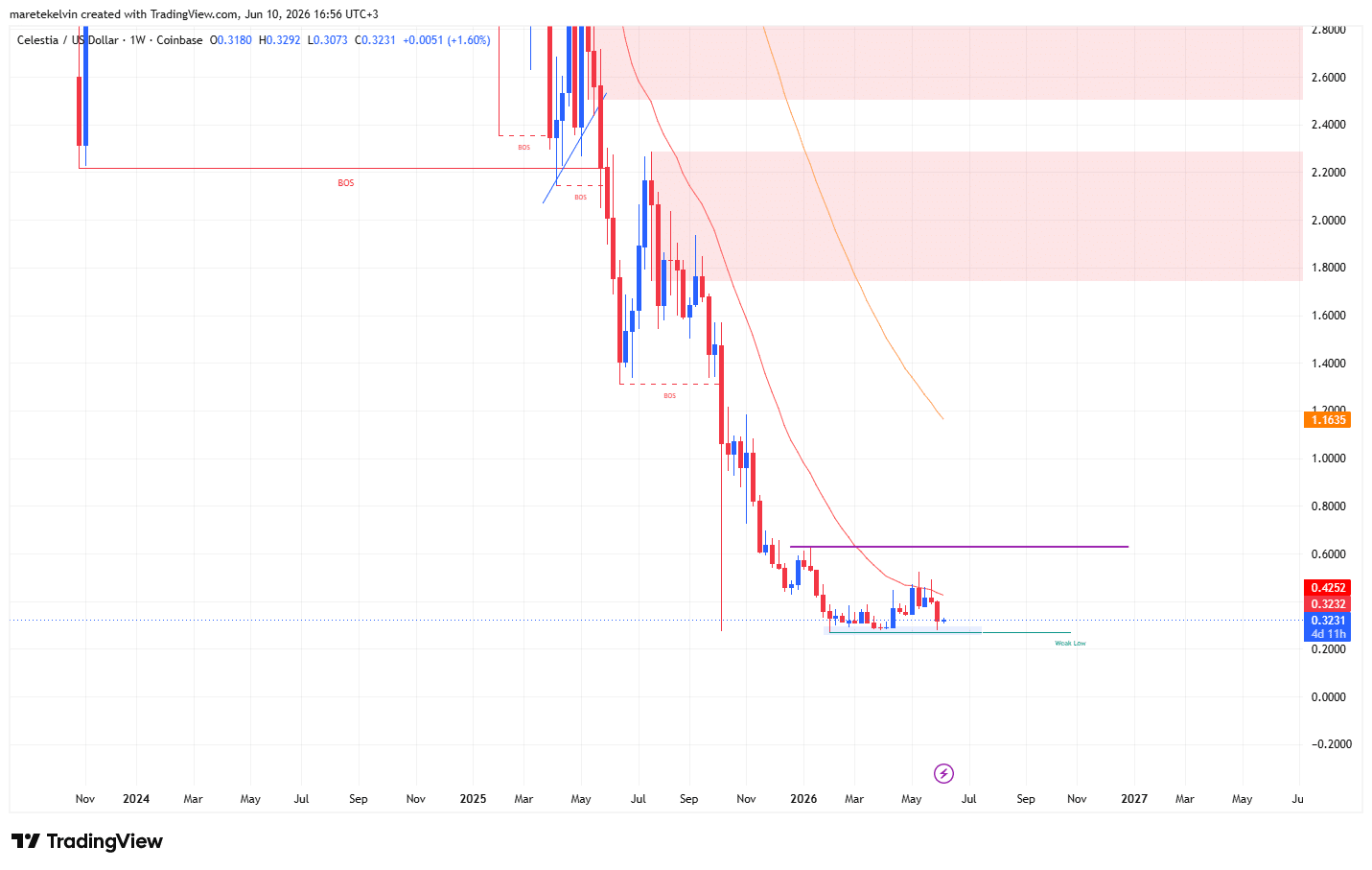
TIA’s broader market trend remains uncertain. On the weekly chart, price has entered a prolonged consolidation phase. Neither buyers nor sellers have managed to establish clear control, leaving the market trapped within a relatively tight range. For now, the key level to watch sits around $0.628.

That resistance continues to cap upside attempts. Until buyers successfully reclaim and invalidate that level, the long-term structure remains bearish. The consolidation may eventually lead to a larger move, but the market has yet to provide confirmation of a directional breakout.

Source: TradingView

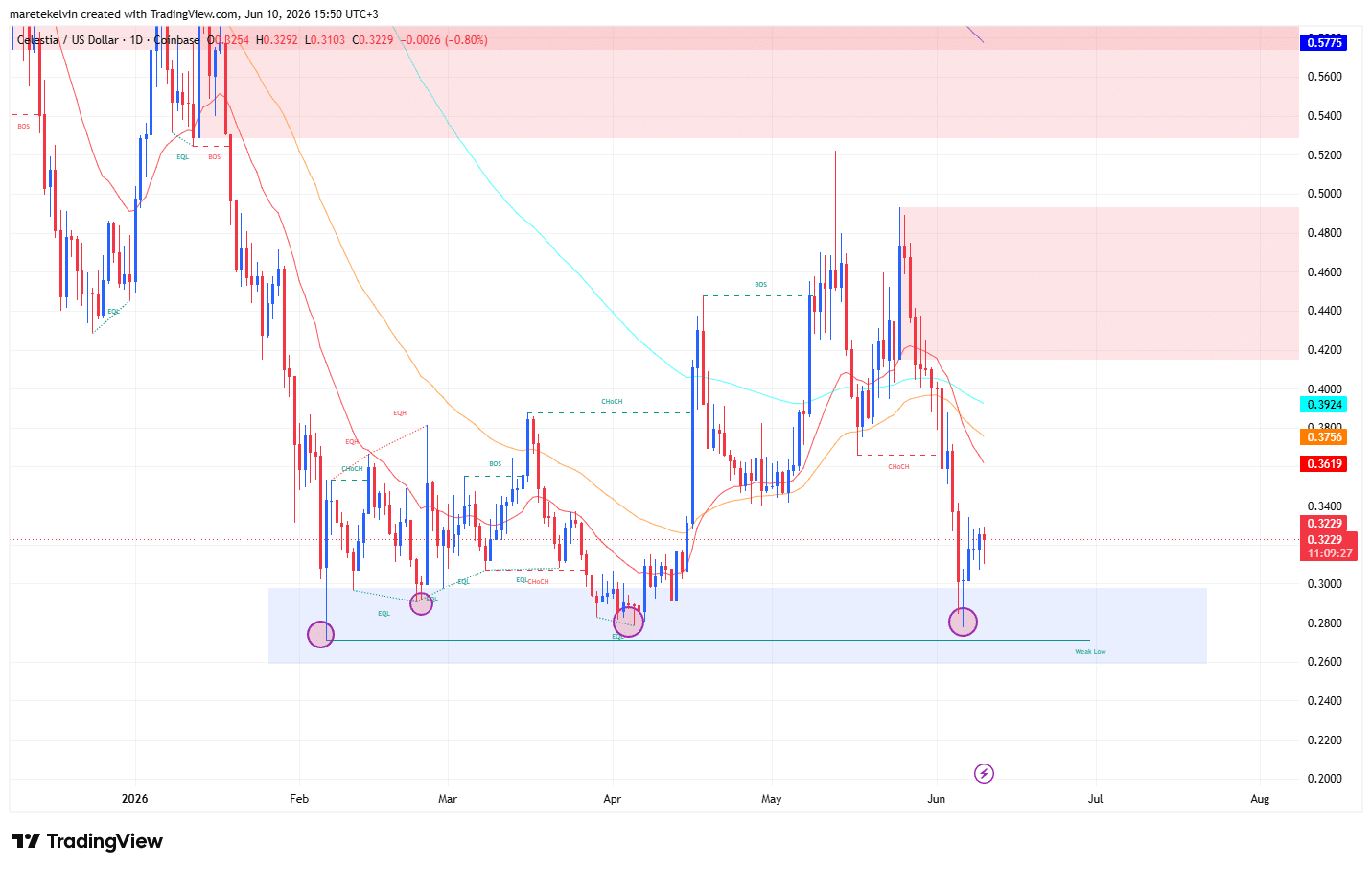
The daily chart provides a slightly more encouraging picture.ย 

Before the recent crypto market sell-off, TIA had started building a constructive recovery structure. That momentum faded during the broader market correction, pushing the price back below key EMA levels.

Source: TradingView

Even so, buyers have not disappeared. The demand zone around $0.28 has repeatedly attracted buying interest. Several rejections have emerged from this area, suggesting that market participants continue to view it as a fair value region.

As a result, the market is showing early signs of stabilization. For now, buyers are attempting to rebuild momentum from support while sellers continue to defend higher levels.

The outcome of this tugโ€‘ofโ€‘war will likely determine TIAโ€™s next major move.ย 

Guides

How to Read Celestia Charts and Predict Price Movements?

Most traders use candlestick charts, as they provide more information than a simple line chart. Traders can view candlesticks that represent the price action of Celestia with different granularity โ€“ for example, you could choose a 5-minute candlestick chart for extremely short-term price action or choose a weekly candlestick chart to identify long-term trends. 1-hour, 4-hour, and 1-day candlestick charts are among the most popular.

Letโ€™s use a 1-hour candlestick chart as an example of how this type of price chart gives us information about opening and closing prices. The chart is divided into โ€œcandlesโ€ that give us information about Celestiaโ€™s price action in 1-hour chunks. Each candlestick will display the assetโ€™s opening price, closing price, as well as the highest and lowest prices reached within that period.

Celestia Price Prediction Indicators

Moving averages are among the most popular Celestia price prediction tools. As the name suggests, a moving average provides the average closing price over a selected time frame, which is divided into a number of periods of the same length. For example, a 12-day simple moving average is calculated by summing the closing prices over the last 12 days and dividing the result by 12.

In addition to the simple moving average (SMA), traders also use another type of moving average called the exponential moving average (EMA). The EMA gives more weight to recent prices, and therefore reacts more quickly to changes in market conditions.

What Affects the Price of Celestia?

Just like with any other asset, the price action of Celestia is driven by supply and demand. These dynamics can be influenced by fundamental events such as block reward halvings, hard forks, or new protocol updates. Regulations, adoption by companies and governments, cryptocurrency exchange hacks, and other real-world events can also affect market sentiment.

Technical indicators such as moving averages, RSI, and trading volume are also used by traders to anticipate price movements and identify potential trend reversals.

FAQs on Celestia Price Predictions

As of today, Celestia (TIA) is trading at $0.367709. The current market sentiment is Bearish, with RSI at 42.67 (Neutral) and volatility classified as Moderate.
Based on our technical analysis and projected annual growth rate, Celestia could reach $0.08825 by 2027. This estimate assumes continued market momentum and adoption trends.
According to our technical analysis indicators, the Celestia price prediction is forecasted to reach $0.000293 within the next five years (by 2031). Over the last 30 days, Celestia recorded green days 52% of the time.
Based on multiple technical indicators, the current outlook for Celestia in 2026 is Bearish. RSI currently sits at 42.67, which indicates Neutral momentum. However, investors should evaluate both technical signals and fundamental developments before making any investment decisions.
Long-term forecasts indicate that Celestia may continue to grow over the next decade if adoption, technology development, and global crypto demand continue to expand.
While Celestia's future value depends on various factors, technical indicators suggest it could experience both bullish and bearish cycles over time. Long-term investors typically monitor RSI levels, moving averages, and broader market sentiment when evaluating TIA's future trajectory.
Disclaimer

AMBCrypto's content is meant to be informational in nature and should not be interpreted as investment advice. Trading, buying or selling cryptocurrencies should be considered a high-risk investment and every reader is advised to do their own research before making any decisions.