Solana gets JPMorgan input on settlement: What could SOL gain?
Solana is gaining institutional traction as JPMorgan’s DvP system puts on-chain settlement into focus.



Is “institutional settlement, not adoption” becoming Solana’s next growth catalyst?
Institutional adoption is evolving beyond ETF flows, with on-chain infrastructure becoming an integral pillar of the TradFi narrative. In other words, fundamentals are starting to matter more as major financial players explore blockchain-based settlement.
With Solana and JPMorgan’s reported partnership, the L1 could be looking to position itself as one of the first networks onboarding TradFi into the world of on-chain markets.
As the post below demonstrates, the Solana foundation has just launched Solana DvP.
But the key here is “institutional settlement”, and unlike ETF flows or strategic accumulation, it’s a much deeper layer of institutional adoption, where institutions are actually “using” the blockchain to settle transactions.
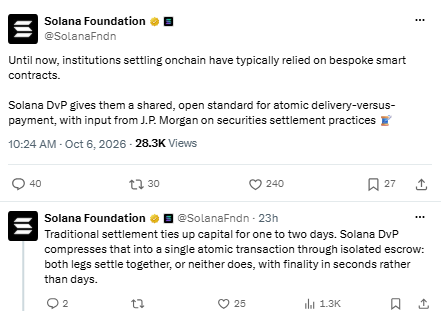
As the Solana Foundation explains, institutions that have settled on-chain have typically used custom smart contracts for their transactions. The traditional settlement process can take up to one or two days to tie up capital.
With Solana DvP, both sides of a trade are executed in one transaction, so they either both settle, or they don’t, with settlement finality in seconds.
This is different from institutions getting exposure to SOL through ETFs or accumulation.
According to AMBCrypto, if Solana DvP takes off, the bigger story would be institutions using the network to move and settle assets. It would change the paradigm of what institutions are using the Solana network for, from owning Solana [SOL] to using Solana as an infrastructure layer.
Solana’s institutional story is moving on-chain
A whale opening a $20 million SOL long after the launch suggests that it is more than just a speculative bet.
The market’s reaction to the news has been quick, with JPMorgan, a roughly $880 billion financial giant, playing a critical role in the design of the system. That itself is a strong signal that TradFi interest in blockchain is shifting from just investing in crypto to using the infrastructure.
At the same time, Circle is continuing to mint USDC on Solana, with another $750 million recently minted.
According to AMBCrypto, this is where Solana’s liquidity shift and the DvP launch start to connect.
Is Solana’s liquidity moving beyond memecoins?
As the chart below shows, in Q1 2025, memecoins drove nearly $260 billion in quarterly spot volume. Now, that’s down to around $57 billion.
On the other hand, the tokenized-asset spot volume grew from only $33 million to $8 billion, marking a 242x increase.
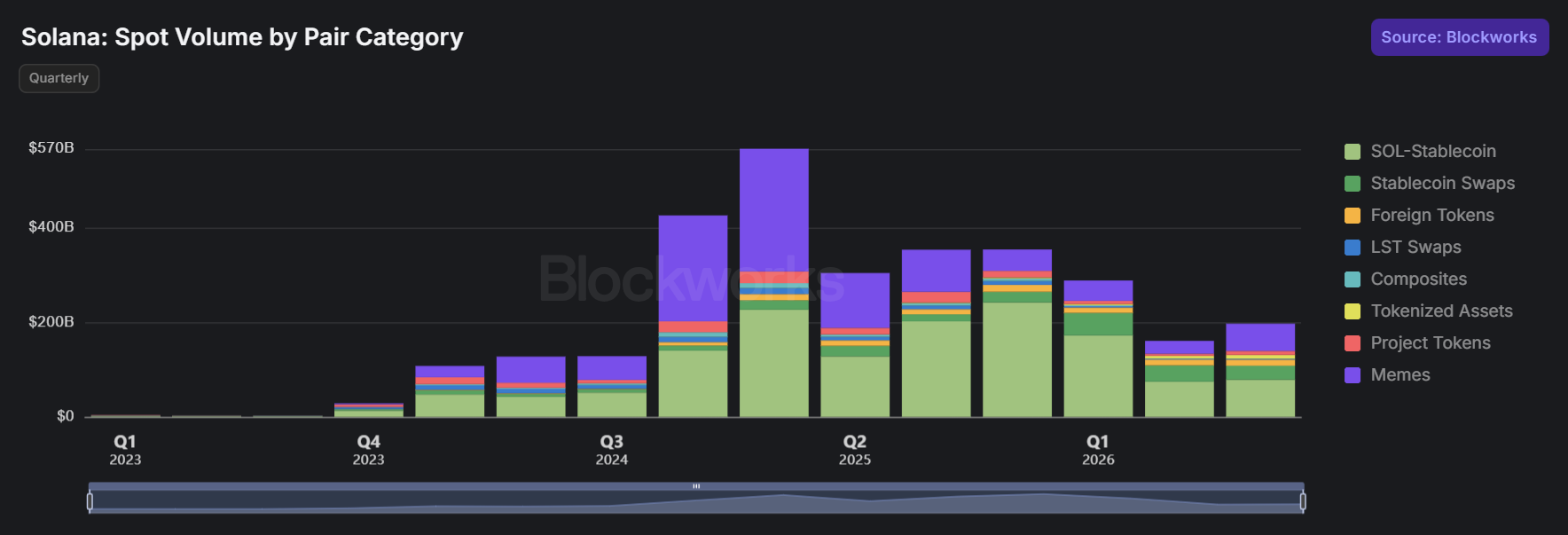
In short, Solana is seeing its activity shift from memecoin speculation to more utility-oriented markets.
Against this backdrop, the DvP launch could be much more relevant for Solana’s emerging institutional use case. With tokenized assets already on-chain, DvP could enhance this setting by improving transaction finality and overall network efficiency.
Thus, Solana’s institutional adoption is entering a phase of real-world application, diverging and setting up a different type of SOL institutional cycle, one which is driven by actual network utilization and liquidity.